Fall 2022 was the first year of “mask-optional, everything in-person” school year. The two years of COVID had affected students’ ability to interact with each other. The modalities of virtual interactions are very different from in-person interactions. I was worried.
As I sat on stage, looking out into the auditorium filled with anxious first year students, I scribbled a few things I thought may be useful in coping with a new life and new rules of engagement. I came up with five.
To remind you of the 5 pieces of advice from me today:
The difference between a reason and an excuse is timing: If you are struggling (with work, with life), let someone know so that we can help you before it becomes a catastrophe. Life happens even if you are a student and we are all here to support you. We are very good at what we do.
You are only competing with yourself: We don’t have class rankings; we don’t publish who has a 4.0. C=degree. Everything else is cherry on top. Pass your classes and try your best, but don’t do it because you think you are competing with your classmates. Learn to learn and not because you think a good grade makes you who you are.
Do less: Most of you said you want to make new friends, get to know Penn and Philadelphia, and that friends and family bring you joy. Remember there are only 7 days a week and 24 hours in a day. Honor the things that you love and bring you joy and make the time.
Belly laugh every day: It got me through 2 years of COVID, to find something that I can genuinely laugh out loud about, every single day. Trust me: it will make you feel better and see your problems more clearly so that you can solve them. Laughter is really the best medicine.
Eat, sleep, and shower: Please, do this for you–for all of us.
Fall 2023 was the last time I stood on stage to address a new class of students. I don’t generally prepare speeches; I usually end up ad libbing a few words of encouragement to fill up the time until the next scheduled orientation event.
That being said, on my eighteenth New Student Orientation, knowing that it would be my last opportunity to help launch a first year class, I decided to share a story that I hope would give them the courage to be themselves.
Below is the speech. Maybe, a few students will remember these words and remember that they belong.
10, 949 days ago, I was sitting where you are sitting today, with a mixture of excitement and anxiety. Over the next several weeks, I got used to sharing a tiny room in Hill, made friends with people on my floor, and even got a job or two. I also began to realize that I had gaps in my schooling. Then, just as I was beginning to doubt whether I could really make it at Penn, some people around me took it upon themselves to tell me which “boxes” I checked to be admitted to Penn.
On an evening shift at the Quad front desk, I happened to chat with someone who was waiting to get signed in. He asked if I was a first year student and asked for my name. Then he said: “I read your application and I admitted you.”
Crazy, right? But true story.
He didn’t remember my accomplishments or my grades or my financial circumstances. What he did remember was the essays I had written that told him about the kind of person I was, my values, my background, and how he believed Penn would be the right community for me to explore and grow.
This kind of chance meeting almost never happens and this encounter gave me the confidence to accept what I did not know and be open to learning and experiencing a new life.
While my academic career and my life was not a field of roses, I never forgot that one person who believed that I belonged at Penn and worked through the minor disasters with help and support from friends, family, faculty, and administrators. Perhaps, that is also the reason I never left this place.
If you ever feel that doubt creeping in, all of us here will remind you that you are here because of the person that you are and the values that you bring to our community. Talk to us. We are your people. We believe in you. We are looking forward to the person you will be in the future.
And finally, especially when things get a bit rough, don’t forget to eat, sleep, and shower!
As a first year student, I was not qualified to do anything.
I never had a real job. My “work” until my first year in college consisted of translating legal documents from English to Korean for my father and I never got paid for it. The people who worked in our household were salaried employees so what they did was never in my purview.
When I was applying for college in the early 1990s, my mandate was as follows: Unless you get into an Ivy League institution, we are going to ship you off to Canada (Alberta, to be exact, which is where my uncle lived). So while my åfather had great expectations that I will end up in MIT, I spent the most energy applying to the University of Pennsylvania where my good friends had chosen to matriculate. And I got in.
I knew the financial sacrifices my parents had to make to afford my tuition. I also decided (without the consent of my parents) that I should try to earn my own spending money. When I broached this topic with my dad, he said anything but food service. Now, food service was the most lucrative non-work study job that was available. That being said, my parents had spent at least a decade running a restaurant and probably realized the personal hardship that came with the service industry.
For that reason, I applied to be an intramural basketball referee with the department of recreation as my first job. I was not so good at my job (not my fault, to be fair). I learned basketball in the international rules and didn’t realize that NCAA rules were different, especially when calling traveling violations. Also, as an introvert, blowing the whistle to call attention to stop the game was an unexpected challenge. Players yelled at me, complained to the supervisor, and even “accidentally” body slammed me against the gym wall.
I survived the first few weeks with the support of my co-referees and my supervisor. They pointed out what I was doing wrong and, once they realized the source of my errors, they took the time to practice with me, a few minutes before or after games. I improved. I gained confidence. The next time someone slammed me against the back wall, I called a technical foul and smiled. I was grateful for the people who waited for me to learn and provided me with the tools to do better.
Once basketball season was over, I was asked if I wanted to stay for the rest of the intramural season and I said yes. That being said, I was awful at refereeing all other sports, mainly because I had no concept of the game. Baseball and football were the worst. Growing up in Ghana where soccer (football) was king, I had no access to American sports.
My supervisor couldn’t, in good faith, keep me as a referee. Nevertheless, she did keep me, doing administrative tasks like checking in the refs, making sure that the equipment was ready, collecting and recording score cards, and cleaning up after the games were over. I was reliable, punctual, and made an effort to learn. This experience provided me with basic skills for other jobs that required some administrative experience. Co-workers became friends and mentors and they helped me fit in and transition to Penn. It was an unexpected gift that far exceeded in value the $5.35 an hour I was making.
When asked by first year students about the best strategy to transition to college from high school, I often recommend that they get a job, even if it is for a few hours a week. Yes, money is nice. However, the greater value, at least to me, is the experiential learning that comes with working together in the company of others. You get to meet people from all walks of life and learn about who they are and what led them to take the seat next to you. Getting a job is entering a community, each with its own culture and sets of rules. You may not like everyone and some folks will be more difficult to work with than others and that’s part of the learning, too.
And, if you are lucky, you will meet someone who will teach you the electric slide at 1am at the front desk of the Quad so that you don’t fall asleep after a long day.
As I look “forward” to my 49th birthday, I also realize that I am looking toward my 31st year in the same place I have spent my entire adult life. I am starting this blog, partly because of a colleague who told me they didn’t have much else to do than read my stories and partly because I realized that I have been thinking of this blog for a while now.
I walk to and from work almost every day, It’s my time to meditate and think about my life. Often, I think about whether or not that familiar route is something I want to go most weekdays. The thoughts, conflicts, and conclusions I make as I cross South Street Bridge is probably the source of this blog.
가끔은 이상하게도 한국말로 내 마음이 정리될 때도 있다. 띄여 쓰기도 초등학교 수준도 되지 않지만 평생 한국인이란 정채성은 30년을 타국 생활을해도 지워지지 않을거라고는 예상하지 못한 상황이랄까…
Every day, I think about the people I meet, the students I counsel, and the staff I mentor. It is only then I realize that I share the most important parts of my life for those who are in the crossroad of their careers and their lives.
I have made many mistakes in my life. I have also met some exceptional people who have given me the strength to be my best self.
I hope this blog gives hope to those who are searching for the meaning in their lives and peace to those who have made the decision to follow their dreams.
It was a rather quiet afternoon, an unexpected lull in the day. Dad got called into a meeting in Seoul and my brother, his wife, and the twins decided to go shopping. The gentle October sunlight flashed in and out through the balcony sheer curtains. Sitting on the floor with my back against the uncomfortably large leather sectional and my bare feet stretched in front of me, I finally felt like I was taking a break. Even the staticky Christian music from the radio seemed appropriate for the mood of the day.
Mom was in the kitchen area, humming to the radio. Now in her seventies, sporting a frizzy brown perm and a back brace, her movements were not as quick as they used to be. She complained that she has shrunk and was no longer 150cm, the cutoff height for not being under-tall. While achy bones and exhaustion was constantly on her lips, she never once looked frail or fragile. I guess that is what happens when you were a spitfire in your youth—you just mellow out.
After two years of forced separation due to the pandemic, I booked the first ticket to Korea the moment the quarantine requirements were dropped for immediate family visitation. As my parents grow older, a year seems to me about the longest I can justify separation. Back when they were in their fifties, there was a good six year stretch that we didn’t see each other or even talk over the phone. But somehow, that seemed fine, even preferred. We had lives to live and it wasn’t like I missed my parents. My childhood was fraught with hurt and misunderstandings. Even after I told Mom that I forgave her, the pain still persists. I have just become more at ease with my deviance from the norm and, now in my forties, absolutely unapologetic about it. Even comfortable.
I stretch my arms over my head and tilt my head back for a stretch and yawn. Looking around the living area, every nook and cranny is filled with tchotchkes and photos from when my parents used to travel. The low cabinet under the large TV was a shrine for her three granddaughters. A family photo with my husband when we came to Korea for a wedding reception two years after getting married was also there. That was ten years ago but since we don’t take photos, there wasn’t a good one for my parents to use to update their collection. The twins, pandemic babies, are now active and chattery toddlers and you could see the stages of their evolution from blob to human just by looking left to right. In between the artwork collected from the places they lived are planters big and small, mostly of orchids and succulents. My mom is from a farming family and she has always loved gardening. I saw that many of the containers had been moved out to the verandah to make space three adults and three children descending on the 1000 square foot apartment. Without any of her children and grandchildren close by, Mom cared for her plant babies.
There is a scent I call “my parent’s house”. I imagine that is different for everyone. It carries on even if they move houses. Mine is combination of flowers, earth, fresh laundry, wood, aged paper, and a hint of dwenjang and braised fish stew. None of the individual smells overpower each other and they combine to mean home. Even after mealtimes where we have to clean up half of the toddlers’ food from the floor, or ordering in food heavily spiced food because the adults are just too exhausted to fix a meal, or grilling mackerel on the stovetop, the apartment always reverts back to this familiar aroma. I had forgotten how much I missed it.
Now, I see two large pots and a skillet going on the gas stove in the kitchen. Without stopping, my mom says to me, “Can you come over here?” I respond, “Anything I can do to help?” and walk over to the counter next to the sink. She motions at the large bunch of scallions in the sink. “I ran out of chopped scallions. Cut them for me? Half straight, half at an angle. Put them in that plastic container when you are done. It goes in the freezer.”
It dawned on me, right at that moment, that while this seemed so mundane, it was a very new exchange between Mom and me. When I left home at just as I turned eighteen to go to college in the United States, I never went back. The longest I spent with my parents after that was three weeks and it was always about ten days too long. When I started going to Korea for work, I would book myself a hotel room in Seoul and take the hour-and-half train commute to see my parents for dinner and never stayed over. Two years ago, we went on a road trip so barely ate at home. Until eighteen, I avoided the kitchen and anything that signified “girl”, at least outwardly. It was much later in life that I took interest in cooking and discovered my own aptitude. During the pandemic, I texted and called Mom for Korean recipes and cooking methods and she started following me on facebook and liked all my food posts. It connected us on a neutral territory as adults, without baggage. She admired my excellent knife skills and broad range of cuisines.
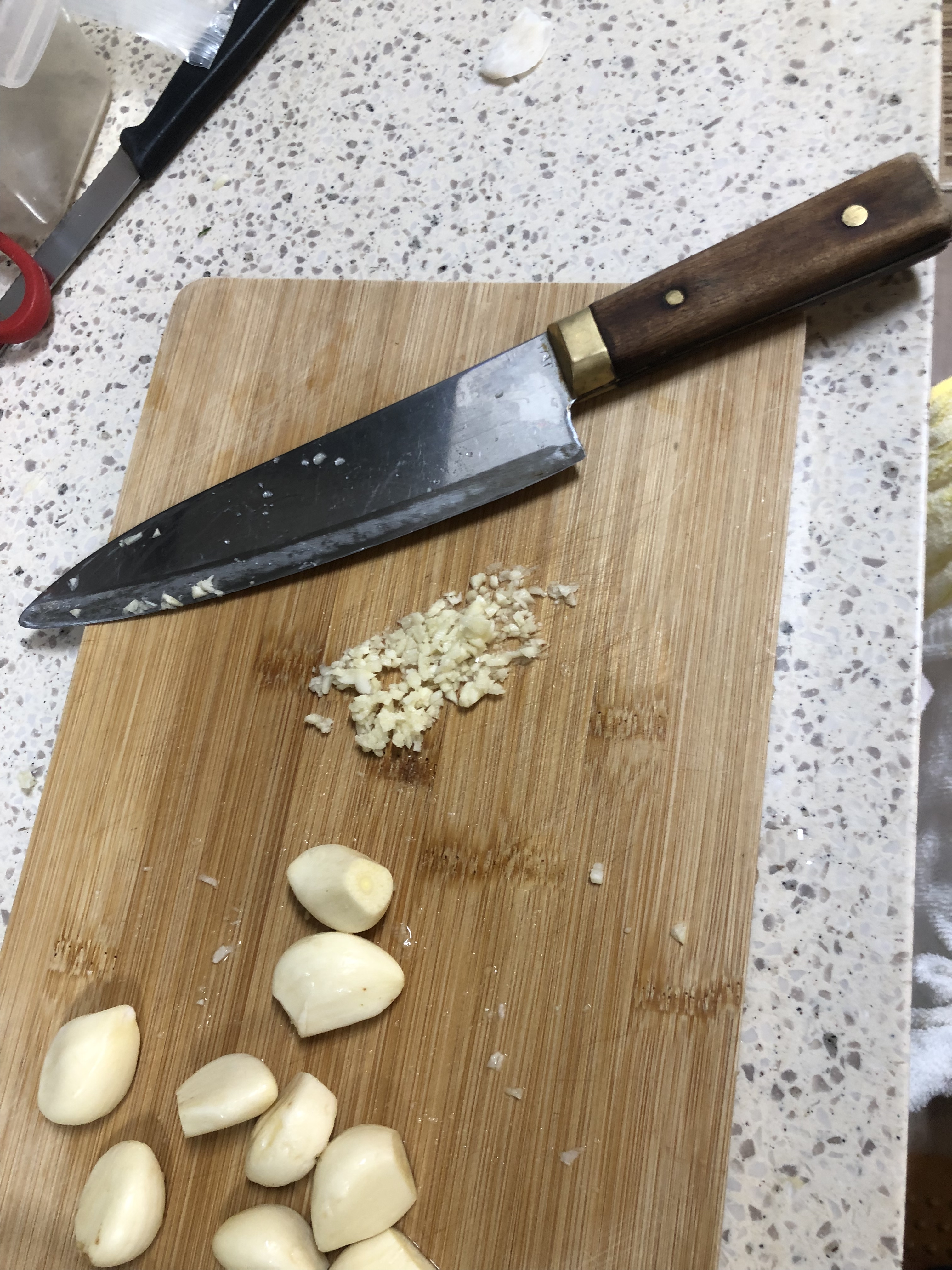
Before I could ask for the sharpest knife she had, she said, “Open the sink cabinet. You should see a knife with a wooden handle. Use that one.” The knife holder screwed onto the door had an eclectic collection of cheap looking knives. The one with the wooden handle poked out about two inches longer than the rest. I pulled it out and could immediately sense that it was very well balanced and fit into my grasp naturally. It was well honed and cared for.
“It cuts really well,” I remarked, swiftly slicing through the scallions.
‘”It was your grandmother’s,” she said. “It’s the knife she used all her life and I took it after the funeral.”
I imagine my grandmother bought the knife when they were still well off because the weight and balance of it was superior to my expensive German steel knives even if it was sixty or seventy years old on a conservative estimate. There was no sign of rust or wear, even for a blade that would have been sharpened and honed a few hundred times. The handle was still the original one, worn a bit and softened over time but still solid and firm in my grip. If there were any inscriptions about its origin, it had long disappeared.
My grandmother passed away after almost two years of suffering dementia and later leukemia. Dad’s younger sister was the main caretaker while she was in hospice care. There wasn’t much of an estate to speak of—an old, unrenovated duplex that was sold to make way for a highway, some photos and clothes, and basic kitchen goods. Like many Koreans, my grandparents lost everything during the Korean War. After the war, my grandfather, an engineer and entrepreneur built one of the first soju distilleries in Korea and Dad remembers living pretty well when he was a kid. However, for some reason, the business failed, his father died, and the family became bankrupt overnight. Since my dad was fourteen at the time, I am sure he knew why but, even to this day, he refuses to share the details. My grandmother had few possessions and I am certain my uncles and aunt took most things of value. I can kinda see Mom sneaking the knife into her purse when no one was looking while cleaning the house.
For both my mom and me, halmoni was a pivotal character in how we created our narratives. For me, she was the woman who raised me from birth. I was her first grandchild and much loved. My parents, newlywed at the time, both worked in a different city while living with mom’s brother’s family. My grandmother took me in so that both my parents could pursue their careers. For my mom, her mother-in-law was a modern woman, the first adult she knew who did not discriminate against her for being a woman. When she was pregnant with me, my grandmother ordered Dad to do the laundry, house cleaning, dishes, and obviously anything that required heavy lifting (he still does those chores). She was also supportive of my mom’s career as an elementary school teacher and volunteered to take me in so that she could work. This all happened in the 1970s in Korea. I recall that my grandmother was not a warm and fuzzy kind of woman and didn’t speak much. I also recall that she had a fiery temper and, being rather tall for a woman of her generation at almost five foot five, she could be intimidating.
Kongnamul-gook, mung bean sprout soup, is the food I associate with my grandmother. It’s some of the cheapest soups you can make and it was always accompanied by a bowl of white rice and kimchi, not much else. My grandmother was not much of a cook and she always felt guilty for having Dad support her financially even while we lived abroad. For that reason, she was very frugal which meant a lot of mung bean sprouts in meals. Pieces of thinly sliced scallions floated on the surface of the kongamul-guk.
I choked back a tear and announced, “I am done. Anything else?”
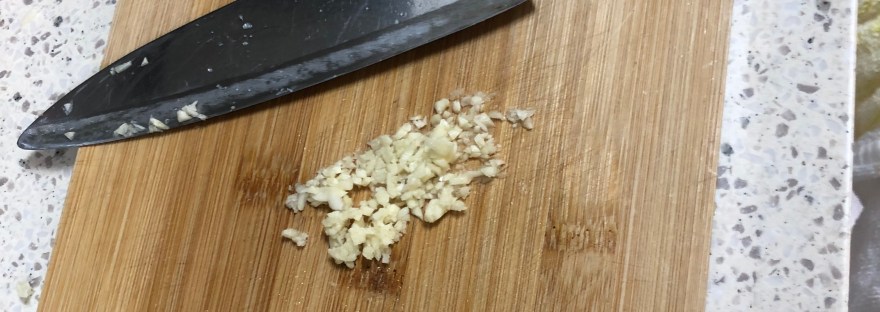
I could hear a slight tightness in Mom’s voice as well. “Can you mince some garlic?”
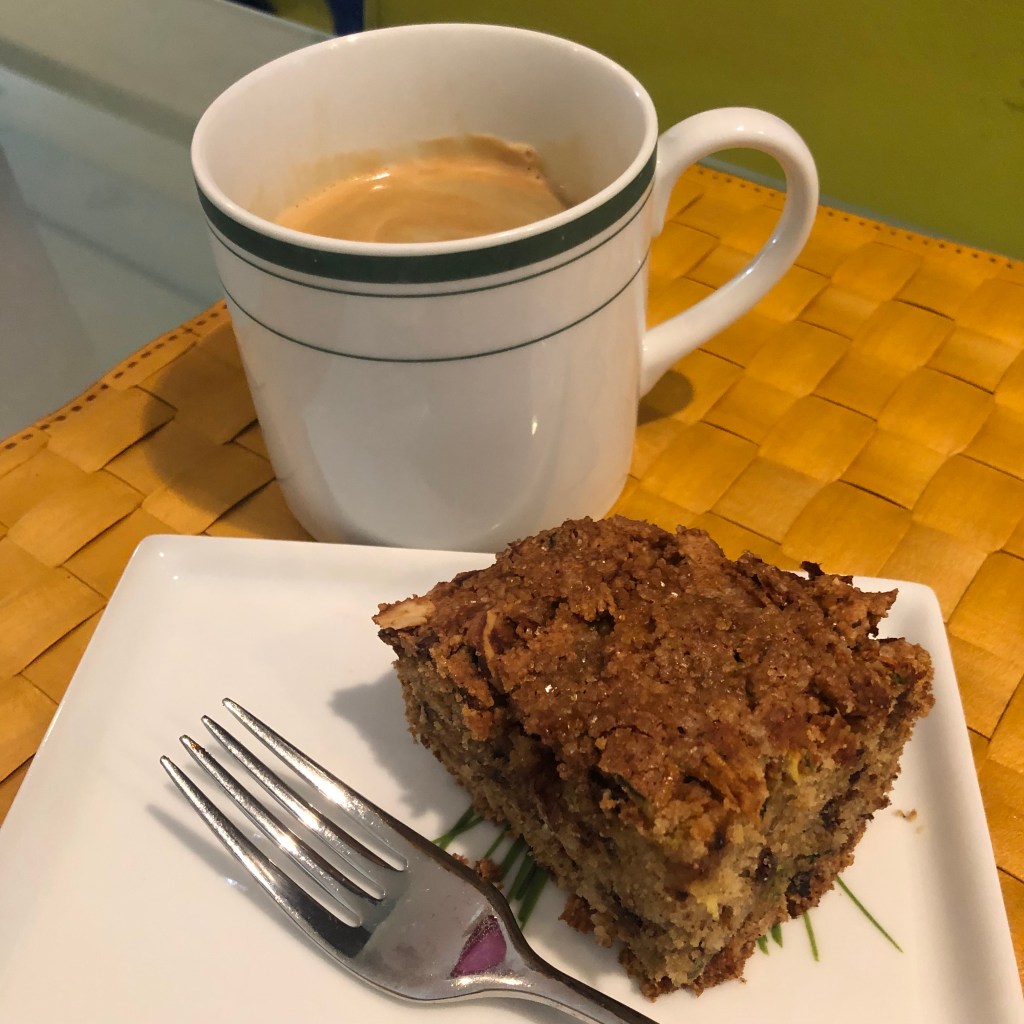
The first time I made zucchini bread was in grad school. Zucchini must have been on sale because it’s not something I would have bought otherwise on a $1000/month stipend plus a couple of odd part time jobs while paying rent. I was learning how to cook at that time, mostly to because I could no longer afford to eat out with a living budget of about $100/week, if I was lucky. One of the purchases I had made was the New York Times Cookbook, a brick of an anthology that promised to teach me everything I needed to know about cooking. Unfortunately, most of the ingredients listed were unaffordable and the number of steps involved was ridiculously long and complicated for a novice cook. One exception was the zucchini bread recipe.
I made a loaf and brought it to work, the research center that my PhD mentor ran. It was a big hit! Even while complaining about how the zucchini bread was going to affect her waistline and cholesterol level, she always took a couple of huge slices–some for now, some for later. For Christmas every year until I graduated, I made sure she got a loaf. One time, while taking a break from work at the center, she looked at me and said, “You know, Sonya, you probably missed your calling as a baker.”
On one hand, this is not the kind of observation you want to receive from your mentor a couple of years into a PhD program. On the other hand, she had always valued my intellect and work ethic and instrumental in leading me to an academic path. She had hired me as a TA when I was still a master’s student, entrusted me with teaching her course while she was on sabbatical, and made sure I was always financially afloat so that I could complete the work I had started. I chose to take the statement as a compliment.
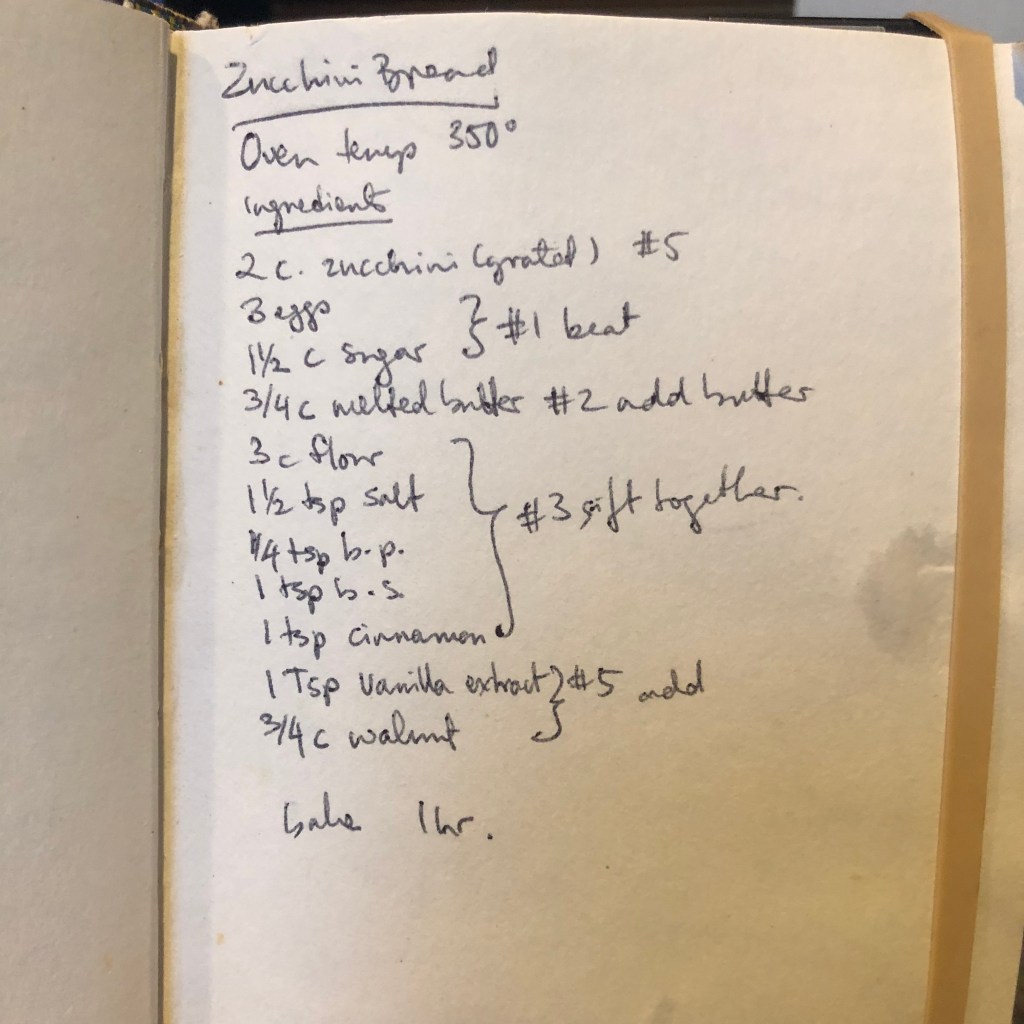
I have since given away the New York Times Cookbook, discovering that it was filled with esoteric dishes that I would not try, even now, as an experienced cook. However, I decided to copy down the zucchini bread recipe for posterities.
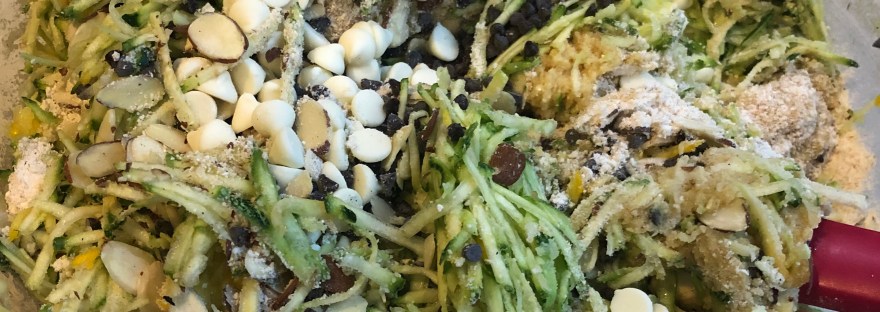
It is a well-loved recipe, dripped on and smudged with bits of ingredients over almost twenty years. It is supposed to be baked in a loaf pan but I actually prefer to use a bundt pan. I often double the recipe and bake it in a 9×13 casserole pan. I have even tripled the recipe before and baked it in a chafing pan. There are other flourishes, such as using pecans or slivered almonds instead of walnuts, adding chocolate chips (a pro tip I got from a friend who asked for chocolate chip zucchini bread as a wedding present), streusel topping, different spice combinations, using other summer squashes in addition to or instead of the standard green one, etc. The plain, original version is the most versatile, especially if it’s made with less sugar, which I do for most baking recipes. Apparently, it’s delicious, sliced thin and toasted with a schmear of cream cheese.
Many years later, on a random street corner, I ran into my mentor and her husband. His face lit up when we were introduced and exclaimed, “You are the zucchini bread baker!” I had always thought that if I had to ever go into witness protection, change my identity, and make a living doing something completely different from my current career, I would open a coffee shop and make my own pastries and quick breads since I had the calling.
When I was sixteen, I swore never to go back to Korea. Until then, Korea was where my brother and I spent most of our summer holidays, sometimes with both our parents, sometimes with just one parent, sometimes by ourselves. It was expected that we took the almost three day trek across the globe to see extended family. Back in the 80’s, in the height of the Cold War, the multileg journey went something like this: Accra-Lagos-Amsterdam-Anchorage-Tokyo-Seoul and then the reverse on the way back. As an angry and sensitive teenager, I hated my cousins who made me speak English even when I spoke Korean perfectly well, like I was a circus monkey. I hated that their friends would treat me like any other Korean kid until they found out I lived in Ghana and then spent the rest of the time making racist and ignorant jokes about Africans. I hated the rules and expectations that I had to follow as a girl that my younger brother could ignore. So at sixteen, I stopped spending my summers in Korea and stayed home in Ghana, mostly reading.
For this reason, I never truly learned to eat and drink in Korea. One thing I knew was that drinking with food was socializing and drinking without food was just one step away from alcoholism. As an adult, I learned a little from my brother who went to university in Seoul and then stayed to work. He knew where all the 맛집 (matjib: literally translates as “tasty house” or places known to have the best food, usually in one category) was and with him as a guide, I ate and drank well.
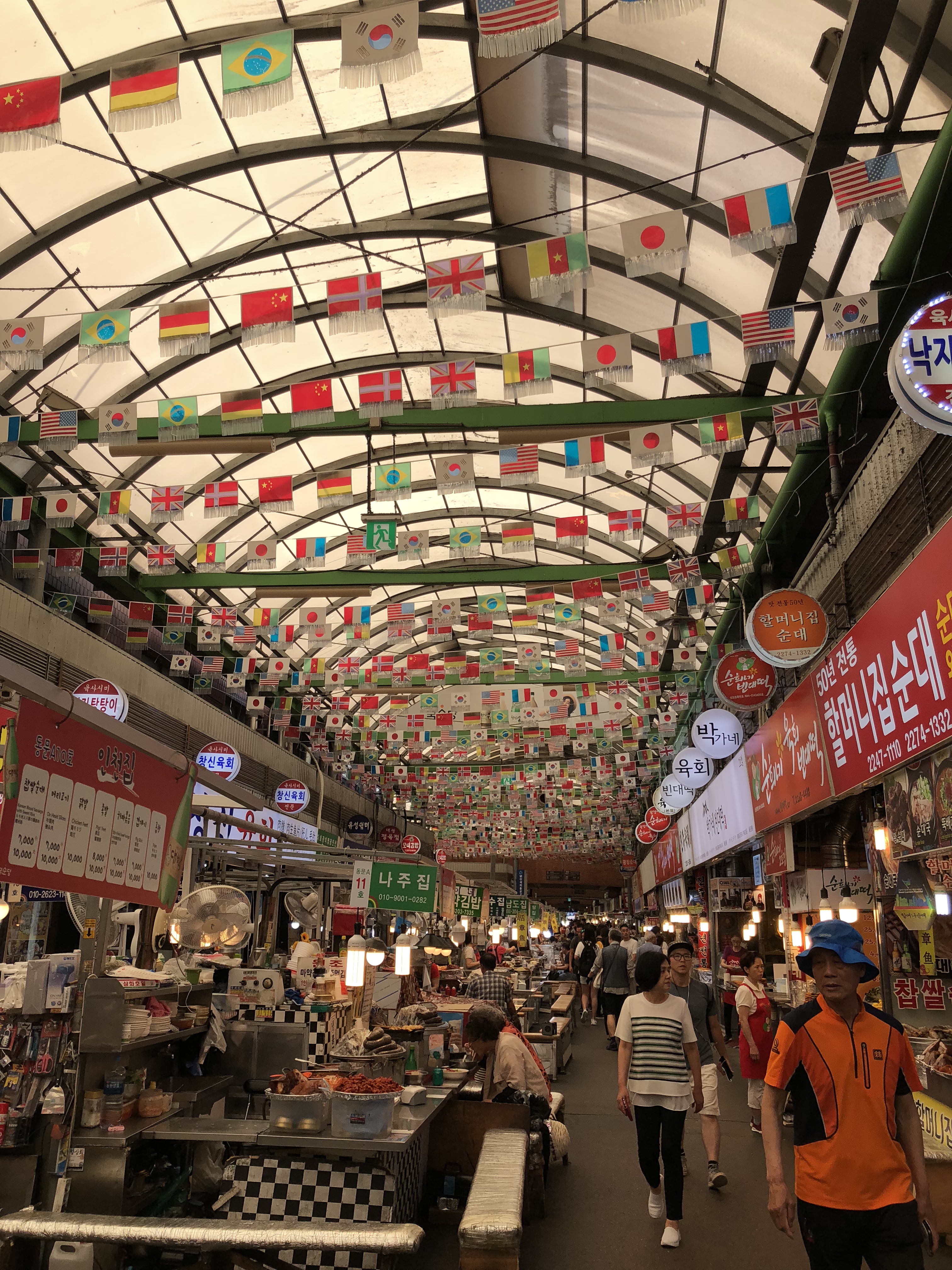
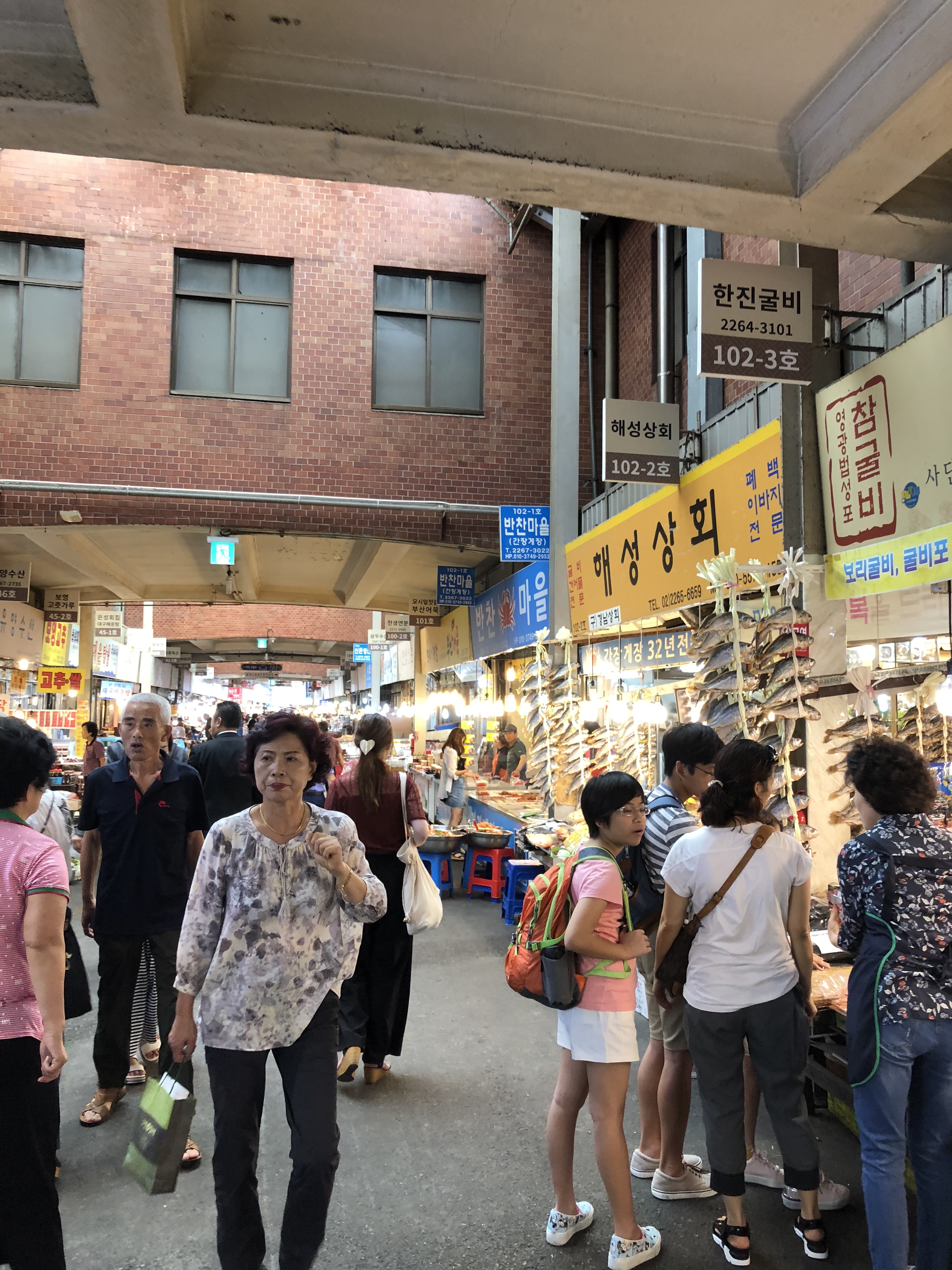
Many years later, I started traveling to Seoul for work about once a year and began to explore places on my own. One stop in the summer of 2018 was Gwangjang Sijang.
On our first trip to Korea, the Dude and I stayed in a place close to Gwangjang Sijang but we were too overwhelmed and full from a recent meal to enjoy the abundant street food. I could not forget the aromas literally steaming up from the hot griddles and cauldrons so the first chance I got, I sought out a 빈대떡 (bindaedduk: mung bean pancakes) stand. Bindaedduk is one of my favorite foods, only made occasionally due to the lack of ingredients in Ghana but a common street food in Korea.
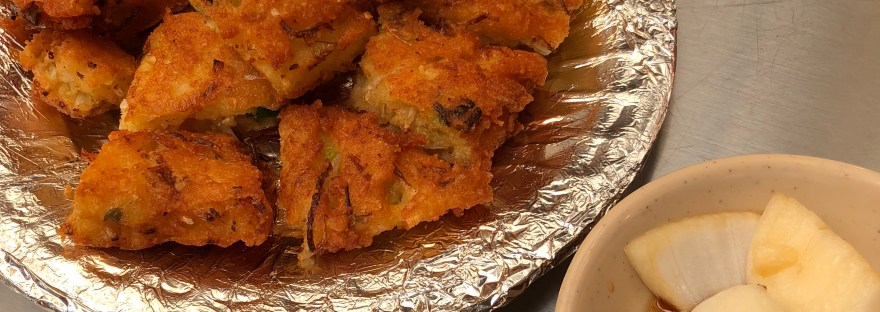
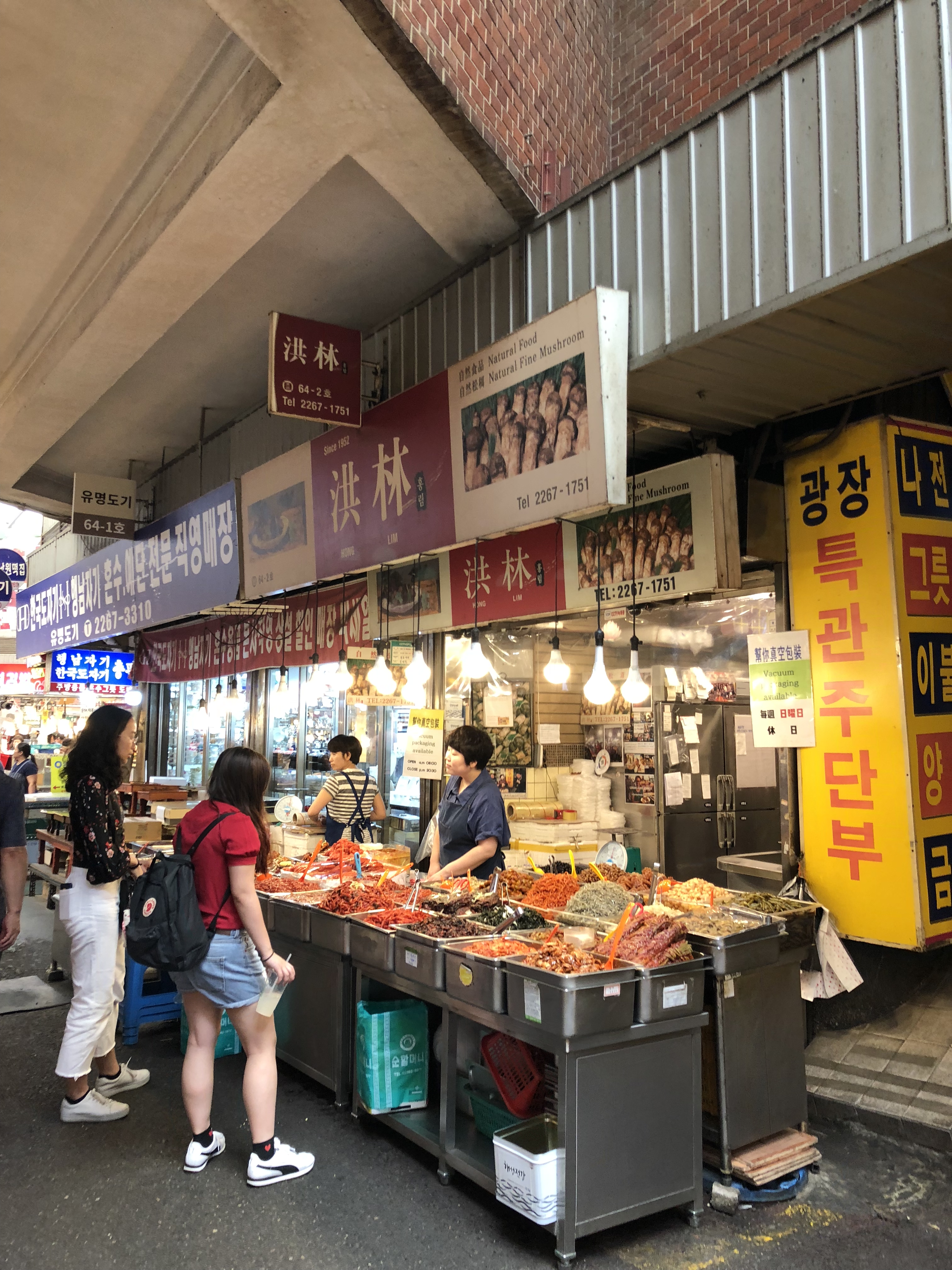
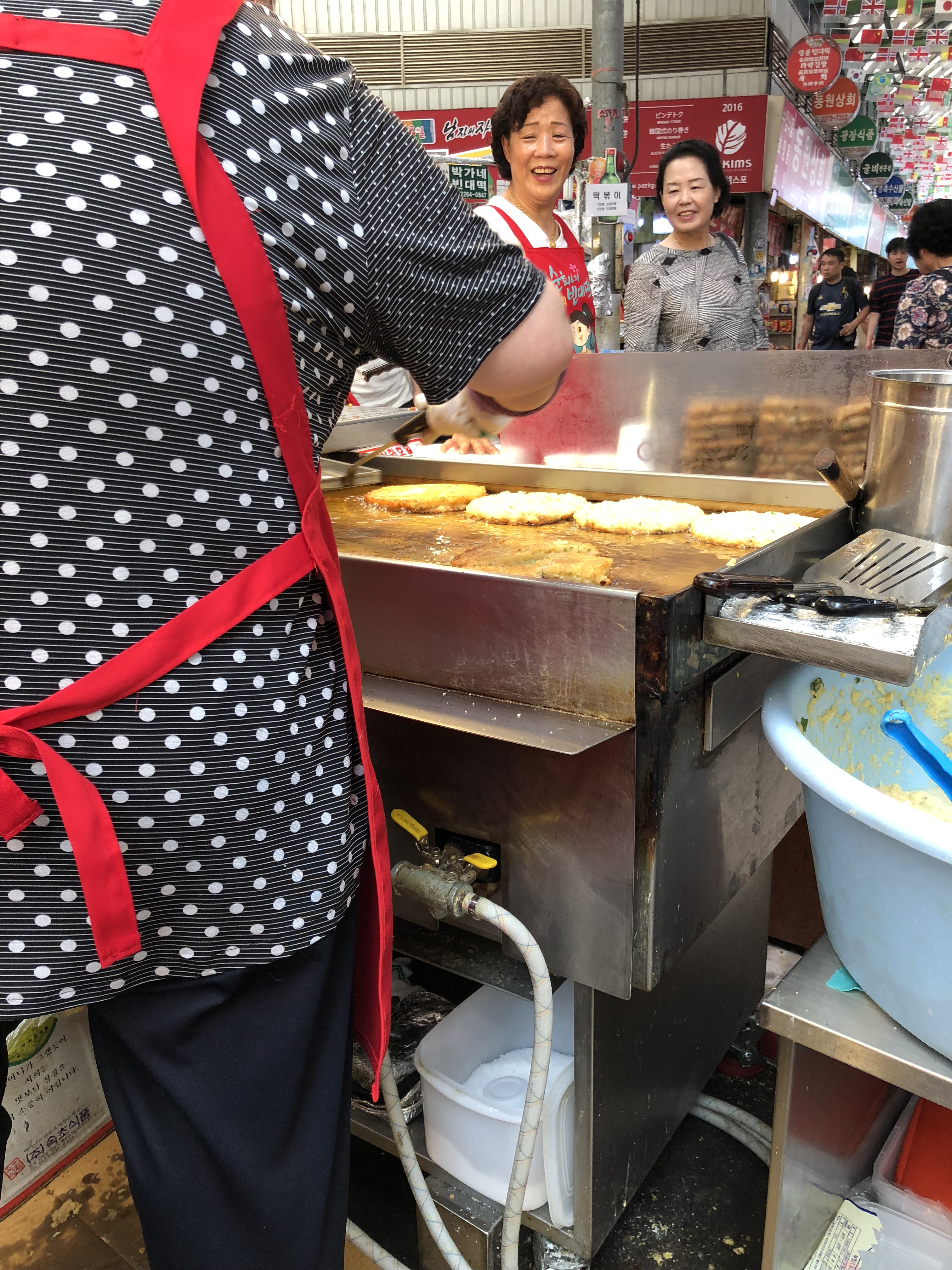
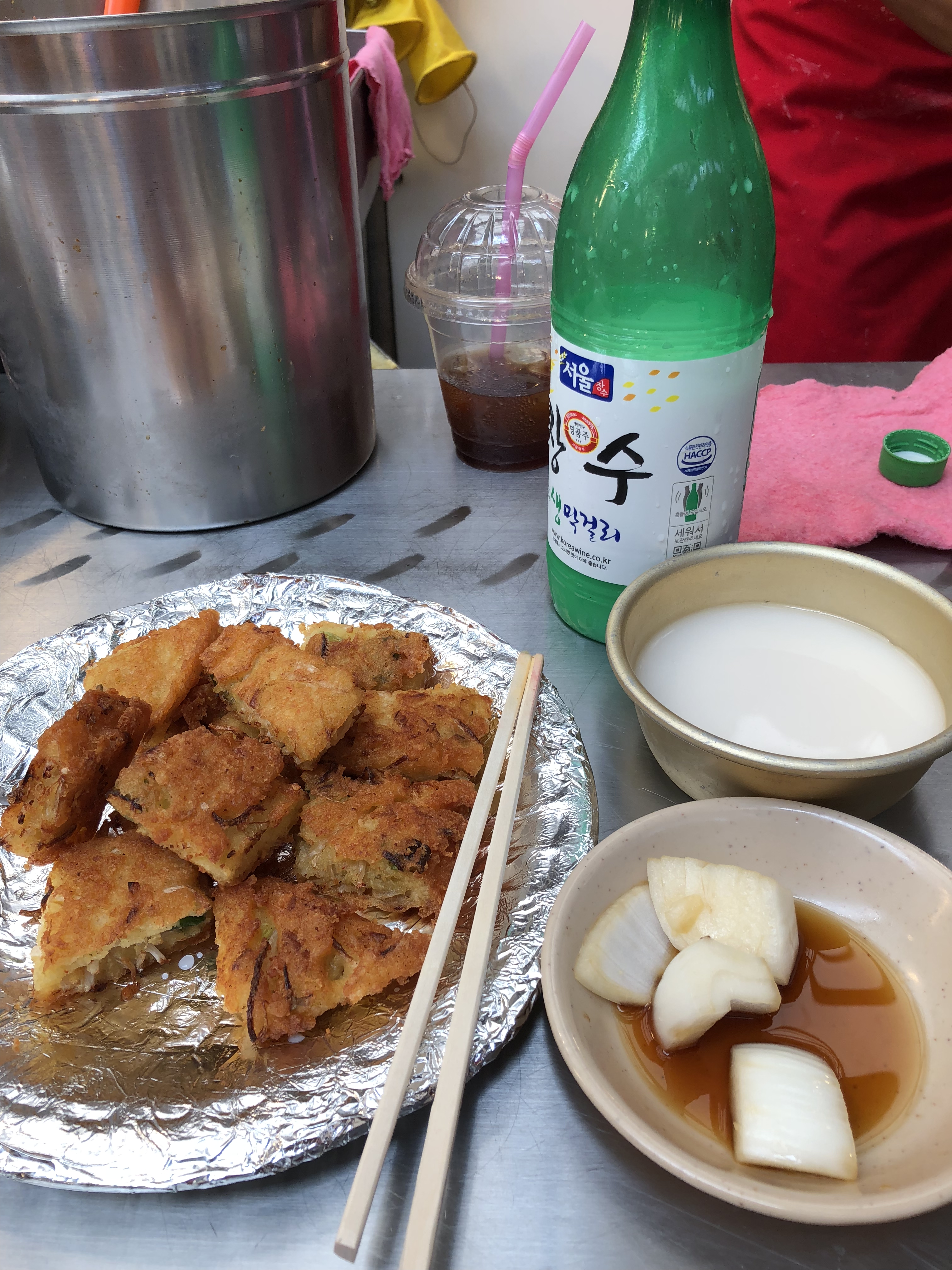
Located in A-60, it is an outpost of 순희네 (Soonhee-nae: Soonhee’s House), the most well known bindaedduk eatery in the Market. There was a bench that seated about three people next to a griddle and a mechanized 맷돌 (metdol: millstone) grinding soaked mung beans into a large vat. It was lunchtime but I lucked out and snagged a seat next to a young woman who was eating by herself. I asked for bindaedduk and said how excited I was to have it since I have been dreaming about it for years (the truth!). I started chatting with the lady in front of the sizzling griddle with the pancakes spitting and crisping up to a golden brown. As she put a styrofoam plate covered in foil in front of me with the bindaedduk cut into small pieces and a side of sauce, she said “빈대떡엔 막걸리가 딱인데 (For eating bindaedduk, makgeolli is the best accompaniment).” So I ordered a bottle. Mass market makgeolli does not come in bottles smaller than 750ml and even if it’s about 6% ABV or less, it’s a lot of day drinking, but what the hell!
She also gave me some 완자전 (wanjajeon: meat pancakes) to try. A perfect bindaedduk is crispy on the outside and creamy on the inside, salty, savory, and filled with stuff. I turned to the young woman and asked in Korean if she would like some makgeolli. She replied in English that she was Japanese, and upon a repeat offer in English, she accepted. After she was done, she smiled and thanked me and left. My next neighbor was a pilot who was trying to purchase a bag of batter to take with him back home to Canada. I translated his request to the 이모 (eemo: auntie, strictly speaking, mother’s sister) and translated her instructions on how to fry it up to him. It was a glorious lunch, chattering with strangers and filling my belly. The bindaedduk-makgeolli combo, while classic, was one that I had never had before and I had a strange coming-of-age feeling. I promised to return. At the time, I didn’t realize how soon that would be.
About fifteen minutes later, as I neared Kyungbokgoong, it suddenly dawned on me that I had not paid for my meal! I hurried back, red from walking fast in the heat, completely embarrassed. I sheepishly apologized and asked how much I owed her. She looked at me with a wry smile and said, “그냥 가지 (you should have just gone).” Her assistant chuckled and said she was trying to treat me to lunch. She accepted the money but then gave me a large bag filled with bindaedduk and wanjajeon. I teared up a little.
During the pandemic, I made bindaedduk a few times but it was never like the one in Gwangjang Sijang. For one thing, it takes griddle mastery to get the oil temperature correct. Plus, Soonhee-nae probably has a secret recipe to have just the right consistency. Nevertheless, here is my recipe.
빈대떡 (Bindaedduk)
1 cups split mung beans (The yellow beans look like tiny yellow split peas. You can also use whole mung beans and gently rub of the skin after soaking.)
1 cup water
4 Tbsp glutinous rice flour (Alternatively, you can soak 1/4 cup glutinous rice with the mung beans.)
1/2 cup napa kimchi, chopped
1 scallion, chopped
1/2-1 cup various other stuff like bean sprouts, ground meat, leftover banchan, etc.
1 Tbsp sesame oil
Salt, pepper, sesame seeds to taste
Soak the mung beans for about 6 hours and drain well.
In a food processor, grind the soaked mung beans and water but not too finely.
Add glutinous rice flour and mix.
Add the rest of the ingredients and mix into a thick batter.
Let it rest for about 20 minutes.
Heat oil gently in low heat in the griddle or cast iron pan or frying pan.
Add the batter in small scoops, about 1/3-1/2 cup (do not crowd the pan).
Flip over when golden brown and fry until cooked through and golden brown on both sides.
You can keep the batter in the fridge for a day or two.
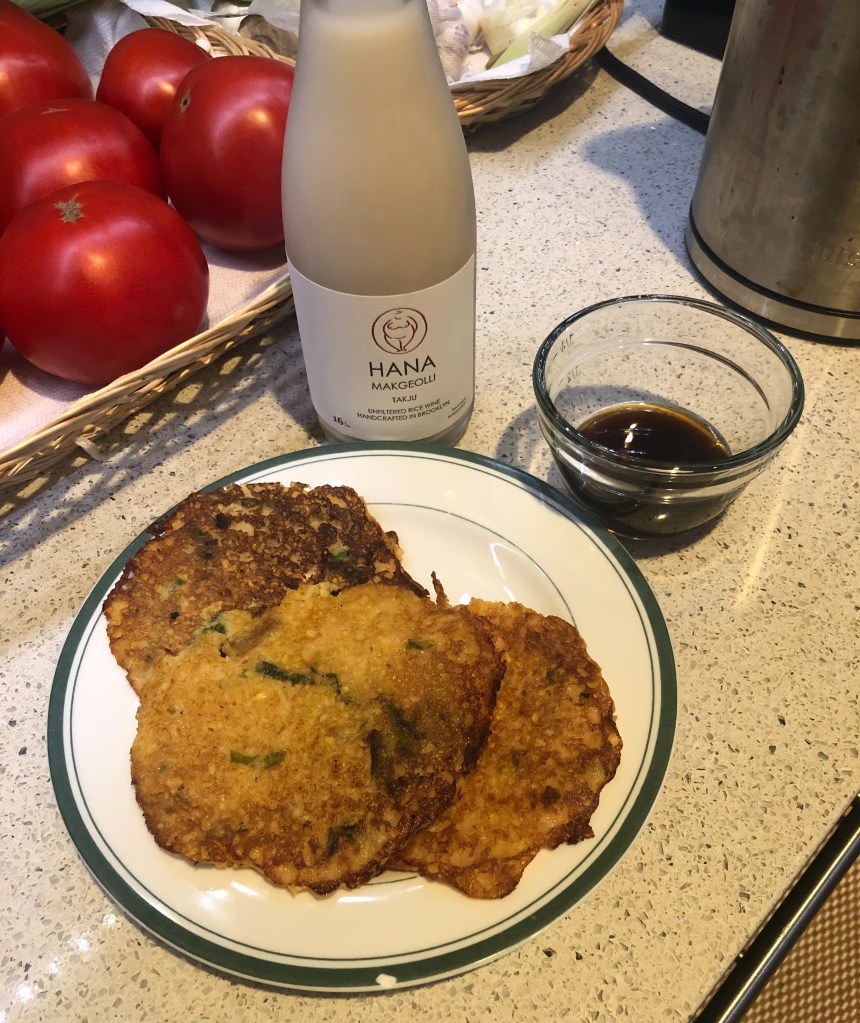
I have not been able to replicate this experience for years because finding makgeolli in Philadelphia is almost impossible unless you go to an HMart with a liquor license (too far for me without a car) or special order it through the PLCB. Recently, I discovered Hana Makgeolli, an artisanal makgeolli brewery in Brooklyn that would ship!
I burnt this batch a bit, and it is tasty but not even close to stand A-60 in Gwangjang Sijang. As I wait for the day I can travel back to Korea for the full experience, this will have to do.
I don’t eat kimchi regularly. When I was going off to college in the US, my mom was relieved that at least I won’t starve since I did not need kimchi with every meal like most Koreans. For the better part of my adult life, I went weeks, and even years, without eating kimchi. Kimchi is now widely available in grocery stores, even ones that are not Korean. Even back then, if I wanted to purchase it, I could. However, there was something that didn’t quite sit right with me about buying mass market kimchi, like there was no soul and therefore no taste.
About ten years ago, I found out that the convenience store around the corner from our new home had homemade kimchi. I could tell that it wasn’t repackaged large grocery store kimchi because each time it tasted slightly different. I was probably one of their best customers and got to know the cashier very well, well enough to make food for each other (she would make me Thai food and I made her cookies and dduk). Then one day, with two weeks notice, the landlord terminated the lease and I had lost my kimchi hook up. The store front remained vacant for almost a year, then the pandemic hit. And suddenly, I was desperate for kimchi.
I found a convenience store owned by Koreans and tried their kimchi. It was pretty good. I ordered a quart from a restaurant. It was pretty good, too. However, fear of leaving the house and the early days of disinfecting everything that crossed the threshold of the front door meant that neither was going to be my go-to source for kimchi. This craving was an alien feeling and the need for kimchi grew each day. So finally, I decided that I will try my hands on making it myself.
The recipes seemed simple enough but I had never made it before. One of my earliest childhood memories was 김장 (gimjang: kimchi making) at my maternal grandmother’s house, involving huge red oblong tubs filled with 배추 (baechoo: napa cabbage) and 무우 (mu: Korean radish pronounced moo) and vats of red pepper powder. My mother’s family owned a farm so I assume now that most of the ingredients were planted and harvested on the farm. It was an all day event that involved a dozen people and took up most of the courtyard in the house. In Ghana, my mom and the staff made kimchi regularly for home and for the restaurant we owned. My job was always eating and never making so the recipe sounded simple but incomprehensible. I called Mom.
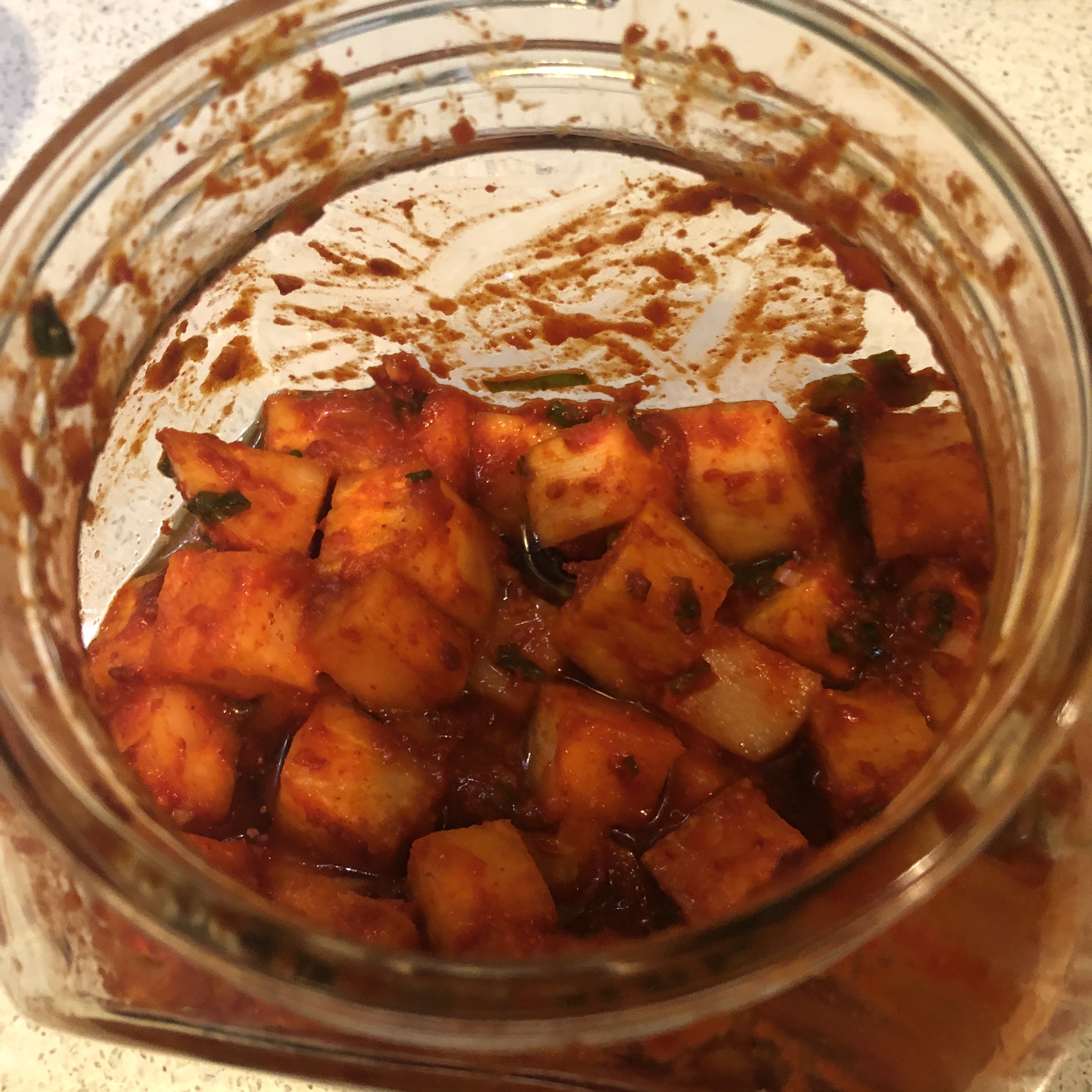
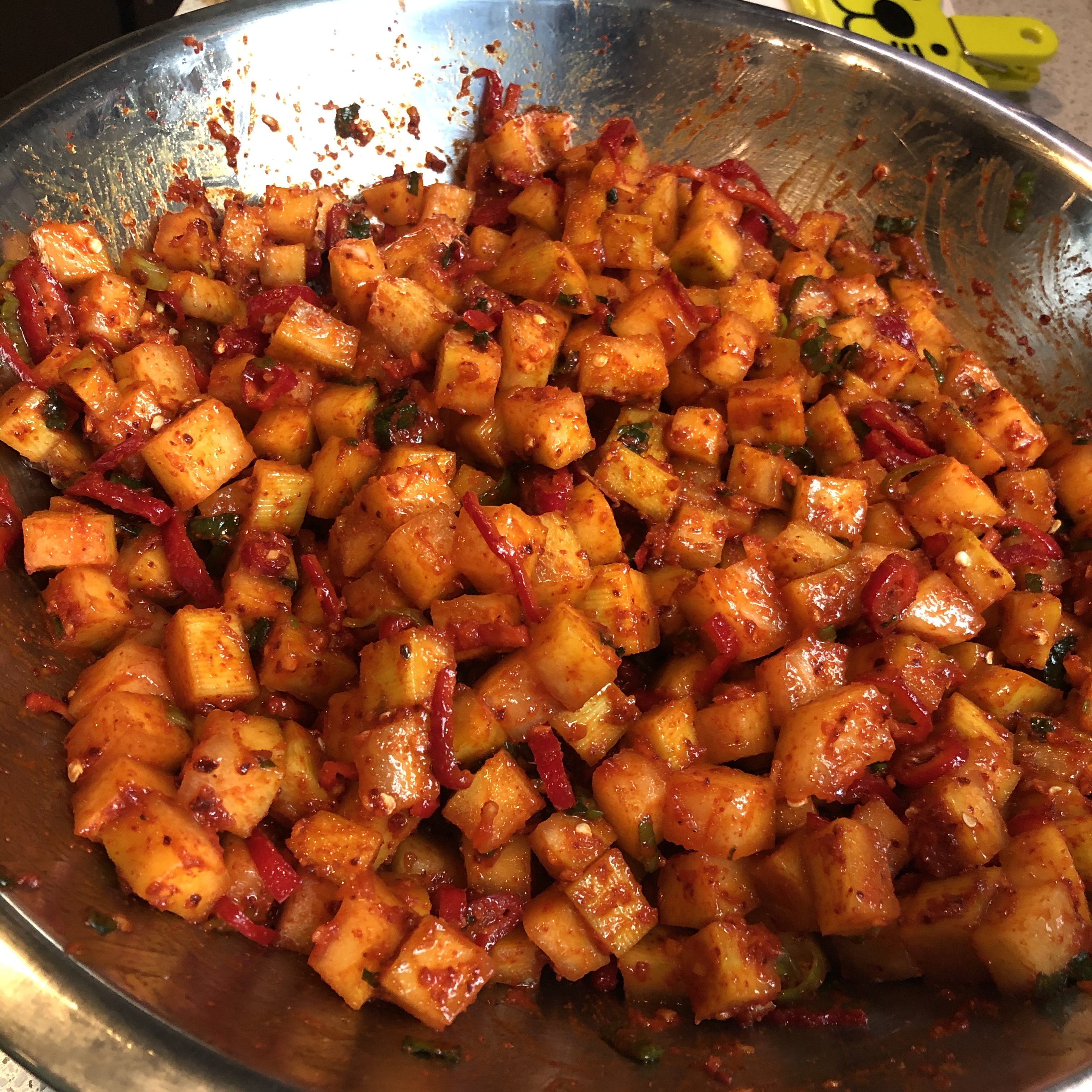
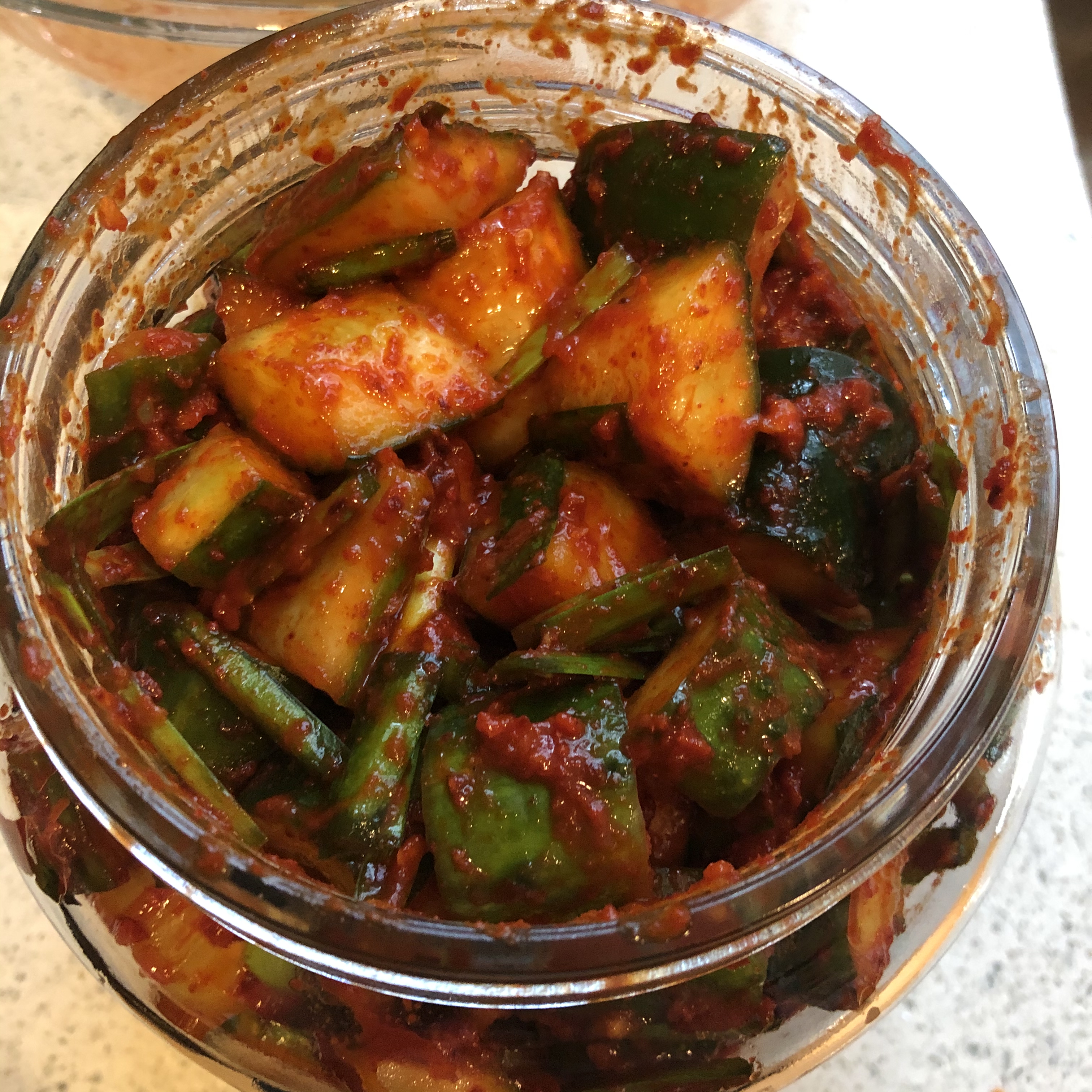
She was surprised and delighted at the same time. She said the easiest one to make would be 깍두기 (kkaktoogi: Korean radish kimchi) because all I needed to do was cut the mu into cubes and mix everything. The second easiest one would be 오이 깍두기 (oh-ee kkaktoogi: cucumber kimchi) because all I needed to do was cut the seedless cucumbers into cubes and mix everything. One thing I needed, though, was 젖 (jeot: fermented fish sauce) because that was what was needed to ferment the kimchi and give it its signature funk. I ordered what I could from HMart and gave it a whirl.
깍두기 is basically a two-step process.
깍두기 (Korean Radish Kimchi)
3-4 lb mu (it’s a large white radish, slightly green at the end, and really fat)
2 Tbsp sugar
2 1/2 Tbsp of coarse salt
8 Tbsp gochugaru (Korean pepper powder. There is no substitute for gochugaru because Korean pepper powder tastes different. This is the main flavor of kimchi and you cannot replicate with other pepper powders. I use a mix of fine and coarse grinds because I like it extra spicy about 2/3 fine and 1/3 coarse.)
4 Tbsp crushed garlic (must be crushed in a mortar, not chopped)
3-4 Tbsp Korean anchovy sauce (if substituting Thai fish sauce, add about 50% to twice as much. Fermented shrimp sauce can also work but it has to be ground into a paste or chopped superfine.)
Peel and cut the radish into 3/4 inch cubes.
Mix the rest of the ingredients well into a paste. Add the radish and mix until it is evenly coated.
Put everything in a jar, close the lid, and let it sit at room temperature for about a day. Make sure there is at least an inch of space on top. It’s fermenting so it will need the space for the gas to go somewhere.
Store in the fridge so that it ferments slowly. It will stay crisp for about a month but I have eaten it after 6 months and it’s still good!
You can add scallions or julienned carrots if you like. The cucumber 깍두기 is about the same but with 부추 (boochoo: Korean chives. These are flat chives and they have a very distinctive taste.) instead of scallions. I even made it with watermelon rinds when I read an article in Food 52 but without the fancy optional ingredients. All good!
The traditional napa cabbage kimchi is another story because it requires several steps.
Brine the cabbage
Make the rice paste
Make the filling
Put it all together
Store it in clay jars to slow ferment over many weeks
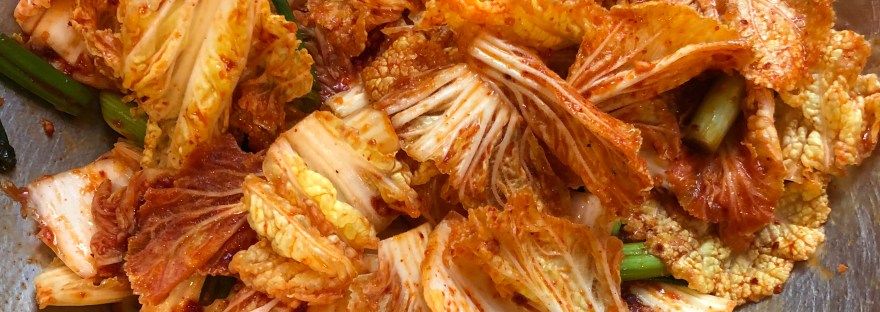
Visions of large red rubber tubs and armies of people laboring all day came into mind and I couldn’t get started. Moreover, I didn’t have any container that could hold a whole cabbage even when cut in half. Mom laughed and she said the simplest way to make cabbage kimchi in small quantities is to start by chopping the cabbage before brining. In terms of making the filling, rather than julienning the radish, she said to cut it to about the same shape and size of the cabbage (2 inch by 2 inch squares). That way, I would not have to make the filling separately since I had nothing to “fill” which also meant that the sauce could be made in a blender and the whole thing could be mixed like 깍두기. In any case, the kimchi would have to be cut up into pieces to eat if it was made the traditional way, an unnecessary inconvenience later on. Suddenly, it wasn’t as daunting and I have since made it a few times.
Mom’s Napa Cabbage Kimchi
2 napa cabbages (about 10 lbs)
1 cup kosher salt
15 cups lukewarm water
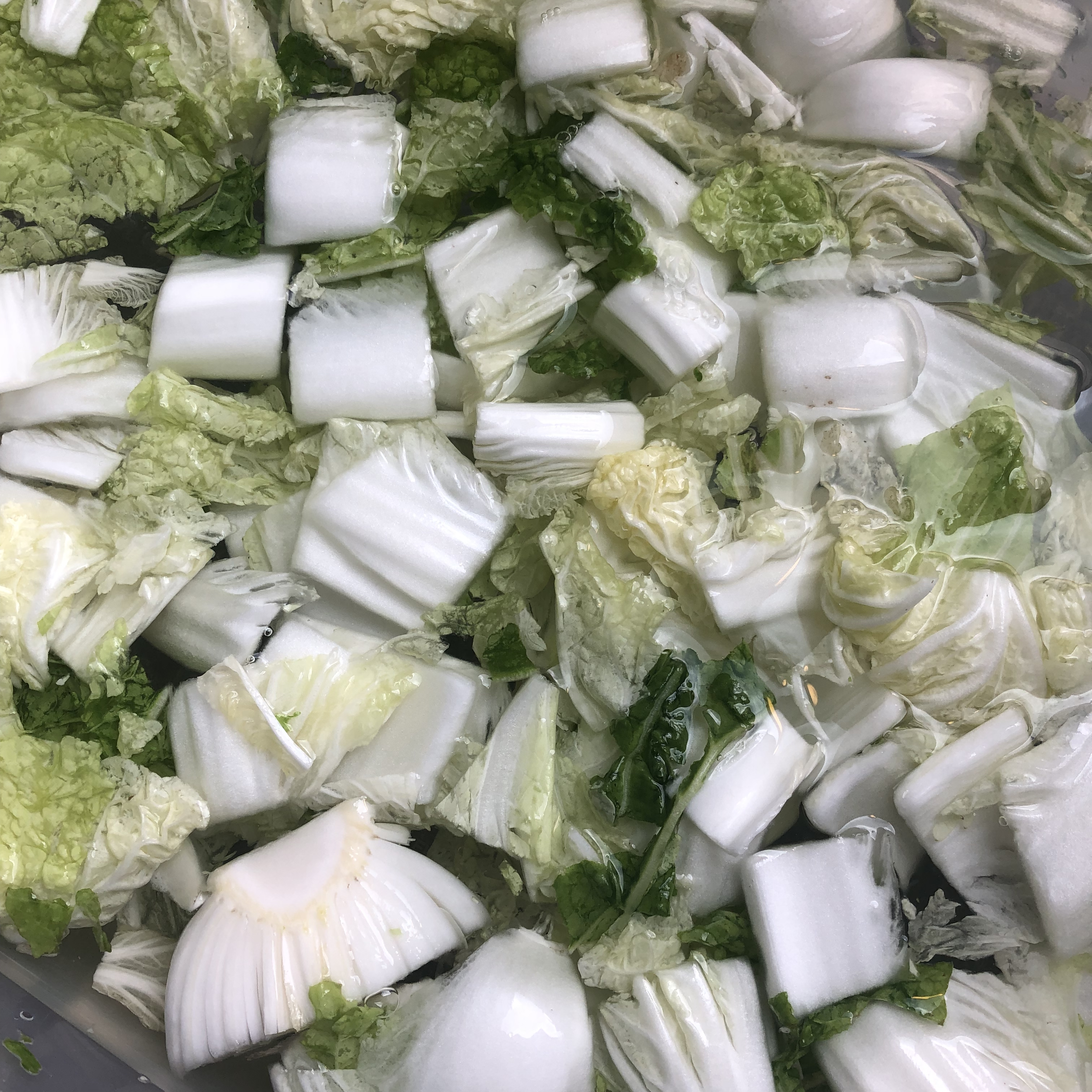
Cut the cabbage into 2 inch by 2 inch squares (rough chop okay but not small). Mix salt and water and brine the cabbage for about an hour.
1 lb Korean radish
10 scallions
1 cup gochugaru
5-6 Tbsp salt
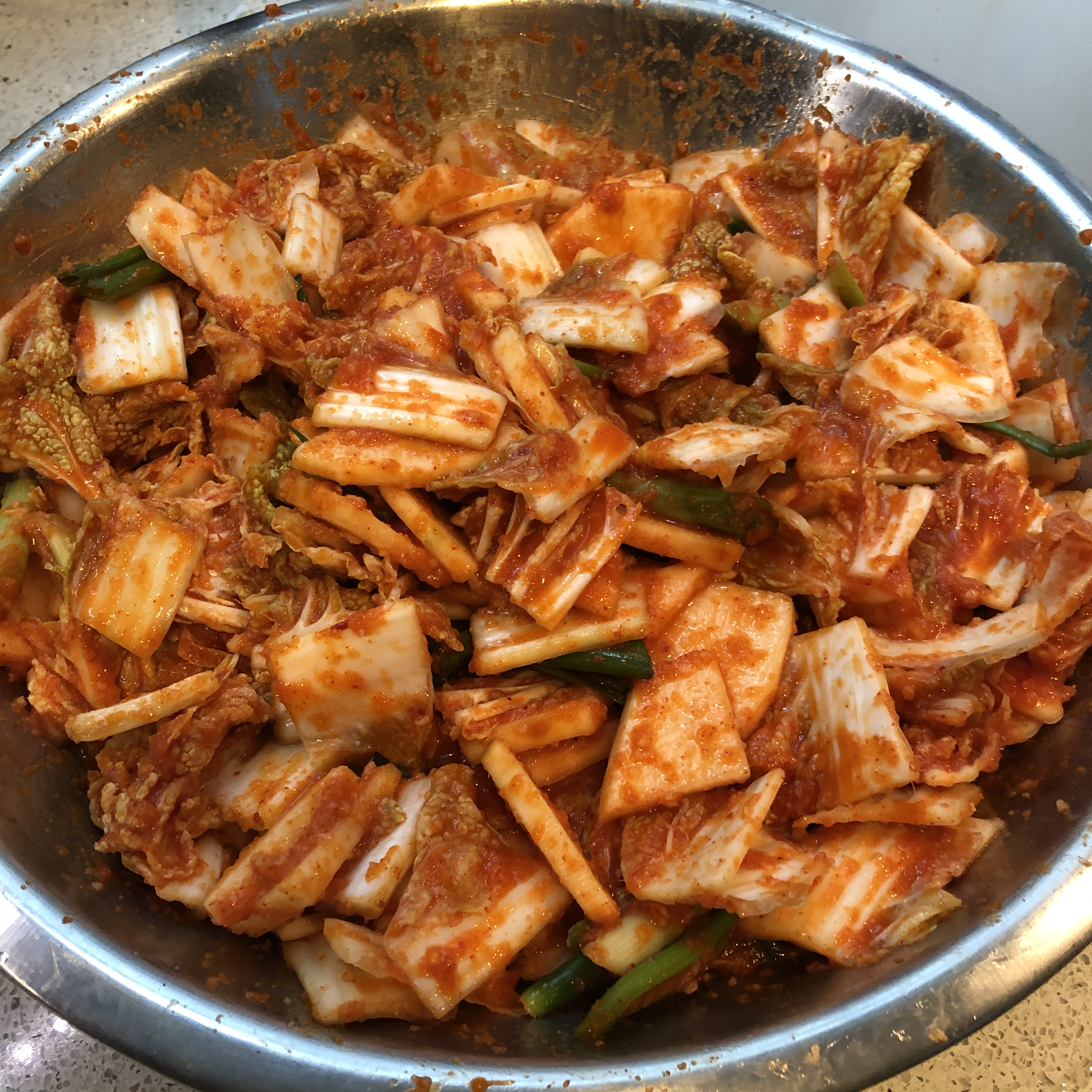
Drain the brined cabbage well (for about 30 minutes in a colander). Slice the radish into about the same thickness and shape of the cabbage. Cut the green part of the scallions to about 1 inch length. Split the white parts and also cut into about 1 inch length. Put everything in a large mixing bowl and mix in gochugaru and salt.
1/4 cup anchovy sauce
1/2 lb Korean radish
1/4 large onion
1 Korean pear, peeled and cored (this makes it extra special but you can substitute with about 1/4 cup of sugar)
Put all ingredients in a blender and blend until smooth. Pour over the cabbage/radish mixture and mix well. Add 1 cup of water in the blender to wash out any remaining sauce and add to the mix. Put in large containers and let it sit out for a day or so at room temperature. Store in fridge. Eat until whenever.
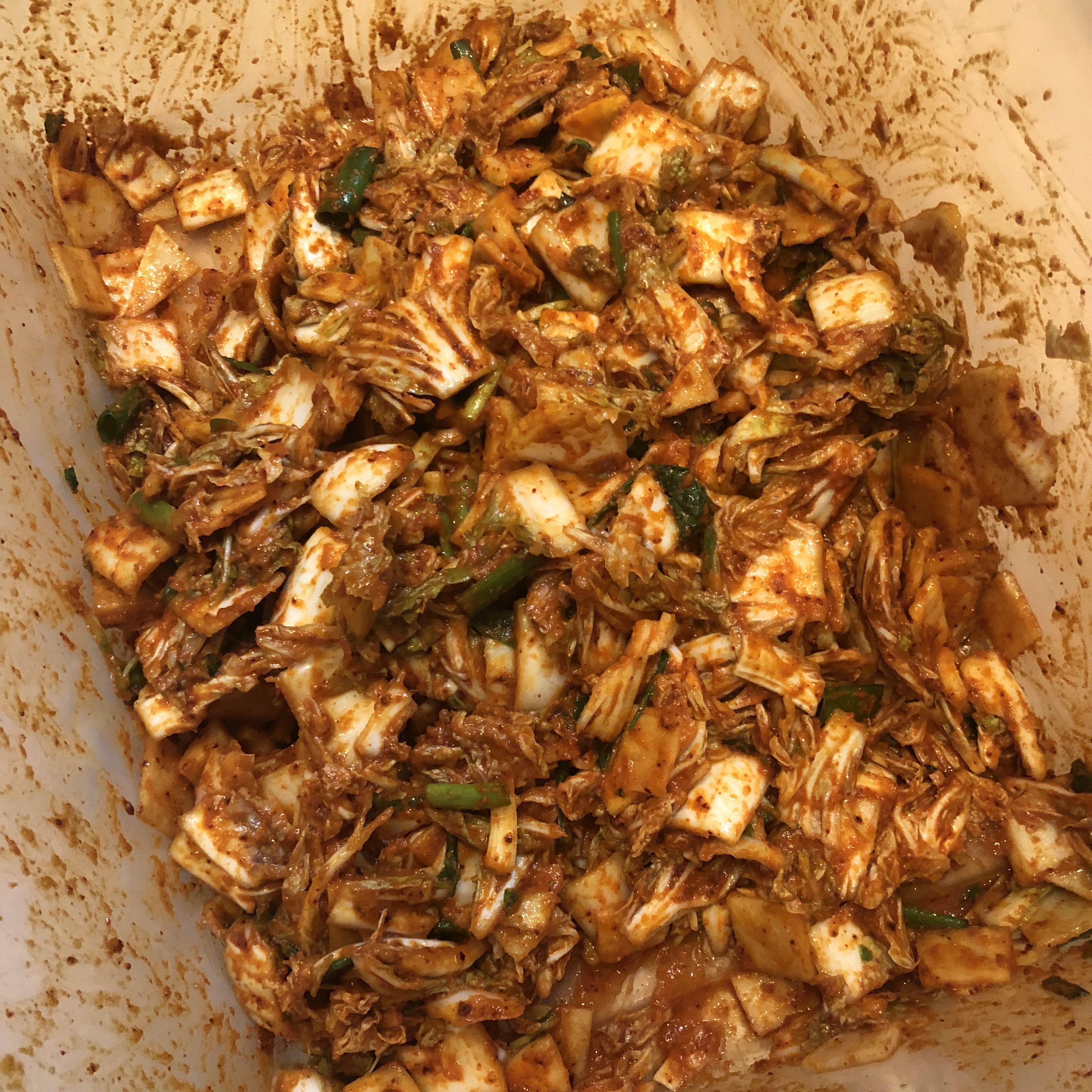
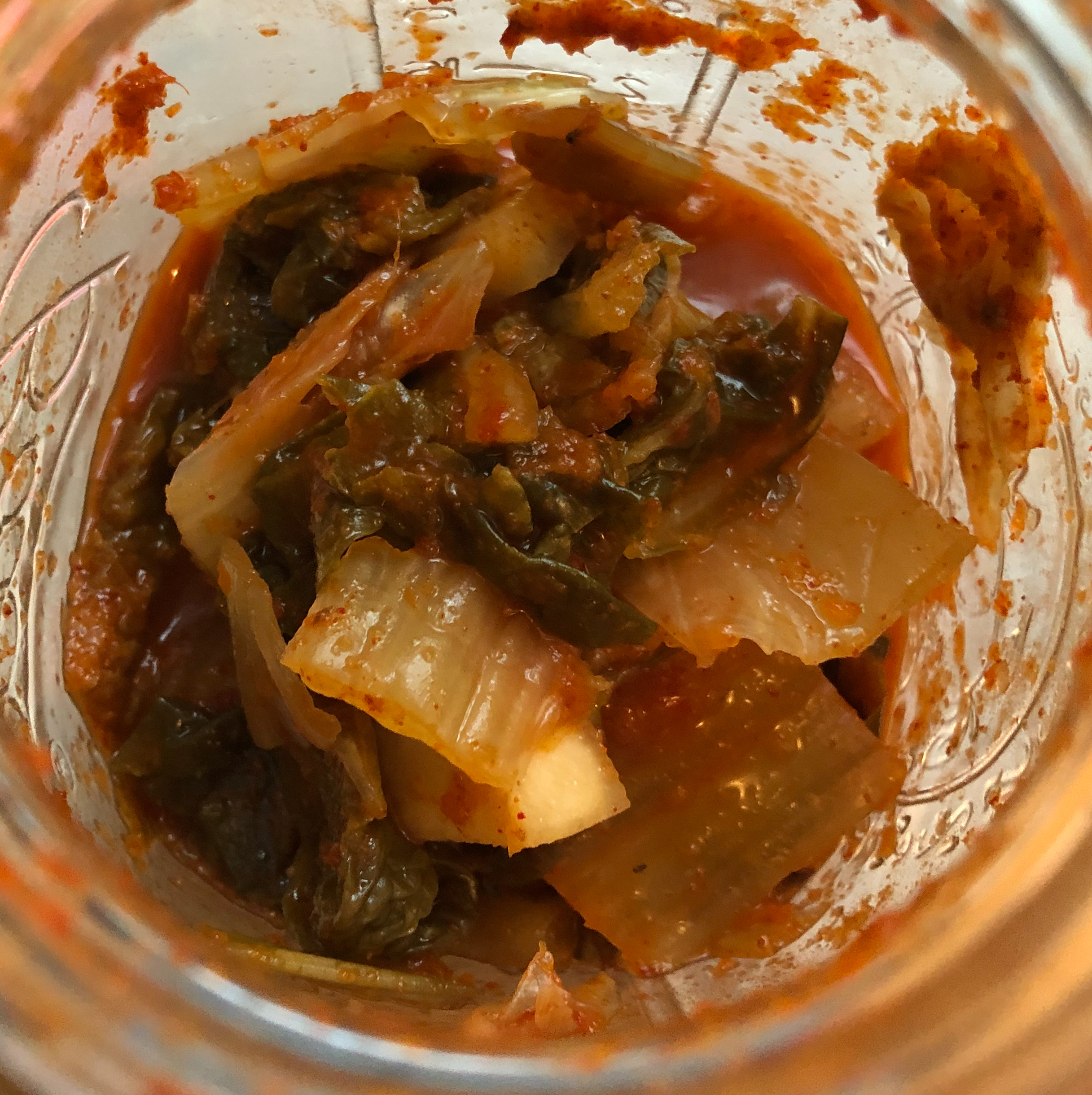
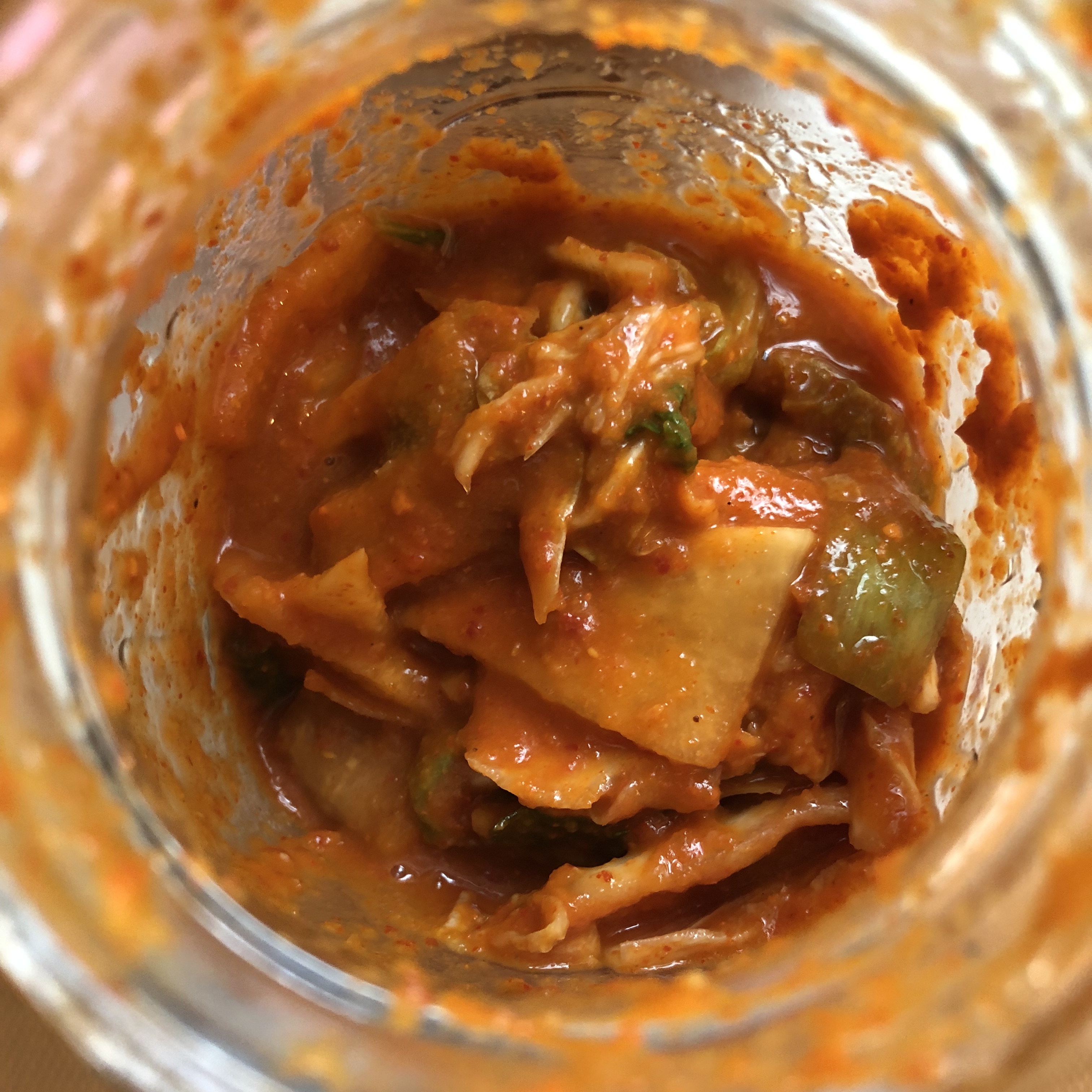
The image on the left is one that has been fermenting for about a year. The image on the right is one that has been fermenting for 3 days. They are both good although different. I prefer the really aged stuff myself because the ingredients have been marinating in its own juices and has become extra pungent and sour. The cabbage is still crunchy even after a year.
I don’t think I will ever buy kimchi in the store again, especially since I found out that my CSA, Root Mass Farm, grows napa cabbage, scallions, and garlic. In the care package my Mom sends me a few times a year, she usually includes a pound or two of the good gochugaru, grown by one of her brothers who still farms, dried and milled, and shared with immediate family only.
Making kimchi used to be a community affair when people still lived close to home and Korea had more farmland than cities. The kimchi would be shared with family and friends and lasted throughout the year. Around June of 2020 would have been the time I would have seen my parents, albeit briefly, as I returned from my annual work trip to Asia. My mom would spend days planning out home cooked meals for me: 반찬 (banchan: side dishes) made with plants foraged in season during hikes with my dad, blanched and frozen; fried mackerel and stir fried dried anchovies; whatever my parents wanted to eat that week (spicy salmon head stew was on the menu June 2019); and, of course, kimchi. Nothing reminds me of home like kimchi, a staple of my childhood, the very “Korean” thing we did in eating it with every meal. I believe my craving of kimchi was my own way of reclaiming the loss of community, forced upon us by the pandemic as we distanced ourselves from each other physically. I read somewhere that in times of uncertainty you seek food from your childhood. I made a lot of kimchi during the pandemic.
Today, I violated my own rule of not cooking chicken (unless it’s chicken soup) in the house and for good reason. For the first time in a very long time, I made jollof rice.
There are several reasons why I hardly ever cook Ghanaian food at home. Ingredients must be just right and I don’t know how to pick them. West African grocery stores are a wondrous maze to me. I remember the last time I went was about a dozen years ago when my brother visited from Singapore and wanted to stock up on Ghanaian groceries. We went to a store in West Philly with a Ghanaian friend who led us through the many aisles to make sure we got the legit stuff (We also met the co-owner of the store, a Korean woman married to a Ghanaian Jamaican man, and we chatted for a while. That’s another story.). Growing up, I only ever ate food that was made for me and I never bothered to learn to make it myself. Had I known how wistful I would be, I would have paid more attention. Finally, but perhaps most importantly, it was the absence of shito.
Shito is a Ghanaian hot pepper sauce made with hot pepper, oil, and dried fish as the main ingredients. Each family had their own shito recipe and you never bought the stuff in the store, at least not when I was growing up. It’s an all purpose condiment that goes with everything and the smell and taste is what makes the food Ghanaian in my mind. If I go to a restaurant that purports to serve Ghanaian food and shito is not offered, it’s not real to me. The last time I had shito in the house was almost a decade ago when a friend gifted me a small jar. If I remember correctly, it was a sample for a recipe that was about to go into the market in Canada and the United States and for that reason, it was not as pungent as it should have been. It was good but not great.
Then a few weeks ago, I ordered jollof from Fudena, a Ghanaian take out near my house. In the comment, I asked if she sold shito. When I went to pick up the order, Ruth, the founder, was working the window and she said that she did not sell it but she had some that her mom made at home and she was happy to deliver it to me. Two weeks later, she texted me to say that she was picking her mom up from the train station and she would swing by with the shito. I met Ruth on the corner where she was parked and she handed me a bag and it was HEAVY!
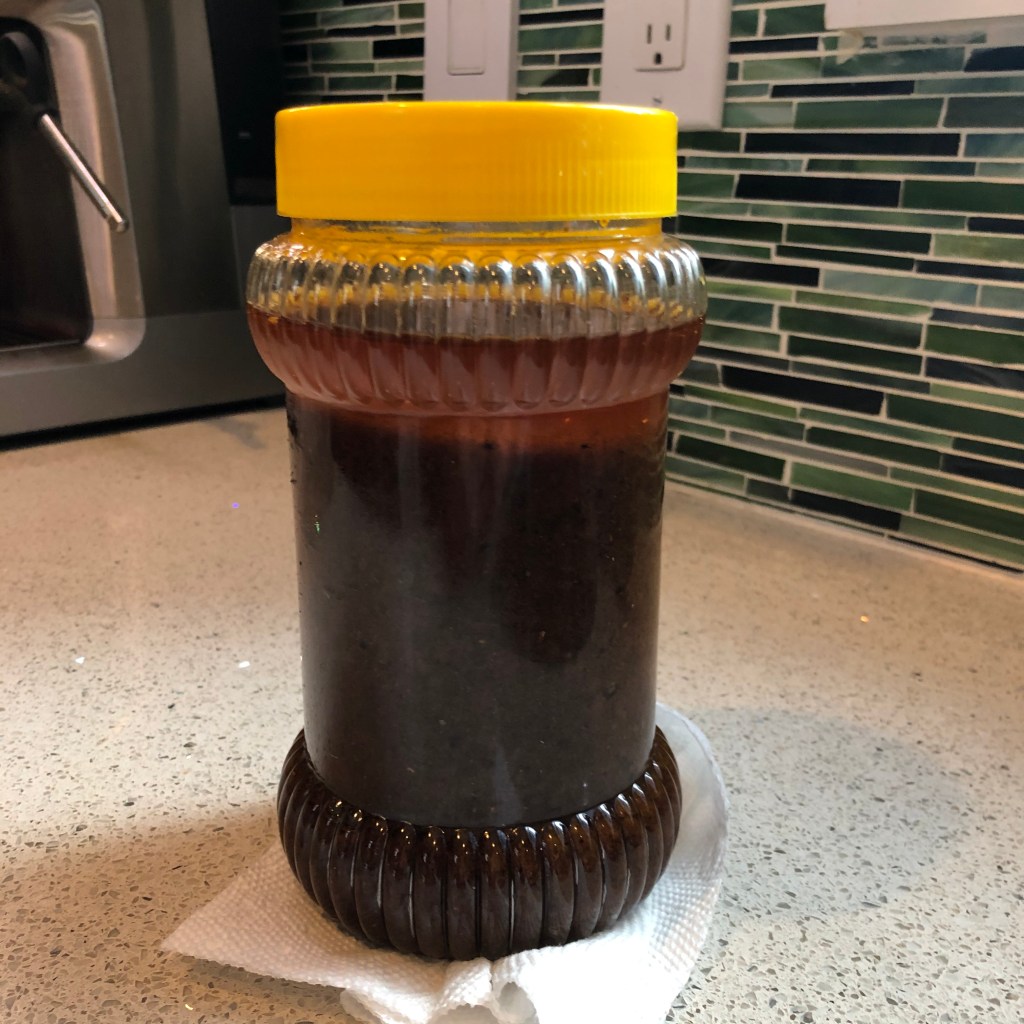
Homemade Shito
What I received was a full liter of shito, the real deal, freshly made less than a week ago, by Ruth’s mom! My jaw dropped behind my mask. I was so grateful. We ended up chatting for about 15 minutes, Ruth and her mom in the car, me standing a few feet away, all of us masked. It was a while since I talked to someone who knew about Ghana in the 1980s, knew my school, understood the healthy skepticism we had about food that we didn’t personally know the source, all spoken with the familiar lilting Ghanaian accent. I have met Ghanaians and Ghanaian Americans in Philadelphia, mostly people who are younger than me and/or born in the United States. Talking to Ruth’s mom was like coming home. We promised to hang out once the pandemic was over to chat about growing up in Ghana. That jar of shito is, to me, a treasure.
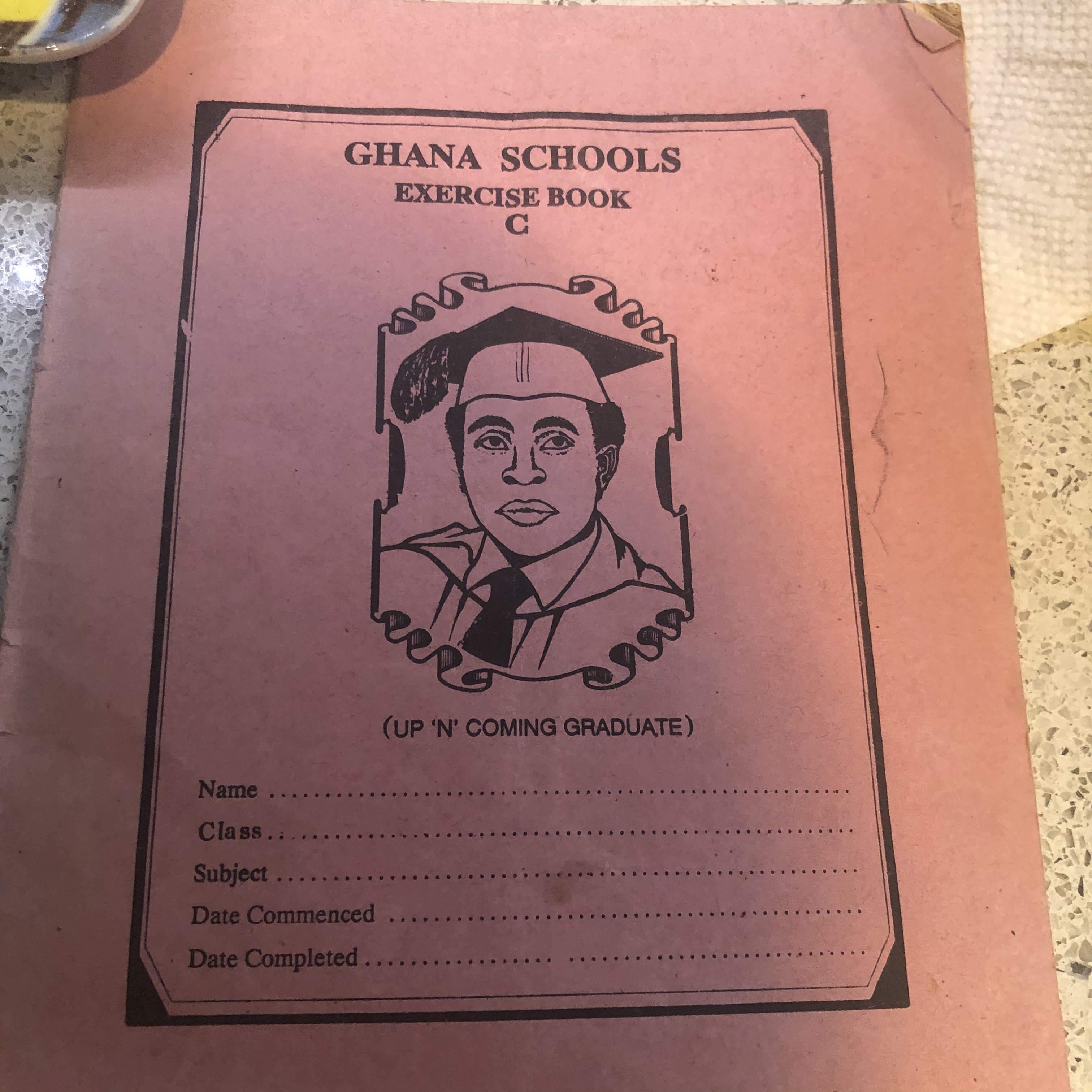
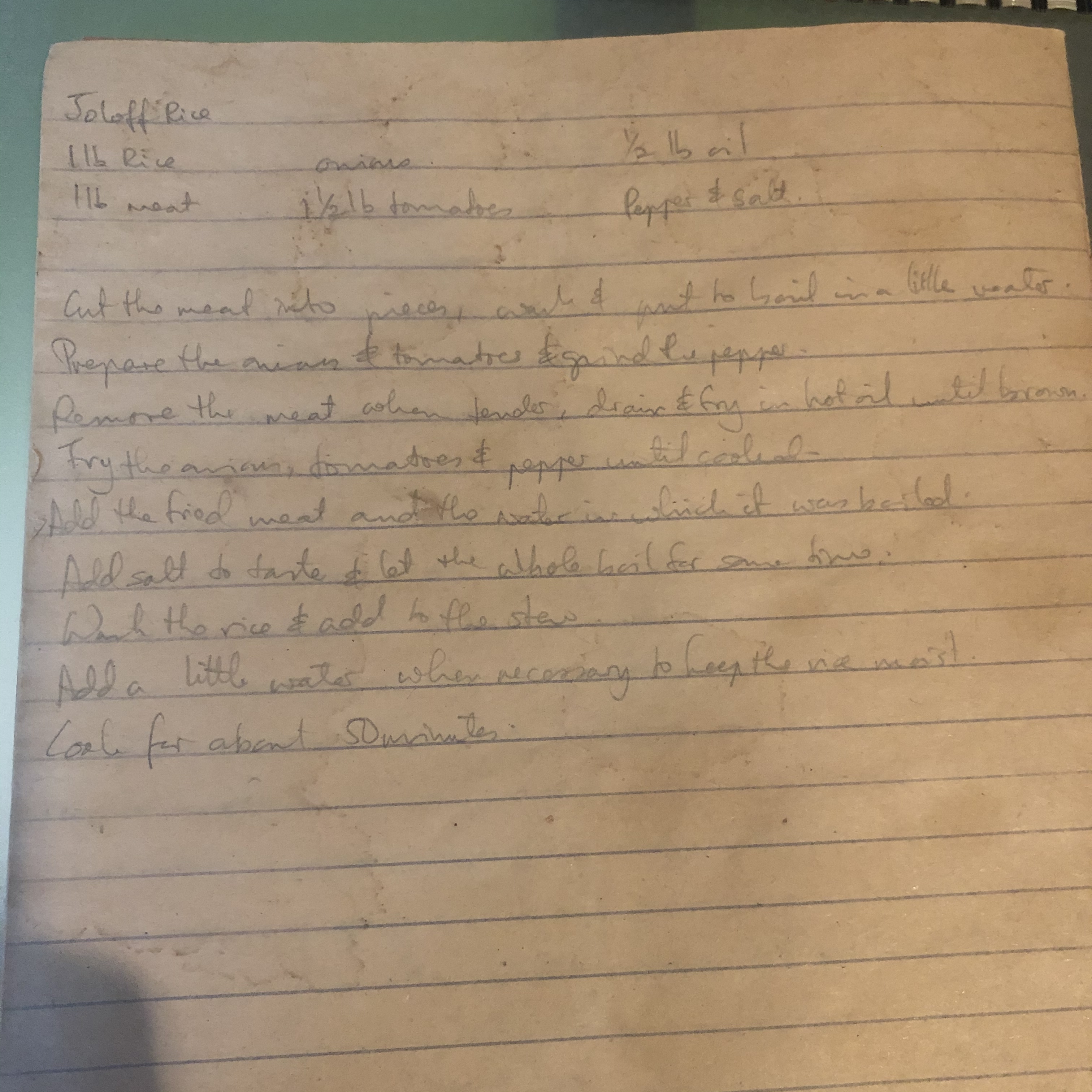
Now, I had to make some jollof rice. The problem is making sure that the recipe is a Ghanaian one. A guest writer for Food 52 talks about jollof rice being a “unifying dish across West Africa” and offers a Nigerian recipe. That blog pissed me off for a while and I can tell you for sure that I wasn’t about to use that recipe. That being said, I wasn’t sure how much I could trust what I googled. Then, I remembered that when I was leaving for college, I had written down some recipes that I wanted to have with me when I finally learned how to cook. I dug it out from a box of letters and keepsakes that had traveled with me for almost three decades. The last recipe in it was jollof rice.
By the vagueness of the description, it was probably not out of a recipe book. I am guessing it was told to me by Auntie Amanda, the woman who helped raise me and cooked for the family, and I had quickly written it down.
Jollof Rice
1 lb rice
onions
1/2 lb oil
1 lb meat
1 1/2 lb tomatoes
Pepper & Salt
Cut the meat into pieces, wash, and put to boil in a little water.
Prepare the onions and tomatoes and grind the pepper.
Remove the meat when tender, drain, and fry in hot oil until brown.
Fry the onion, tomatoes, and pepper until cooked.
Add the fried meat and the water in which it was boiled.
Add salt to taste and let the whole boil for some time.
Wash the rice and add to the stew.
Add a little water when necessary to keep the rice moist.
Cook for about 50 minutes.
Some notes:
1 lb of rice is about 2 1/4 cups of rice. I used white rice.
1 large onion, diced, is what I used.
I used about 1/4 cup of olive oil.
The meat I used is skinless boneless chicken thighs. It’s best not to have the skin on for this recipe. Although less common, you can use beef.
I used 5 small vine ripened tomatoes, rough chopped, skin on.
I added 5 cloves of garlic when boiling the meat and added it to the pot later. I used 2 cups of water to basically make the chicken broth.
Pepper is not black pepper. Pepper is fresh hot pepper. Since I can’t get Ghanaian hot pepper, I used a combination of 2 Cayenne peppers and 10 red jalapeno peppers. I ground it with about 1 Tbsp of kosher salt in the food processor. I think I could have added a red habanero or Scotch Bonnet to make it spicier.
Instead of adding more water to make the total amount of liquid necessary for cooking, I added a cup of Low Sodium V8.
I used an Instapot. I had a recent debacle with potatoes not cooking properly in a tomato based curry and a friend pointed out that if you cook starch in an acid based sauce it will take longer unless done under pressure. Nothing worse than crunchy rice.
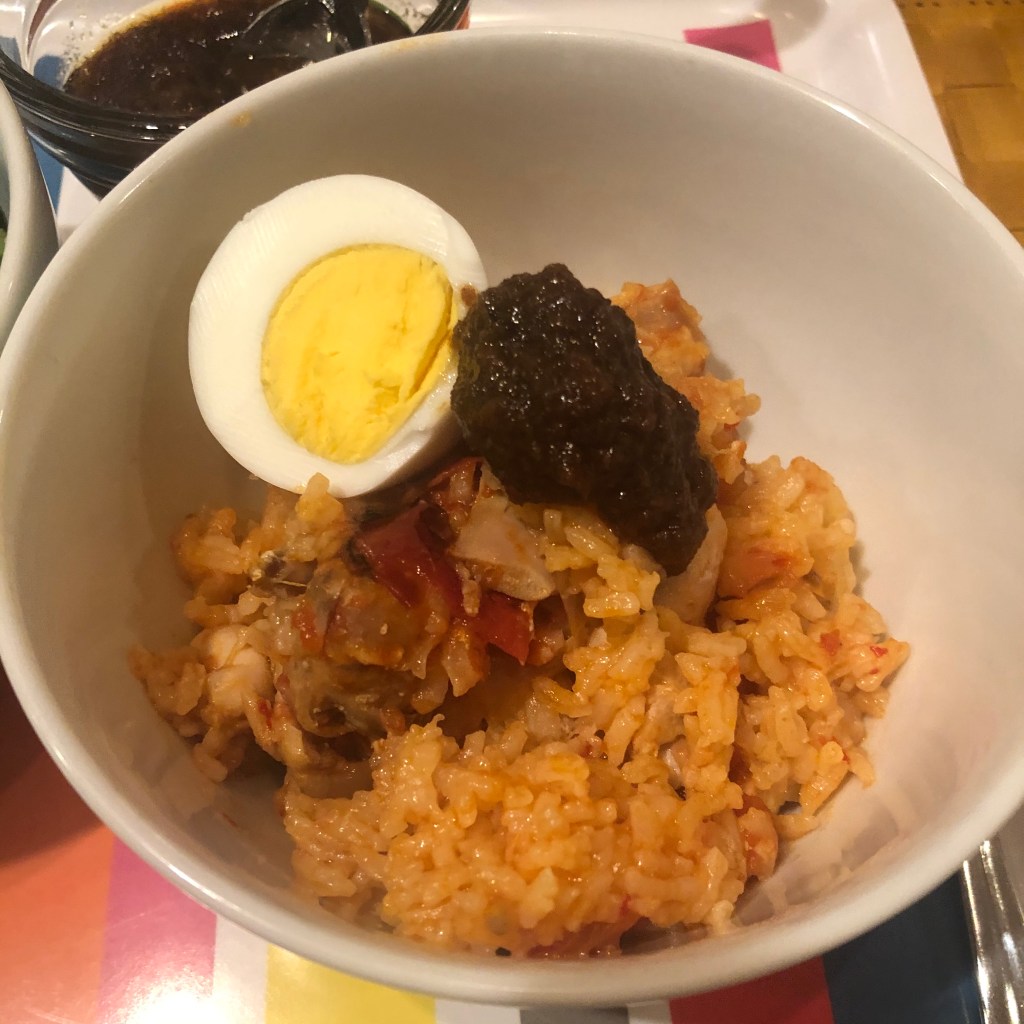
Chicken Jollof Rice with Shito and Boiled Egg
With the boiled egg and shito, it was exactly how I remember the jollof rice of my childhood to be. I was probably a tad exuberant with the shito because now I have heartburn. But I regret nothing!
I uploaded the photo on our family group chat. My brother wrote: “If it turned out well, please share the jollof recipe.” Then he added, “It’s not a Nigerian recipe, is it?”
A few months into the pandemic, a crisis hit the sanitation workers. The lack of PPEs and inability to be socially distant in their jobs meant COVID spread rapidly among these front line workers. Since they worked in teams, one person’s positive test meant the entire team had to be under quarantine. That also meant that garbage collection got delayed just as the weather started to get warm. I don’t compost so my goal was to reduce as much as food waste as possible so that I did not have stuff decomposing in the trash compactor.
It was also about the time when I started ordering oranges and lemons in bulk, like 20 pounds at a time. I always felt bad about throwing out what seemed to be about 20 percent of the fruit so I started thinking about ways to use it.
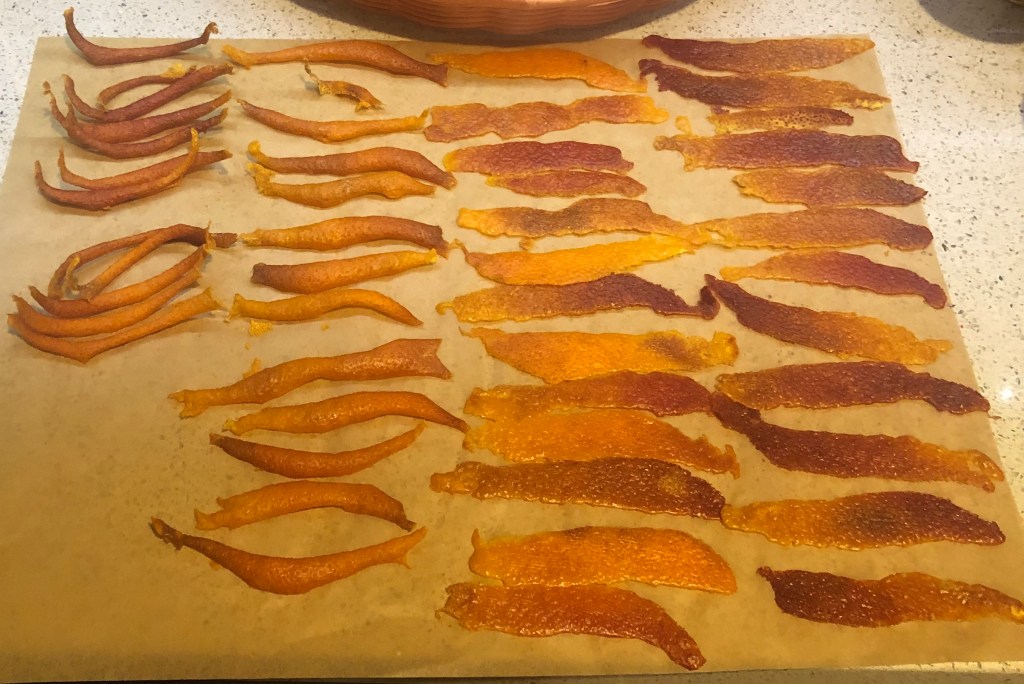
Various stages of drying blood orange peels.
First, I found out that it was rather easy to just dry the peels. Using a vegetable peeler, peel the rind, making sure not to get too much of the white bits, put it on a piece of parchment paper pith side down, and let it sit for a few days. The rind will curl up as it dries. It’s completely dry when it snaps with a nice crisp sound when you bend the peel. I store these in a large, wide-mouthed jar, lid open, in the cabinet. It really makes the cabinet smell fresh. I add dried peels along with cinnamon sticks, star anise, and bay leaves and simmer on the stove as an air freshener, especially after cooking fish.
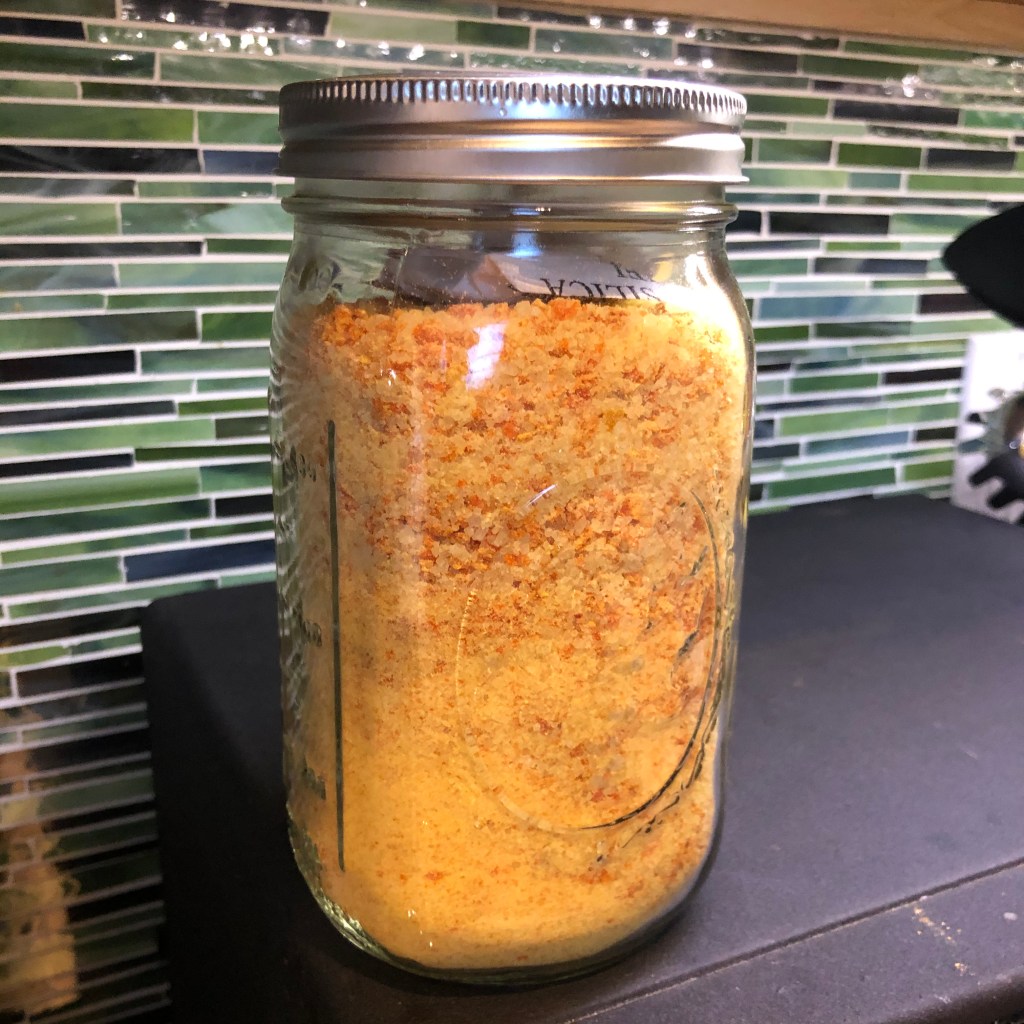
Orange salt
At some point, though, the dried peels were piling up. Even dried, 20 pounds of navel oranges produce a lot of peels. So, the next step was to figure out what to do with those dried peels. I remembered seeing orange and lemon salt in the grocery store. I took out the “spice grinder” (that is, the coffee grinder that I never threw out when we bought a burr grinder) and ground up some dried peels. It totally turned it into powder! I added some kosher salt and ground it again, and voila! Orange salt! I kinda like it ground a bit unevenly. When added to something liquidy (like oil or vinegar), it reconstitutes and becomes a pretty orange flake. Instead of regular salt for baking molasses cookies, I add a teaspoon of the finer parts of the orange salt. I don’t know if it actually makes a difference, but I would like to think so.
Since a small quantity goes a long way, I could even mail it in a regular envelope to friends without extra postage. I would put about a quarter to a third cup of orange salt in a snack size ziploc bag and flatten it out so that it didn’t bulge too much and a forever stamp was all that is necessary. It’s shelf stable so it travels well. Just in case, though, for large quantities I keep at home, I throw in a dessicant pack or two.
Apart of making salt, I started macerating orange peels in sugar to use as a base for making orange marmalade.
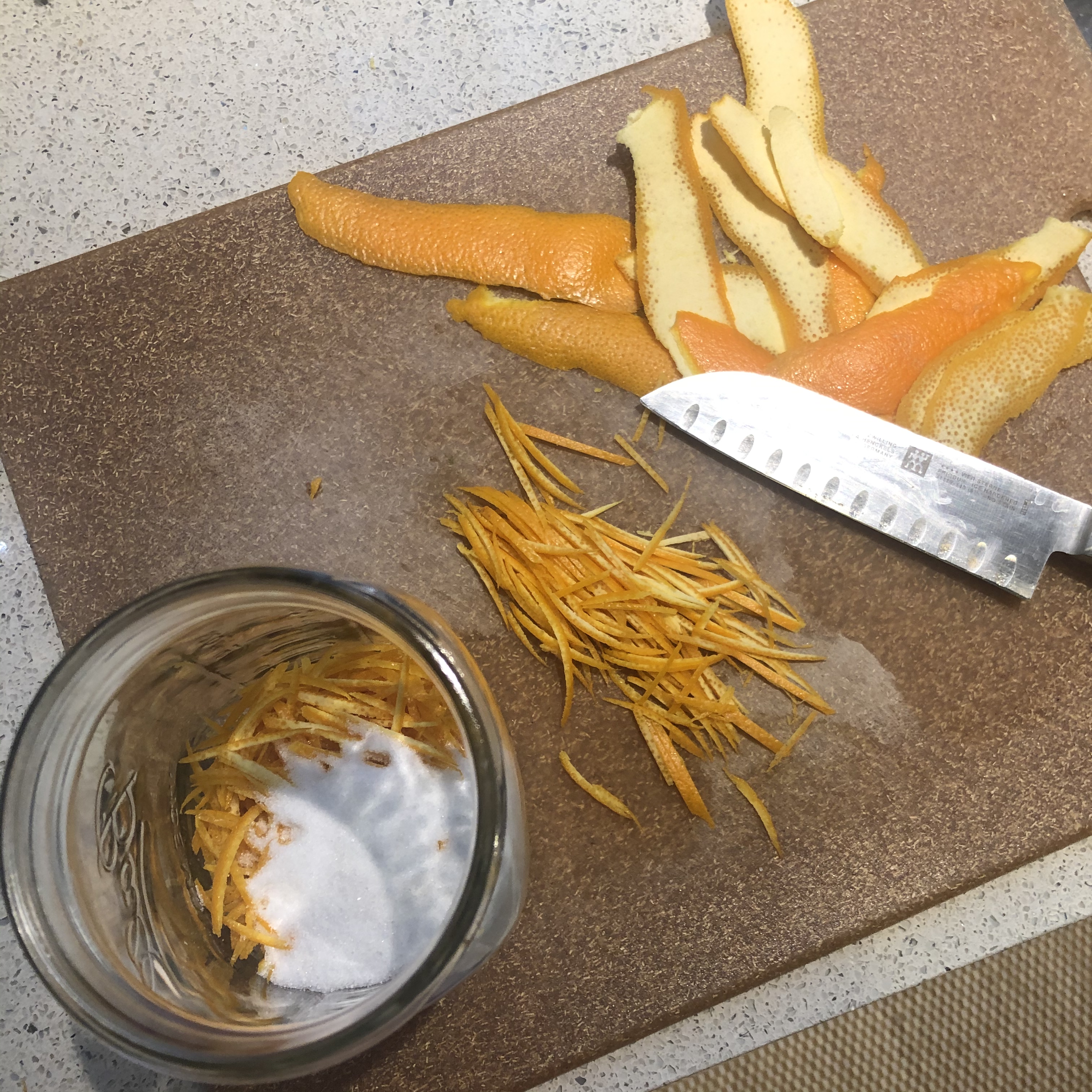
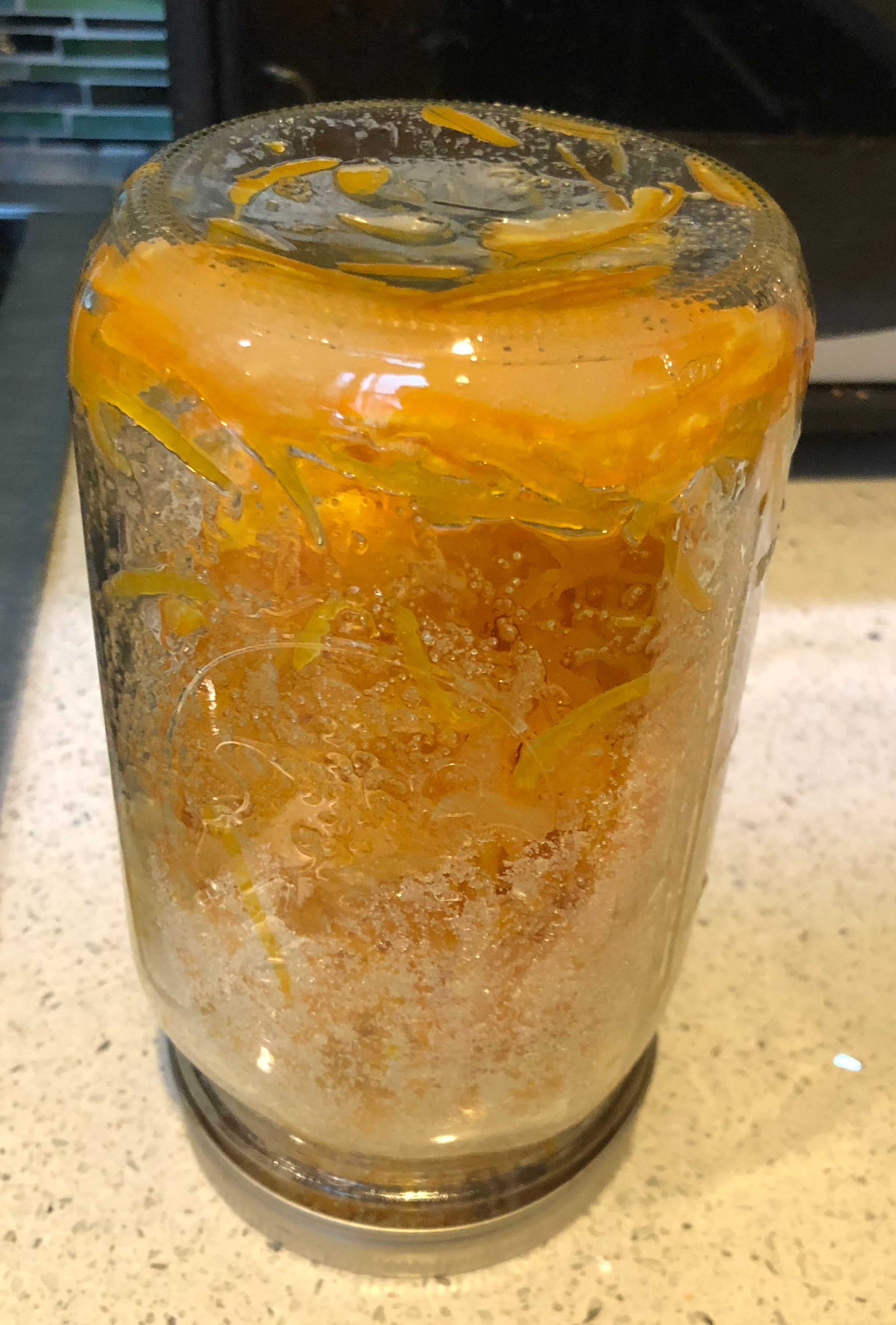
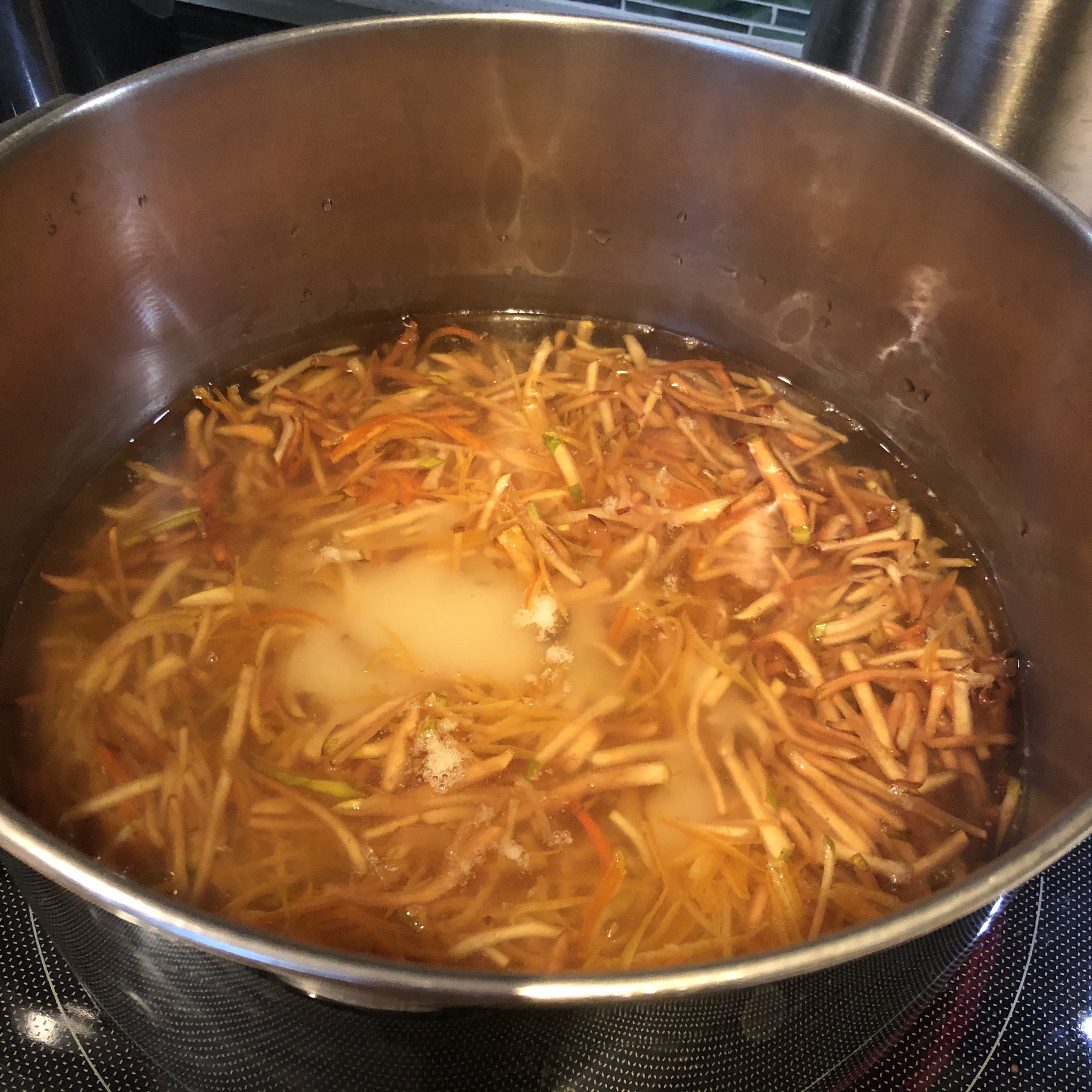
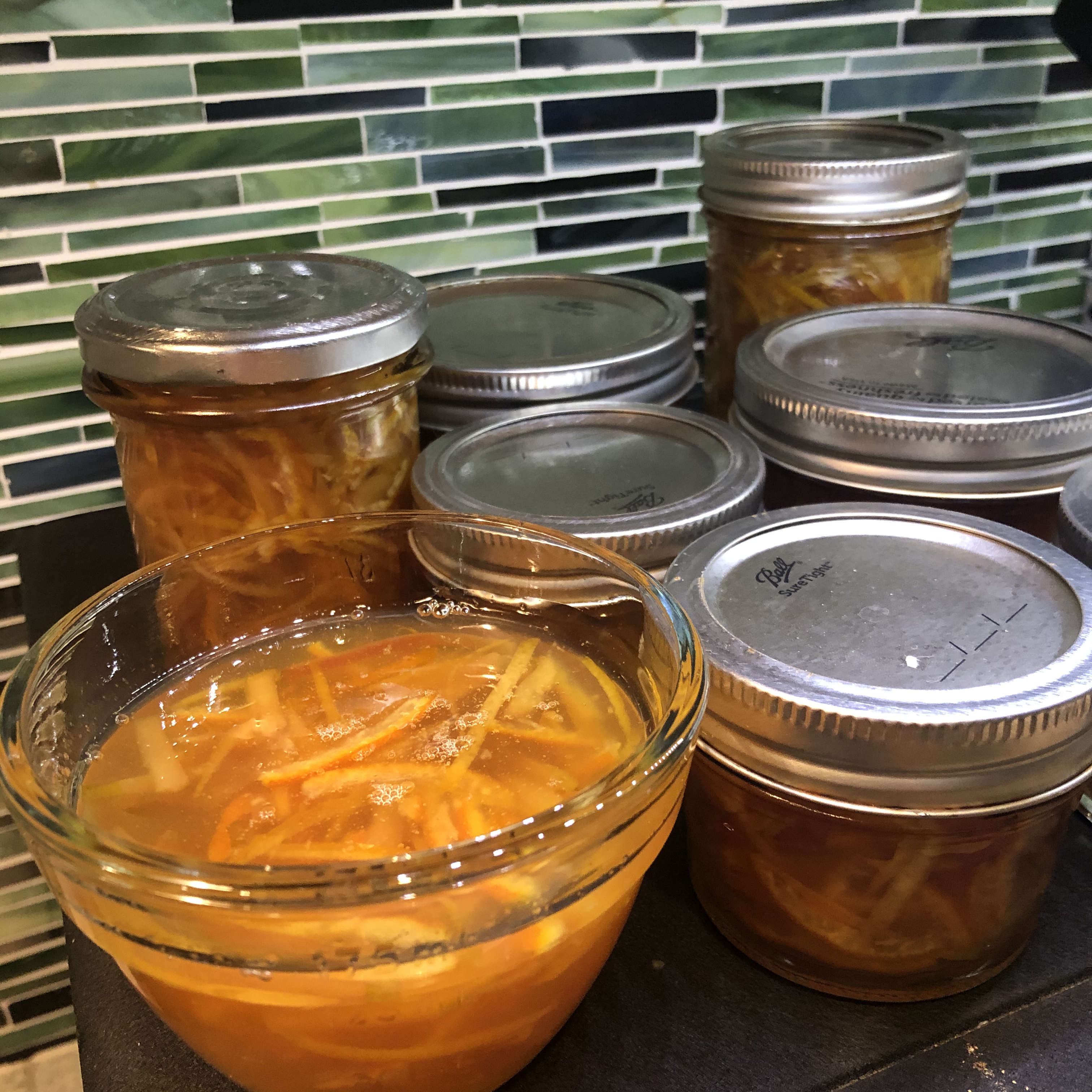
For this, I make sure to get a good chunk of the pith when peeling the orange. That’s because the pith contains pectin and while I always add extra pectin when making marmalade, it does give me the option to just boil it down if necessary. I like to julienne the peels by hand. You would need to use a really sharp knife on a stable cutting board if you don’t want to chop off your fingers. For each cup of julienned peels, I cover with a quarter cup of sugar. I think I read somewhere that the sugar and peels should be equal in weight, but I really hate toting out the kitchen scale… After stirring it a bit to distribute the sugar, I keep it in the fridge and turn the jar a few times every several days for a few weeks. Over time, the peels become translucent. Add liquid, sugar, and pectin then boil until thickened. You got marmalade. Any liquid you have on hand is fine but I prefer juice to water. One time, I used a hibiscus infused ginger drink from a local beverage business, Really Reel Ginger, because it had been sitting in the fridge for a while. I have also added julienned ginger, quince, and blood orange sections as well. Just make sure that whatever you add, it’s julienned to the same size as the macerated peels.
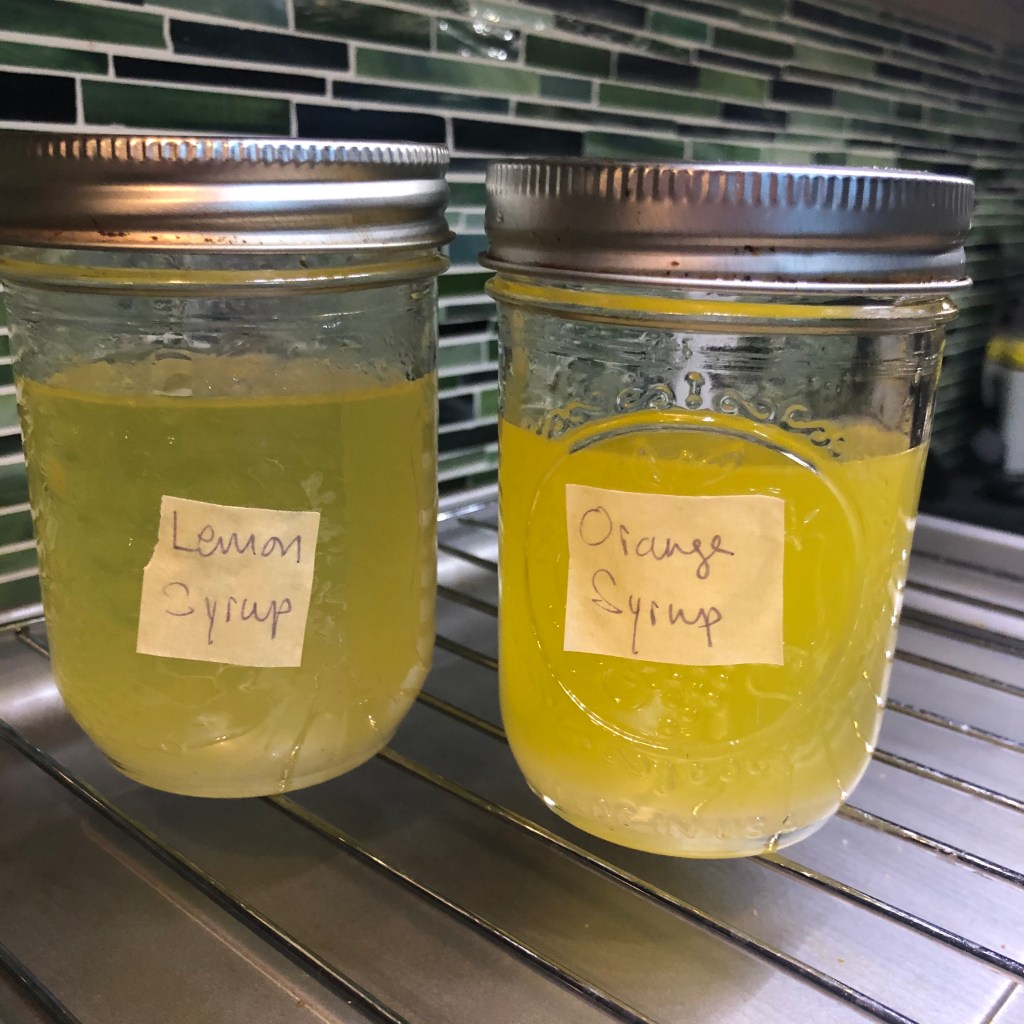
If you feel bad about throwing out lemon rinds, Serious Eats has a solution for you! It totally works with lemon, meyer lemon, lime, and orange.
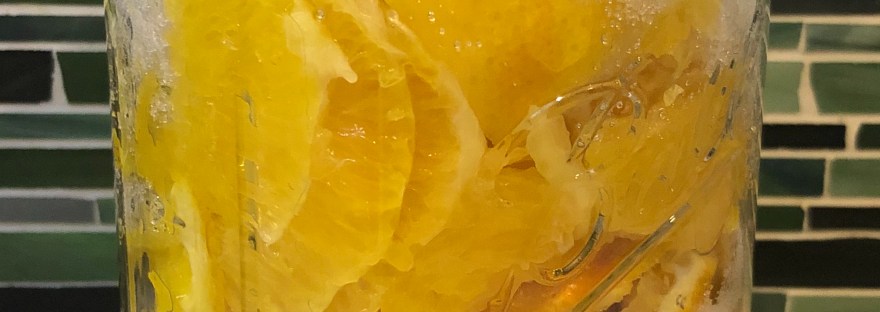
It even works with the peels zested off. They all end up being a greenish yellowish color so it is very important to label them. Serious Eats suggests many uses; the dude’s favorite thing is to drizzle it over blueberries for dessert. I recently tried this out with pineapple peels and core to see if I could make pineapple syrup. That worked too! Then, a friend pointed out that I was part of the way to making tepache.

 What will Dr. Gwak say?