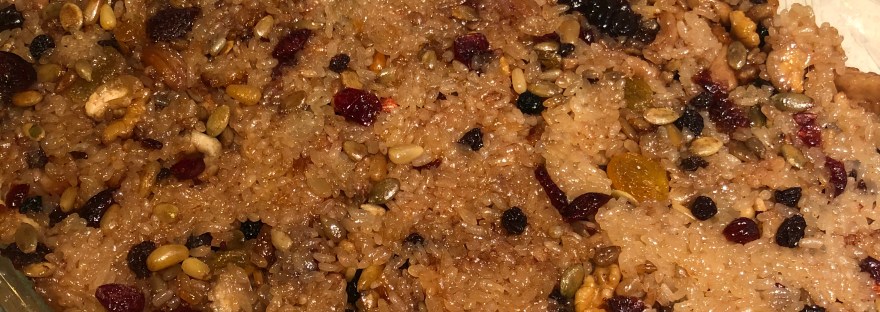
It’s probably one of my favorite Korean food. It’s technically 떡/rice cake but it us made of whole rice instead of rice flour or pounded rice. It’s full of nuts and dried fruit and sweet and savory. It looks impressive when made but all it takes is some prep work and a rice cooker. It freezes well too, and 15 seconds in the microwave and it’s tastes like fresh made (Almost. Let’s be honest: nothing ever tastes like fresh made food). The literal translation is “medicine food” and it’s traditionally eaten on the first full moon after Lunar New Year/정월대보름. I eat it whenever.
I started making yaksik several years ago because I really craved it. After browsing through several recipes online, I settled on this one by Crazy Korean Kitchen, which looked like the most straightforward. The first time I made it, I ran into ingredient problems. First of all, I didn’t have any chestnuts. I usually keep a stash of boiled chestnut snack bags somewhere but there was none in sight. Also, I really, really, dislike dried jujubes. It looks like a petrified red bug, has the mouth feel of tree bark, and tastes sweet and medicine-y. At least to me. If you assume it’s going to be like medjool dates just because it is called Korean dates, you are going to be very disappointed. When I was a kid, my mom would smuggle a small bag of this stuff and keep in the freezer for special occasion foods and I will religiously pick each bit out before eating said food.
So what do I do when I hit an impasse with a Korean recipe? Call Mom of course. Making Korean food in Ghana meant improvising everything if the ingredient wasn’t brought in our suitcases on our last trip to Korea. If there is someone who had an out-of-the-box solution, it would be Mom. Basically, this is what she said: What goes in it isn’t that important. Whatever dried fruits and nuts I had on hand was totally fine. She even put cubed kabocha squash instead of the chestnuts and it was totally fine. Also, plain water instead of boiled jujube water would work although the flavor would not be ask complex. After many iterations of making yaksik, I have a few guidelines.
Sonya’s Pro-Tips
- Soaking the rice is super important. This actually makes of breaks the end product. Overnight in the fridge is best.
- I discovered dried chestnuts in the Asian grocery store near the house. Right at the beginning of the pandemic, I bought out all the packets of dried chestnuts. make sure to soak it with the rice if using dried chestnuts. Even then, it could be hard so cut it into small pieces so that it cooks through in the rice cooker.
- The boiled chestnut snacks, also widely available in Asian grocery stores are great because you don’t have to worry about texture. Obviously, don’t soak these.
- The rice to liquid ratio has to be precise. I actually measure this carefully.
- Traditionally, it’s all honey but using dark brown sugar adds more color. I go 50/50 for the most part.
- Pine nuts are a must for me. Somehow, it doesn’t taste right without it.
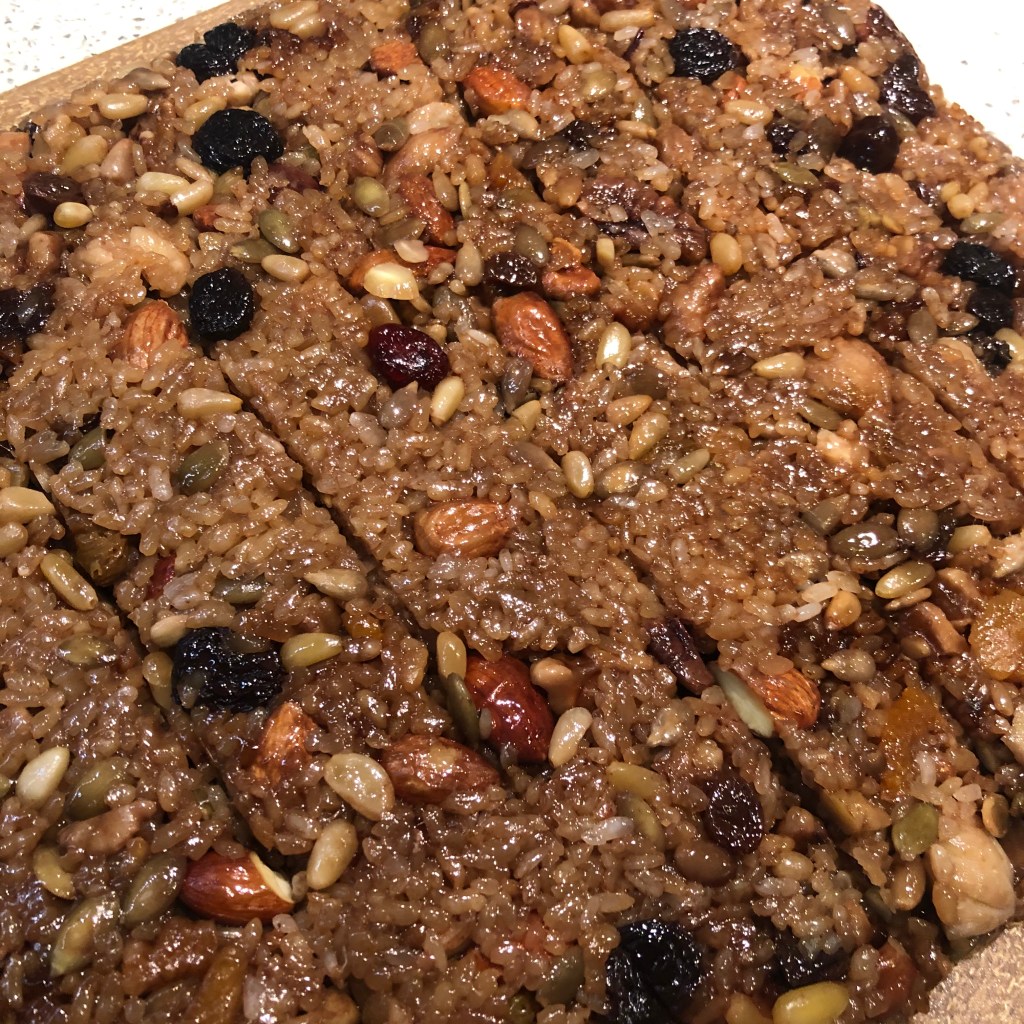
- Whatever amount of nuts and dried fruit that the recipe suggests ignore it. 2 Tbsp of raisins? Really? I put in like a cup of mixed raw nuts, a cup of mixed dried fruit, and about 1/2 cup of sunflower seeds and pepitas. Just make sure they are roughly even in size and there aren’t clumps or gigantic pieces of something.
- The nuts and fruit must stay on top so that the rice cooks evenly. Don’t worry–it will get mixed in there evenly eventually.
- Wait to open the lid. It says 5 minutes in the recipe but I would say at least 15 minutes. The Korean expressions is “뜸드린다” and it is an expression used when someone keeps hesitating and implying something without saying or doing it outright. You will feel the exact same kind of frustration but this step is totally necessary to make sure the rice is cooked properly.
- Using plain water is so boring so I steep things other than jujubes to provide depth. My go to is ginger and dried persimmons. I like ginger and dried apricots too. I like adding the ginger because it balances out some of the sweetness. Straight up dried persimmons or dried apricots work too.
- I have never doubled this recipe before because my rice cooker is not big enough. It’s the same Black and Decker rice cooker I bought at the CVS when I was a grad student. It’s got a dent but still works!
When I am organized, I make a couple of batches and share it with friends, colleagues, students, neighbors, and a couple of Korean business owners in my neighborhood. One of them was the shoe repair guy. He is around my dad’s age and repaired my shoes for many years. When he moved location, I tracked him down. We would have short pleasantries in Korean. One time, around Lunar New Year, I dropped off a small loaf pan of yaksik on my way to work. The next time I went to drop off some shoes, we had a long chit chat. He said his wife makes everything well except for yaksik and it was his favorite food. He hadn’t had good homemade yaksik in many years so it was a treat for him. Since then, we would chat until the next customer came in. I met his wife when she retired. She would spend time in the shop with him, probably a little bored, so I was always a welcome visitor. I found that they were almost exactly the same age as my parents. They spoke of the culture shock they experienced when they went back to Korea for a visit after many years in the US. We laughed at how sometimes we would pretend to not speak Korean because we were treated differently, like foreigners. She loved my yaksik too. He finally retired when COVID closed the doors of many small businesses. I never got to say happy retirement to him but I am sure his wife is glad to have him at home.

 What will Dr. Gwak say?