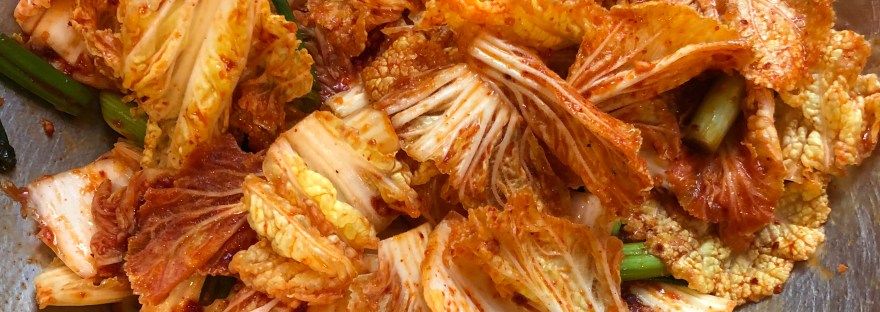
I don’t eat kimchi regularly. When I was going off to college in the US, my mom was relieved that at least I won’t starve since I did not need kimchi with every meal like most Koreans. For the better part of my adult life, I went weeks, and even years, without eating kimchi. Kimchi is now widely available in grocery stores, even ones that are not Korean. Even back then, if I wanted to purchase it, I could. However, there was something that didn’t quite sit right with me about buying mass market kimchi, like there was no soul and therefore no taste.
About ten years ago, I found out that the convenience store around the corner from our new home had homemade kimchi. I could tell that it wasn’t repackaged large grocery store kimchi because each time it tasted slightly different. I was probably one of their best customers and got to know the cashier very well, well enough to make food for each other (she would make me Thai food and I made her cookies and dduk). Then one day, with two weeks notice, the landlord terminated the lease and I had lost my kimchi hook up. The store front remained vacant for almost a year, then the pandemic hit. And suddenly, I was desperate for kimchi.
I found a convenience store owned by Koreans and tried their kimchi. It was pretty good. I ordered a quart from a restaurant. It was pretty good, too. However, fear of leaving the house and the early days of disinfecting everything that crossed the threshold of the front door meant that neither was going to be my go-to source for kimchi. This craving was an alien feeling and the need for kimchi grew each day. So finally, I decided that I will try my hands on making it myself.
The recipes seemed simple enough but I had never made it before. One of my earliest childhood memories was 김장 (gimjang: kimchi making) at my maternal grandmother’s house, involving huge red oblong tubs filled with 배추 (baechoo: napa cabbage) and 무우 (mu: Korean radish pronounced moo) and vats of red pepper powder. My mother’s family owned a farm so I assume now that most of the ingredients were planted and harvested on the farm. It was an all day event that involved a dozen people and took up most of the courtyard in the house. In Ghana, my mom and the staff made kimchi regularly for home and for the restaurant we owned. My job was always eating and never making so the recipe sounded simple but incomprehensible. I called Mom.
She was surprised and delighted at the same time. She said the easiest one to make would be 깍두기 (kkaktoogi: Korean radish kimchi) because all I needed to do was cut the mu into cubes and mix everything. The second easiest one would be 오이 깍두기 (oh-ee kkaktoogi: cucumber kimchi) because all I needed to do was cut the seedless cucumbers into cubes and mix everything. One thing I needed, though, was 젖 (jeot: fermented fish sauce) because that was what was needed to ferment the kimchi and give it its signature funk. I ordered what I could from HMart and gave it a whirl.
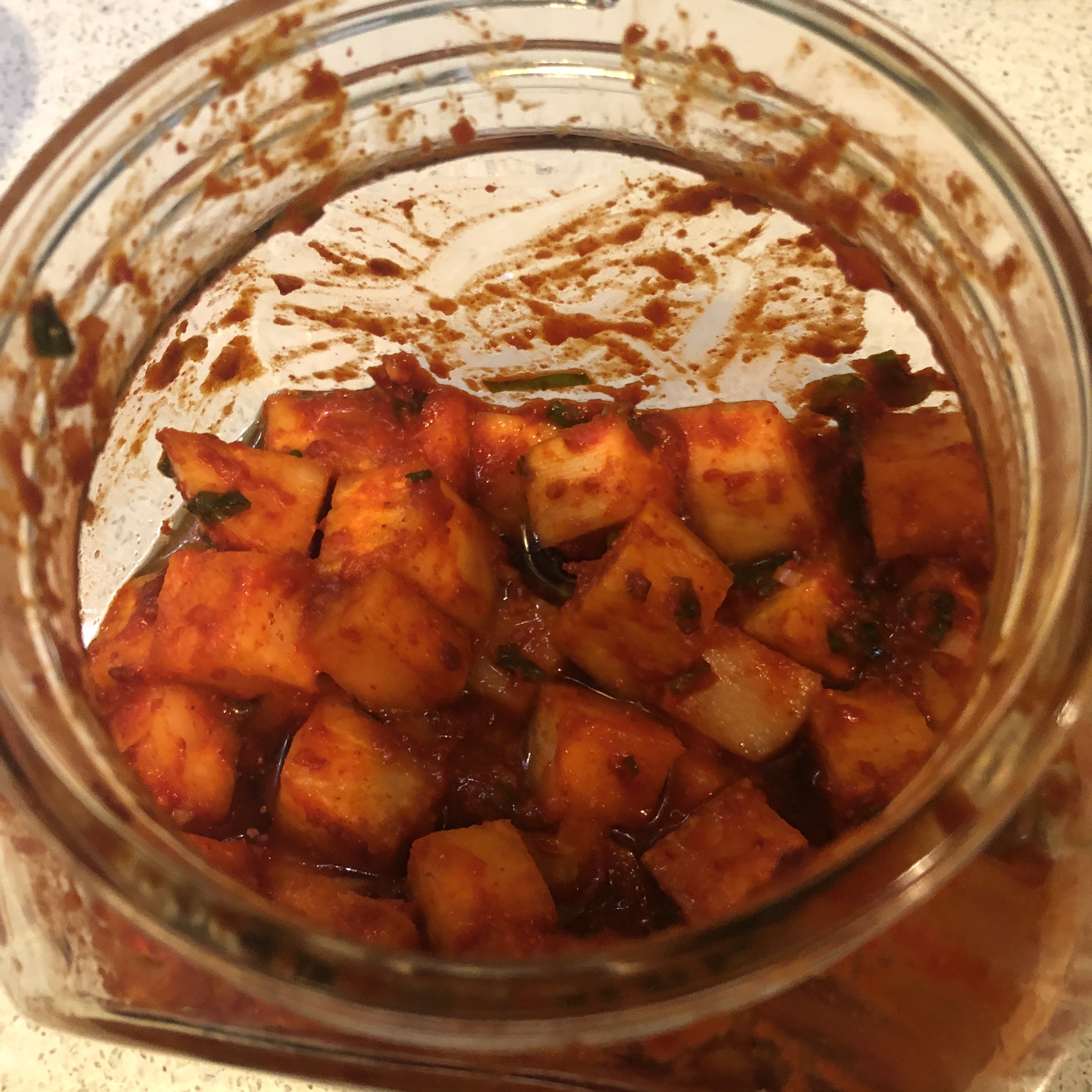
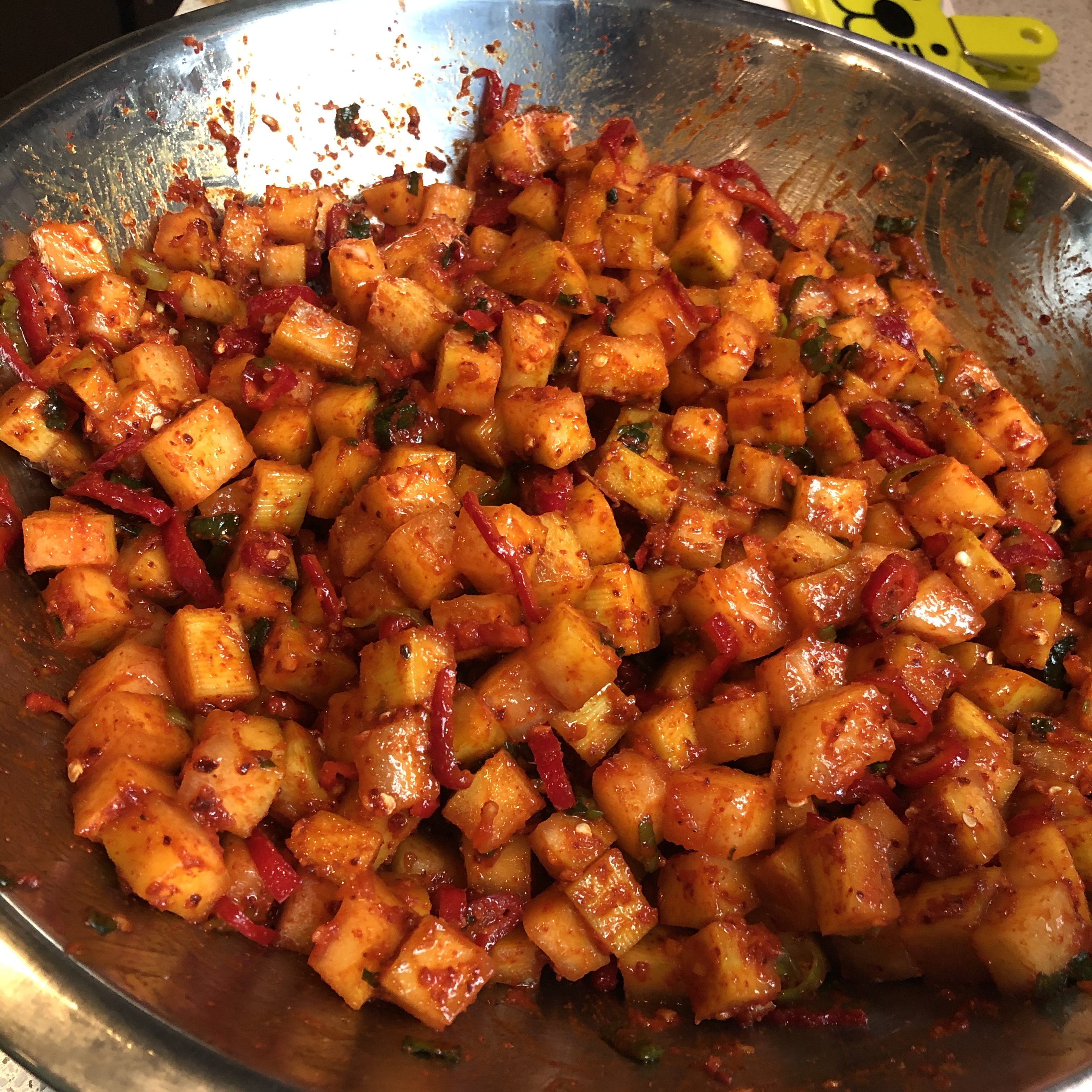
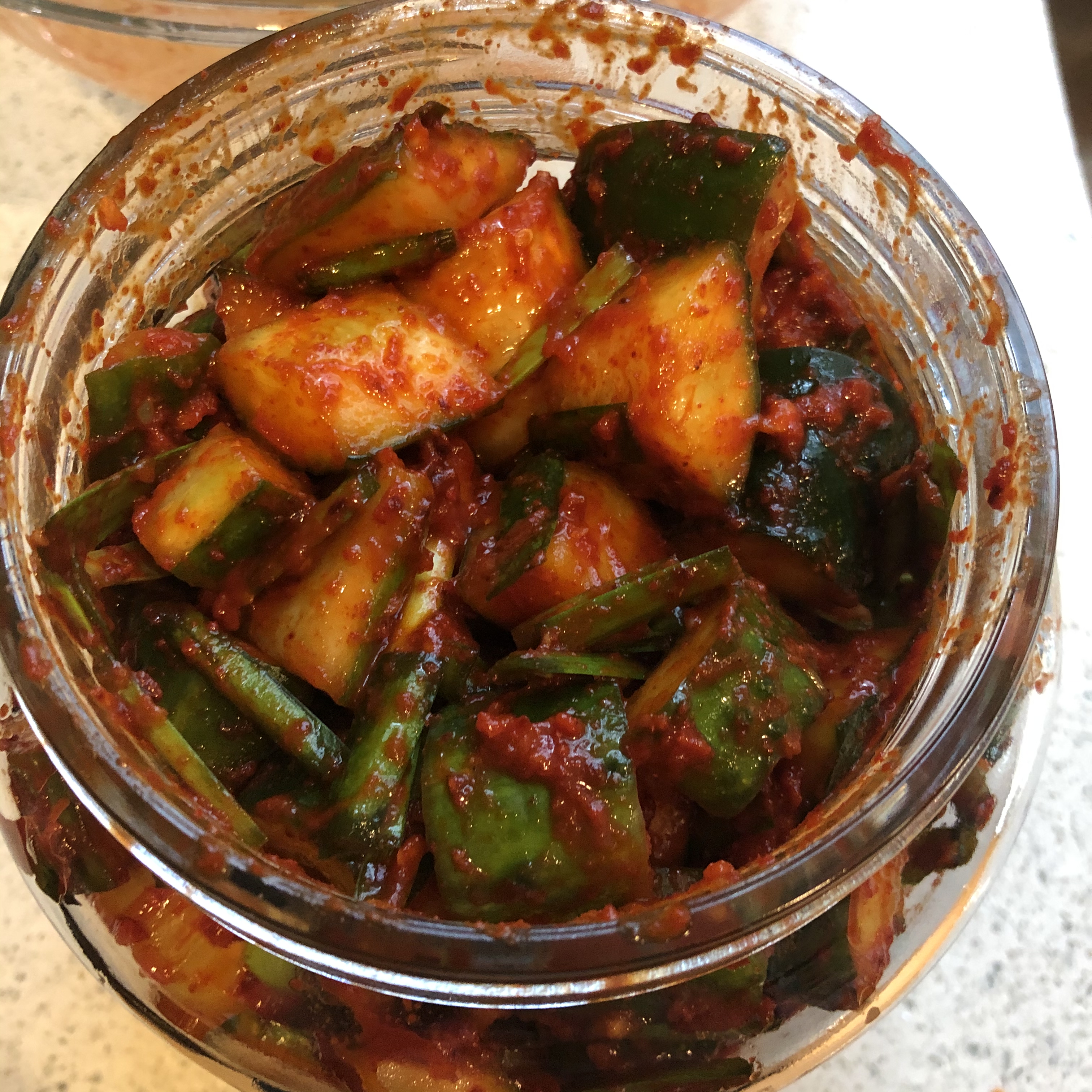
깍두기 is basically a two-step process.
깍두기 (Korean Radish Kimchi)
- 3-4 lb mu (it’s a large white radish, slightly green at the end, and really fat)
- 2 Tbsp sugar
- 2 1/2 Tbsp of coarse salt
- 8 Tbsp gochugaru (Korean pepper powder. There is no substitute for gochugaru because Korean pepper powder tastes different. This is the main flavor of kimchi and you cannot replicate with other pepper powders. I use a mix of fine and coarse grinds because I like it extra spicy about 2/3 fine and 1/3 coarse.)
- 4 Tbsp crushed garlic (must be crushed in a mortar, not chopped)
- 3-4 Tbsp Korean anchovy sauce (if substituting Thai fish sauce, add about 50% to twice as much. Fermented shrimp sauce can also work but it has to be ground into a paste or chopped superfine.)
- Peel and cut the radish into 3/4 inch cubes.
- Mix the rest of the ingredients well into a paste. Add the radish and mix until it is evenly coated.
- Put everything in a jar, close the lid, and let it sit at room temperature for about a day. Make sure there is at least an inch of space on top. It’s fermenting so it will need the space for the gas to go somewhere.
- Store in the fridge so that it ferments slowly. It will stay crisp for about a month but I have eaten it after 6 months and it’s still good!
You can add scallions or julienned carrots if you like. The cucumber 깍두기 is about the same but with 부추 (boochoo: Korean chives. These are flat chives and they have a very distinctive taste.) instead of scallions. I even made it with watermelon rinds when I read an article in Food 52 but without the fancy optional ingredients. All good!
The traditional napa cabbage kimchi is another story because it requires several steps.
- Brine the cabbage
- Make the rice paste
- Make the filling
- Put it all together
- Store it in clay jars to slow ferment over many weeks
Visions of large red rubber tubs and armies of people laboring all day came into mind and I couldn’t get started. Moreover, I didn’t have any container that could hold a whole cabbage even when cut in half. Mom laughed and she said the simplest way to make cabbage kimchi in small quantities is to start by chopping the cabbage before brining. In terms of making the filling, rather than julienning the radish, she said to cut it to about the same shape and size of the cabbage (2 inch by 2 inch squares). That way, I would not have to make the filling separately since I had nothing to “fill” which also meant that the sauce could be made in a blender and the whole thing could be mixed like 깍두기. In any case, the kimchi would have to be cut up into pieces to eat if it was made the traditional way, an unnecessary inconvenience later on. Suddenly, it wasn’t as daunting and I have since made it a few times.
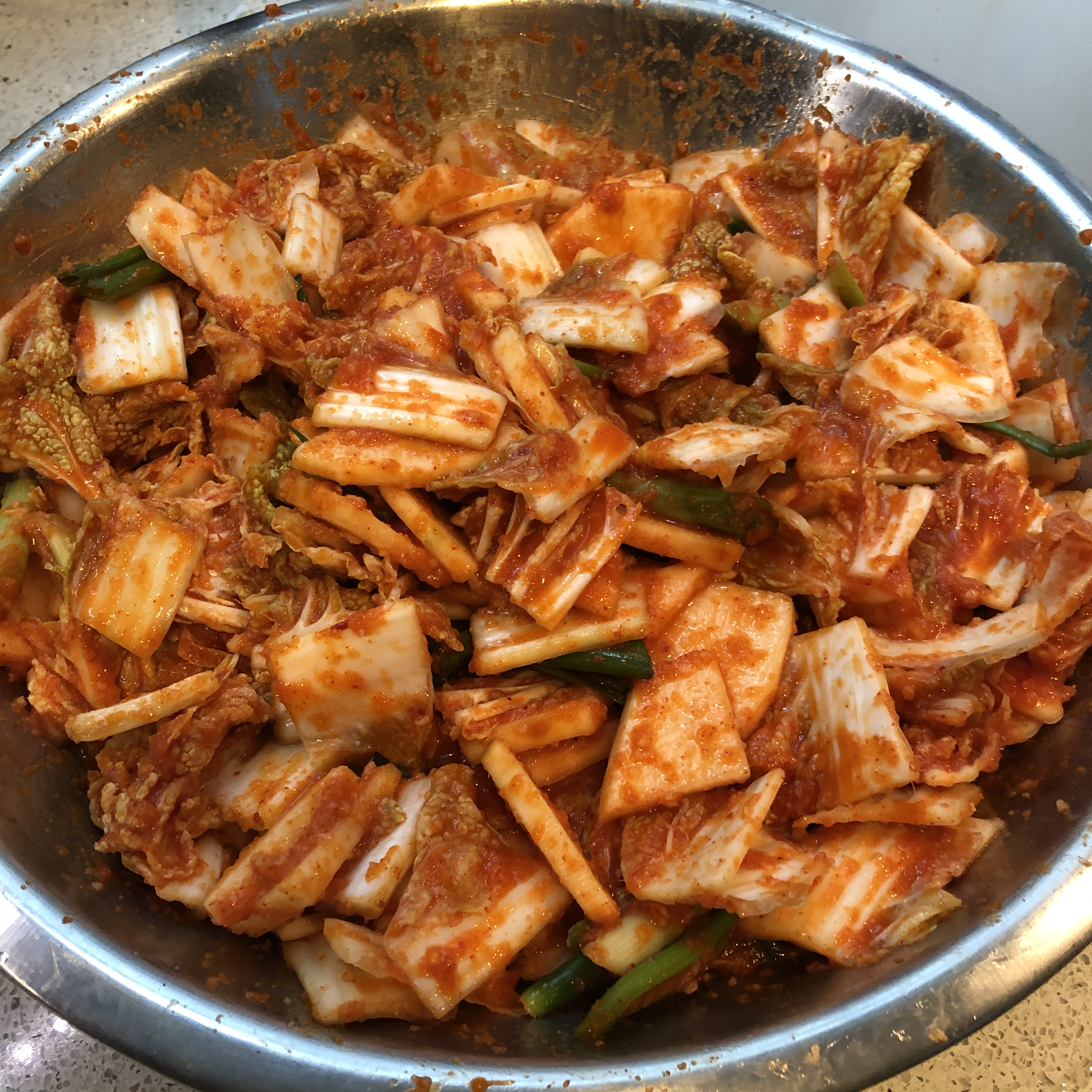
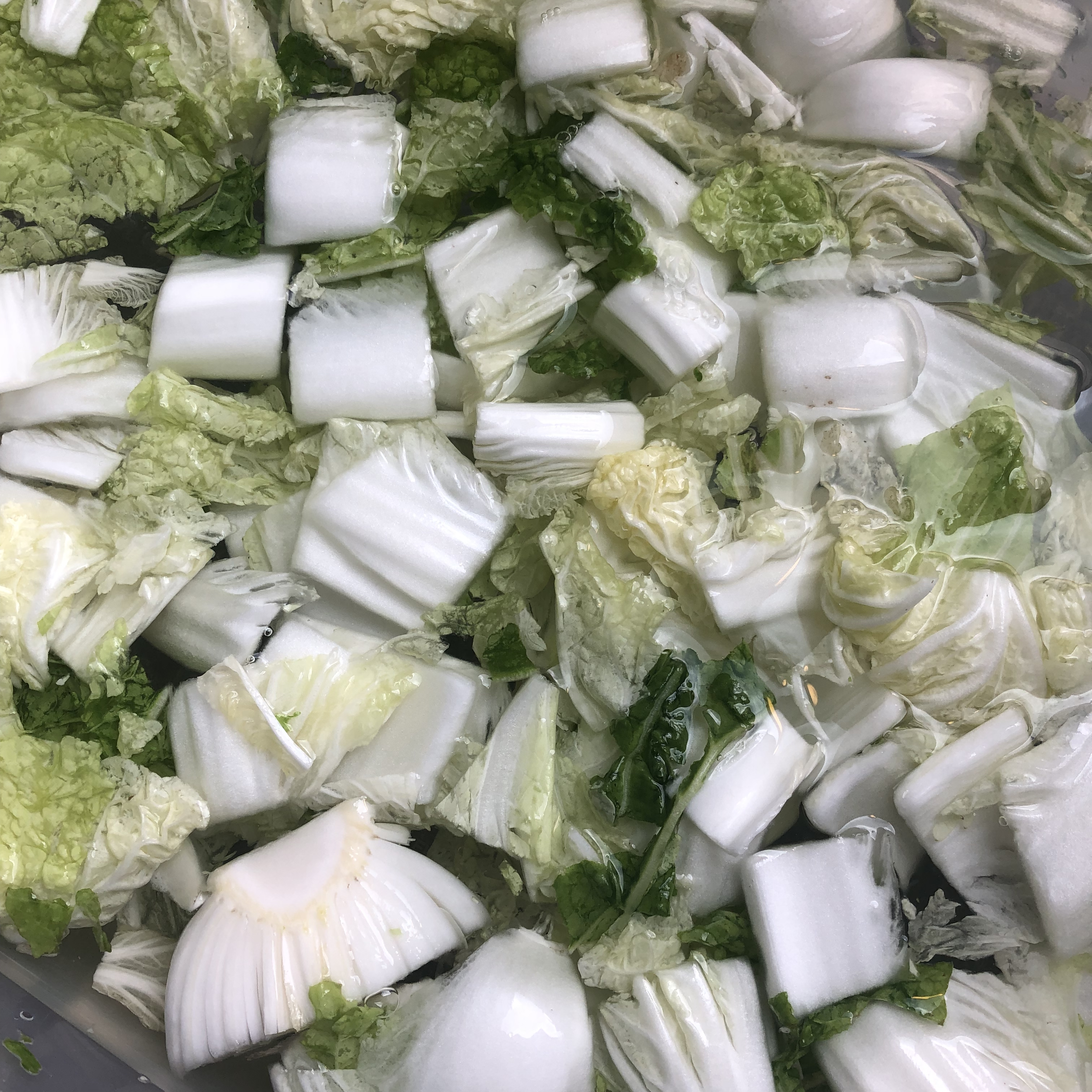
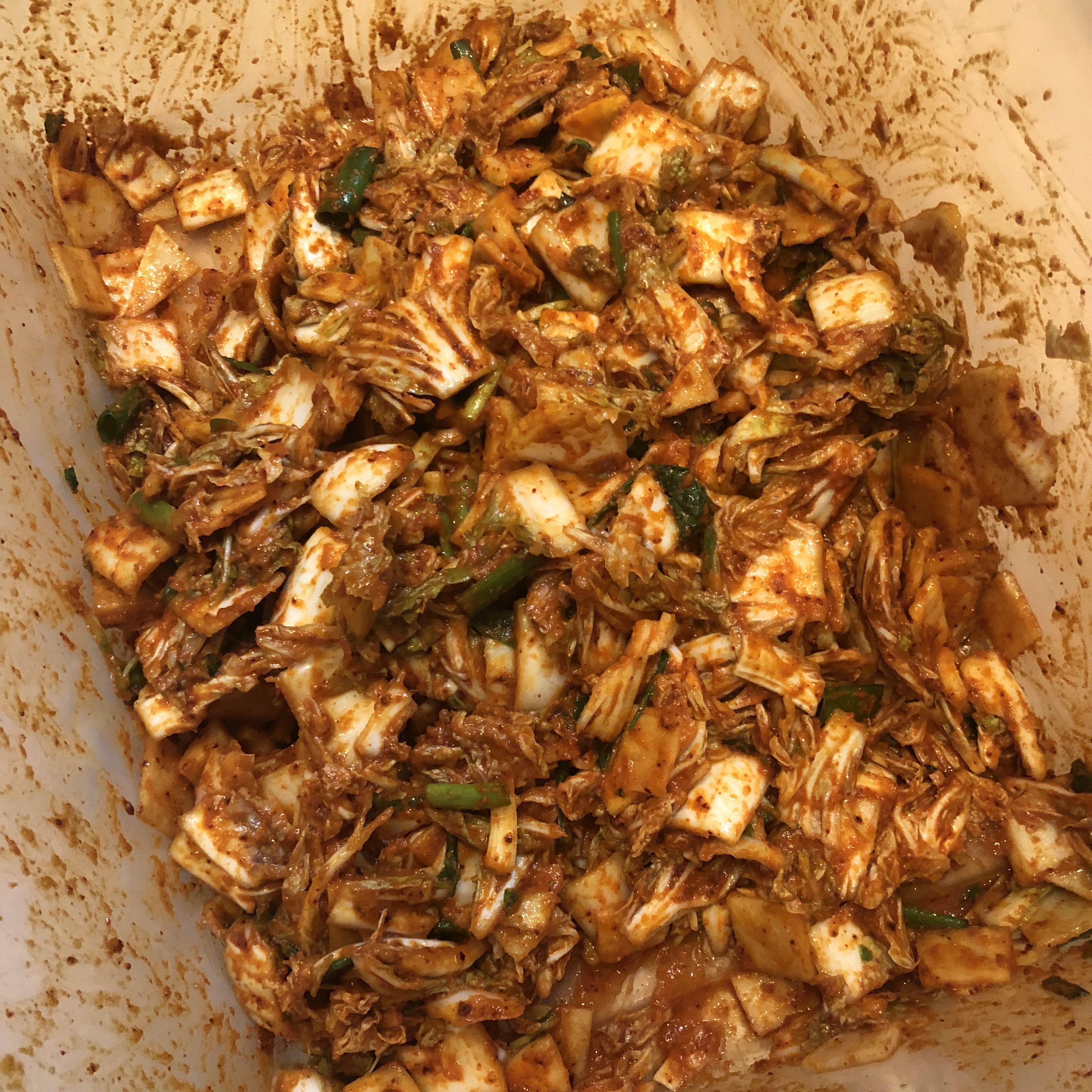
Mom’s Napa Cabbage Kimchi
- 2 napa cabbages (about 10 lbs)
- 1 cup kosher salt
- 15 cups lukewarm water
Cut the cabbage into 2 inch by 2 inch squares (rough chop okay but not small). Mix salt and water and brine the cabbage for about an hour.
- 1 lb Korean radish
- 10 scallions
- 1 cup gochugaru
- 5-6 Tbsp salt
Drain the brined cabbage well (for about 30 minutes in a colander). Slice the radish into about the same thickness and shape of the cabbage. Cut the green part of the scallions to about 1 inch length. Split the white parts and also cut into about 1 inch length. Put everything in a large mixing bowl and mix in gochugaru and salt.
- 1/4 cup anchovy sauce
- 1/2 lb Korean radish
- 1/4 large onion
- 1 Korean pear, peeled and cored (this makes it extra special but you can substitute with about 1/4 cup of sugar)
- 10-12 cloves of garlic
- 1 thumb ginger
- 1/2 cup cooked white rice
- 8 Tbsp Korean pepper powder
- 5 Tbsp shrimp sauce (3 Tbsp shrimp and 2 Tbsp juice)
- 3/4 cup water
Put all ingredients in a blender and blend until smooth. Pour over the cabbage/radish mixture and mix well. Add 1 cup of water in the blender to wash out any remaining sauce and add to the mix. Put in large containers and let it sit out for a day or so at room temperature. Store in fridge. Eat until whenever.
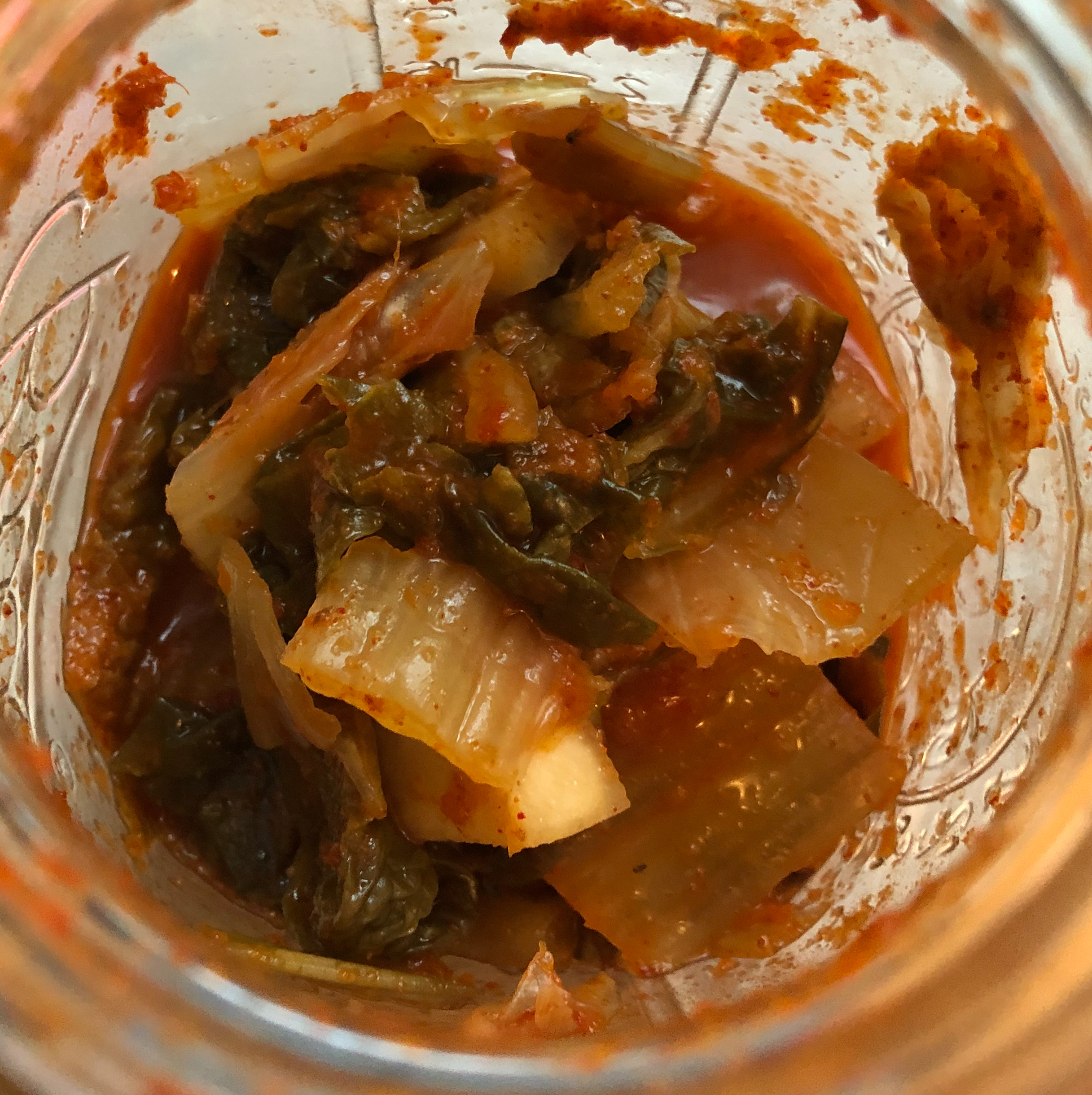
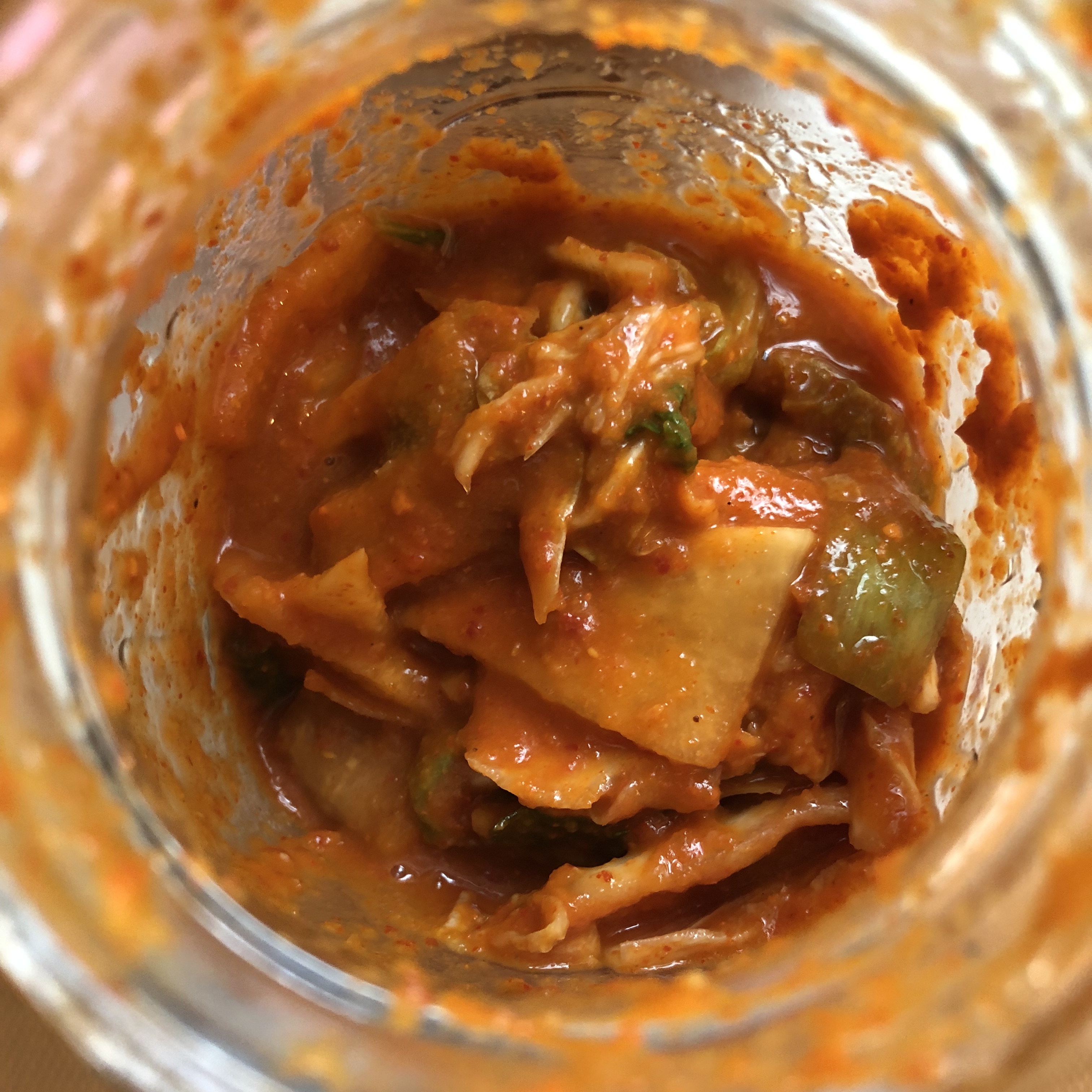
The image on the left is one that has been fermenting for about a year. The image on the right is one that has been fermenting for 3 days. They are both good although different. I prefer the really aged stuff myself because the ingredients have been marinating in its own juices and has become extra pungent and sour. The cabbage is still crunchy even after a year.
I don’t think I will ever buy kimchi in the store again, especially since I found out that my CSA, Root Mass Farm, grows napa cabbage, scallions, and garlic. In the care package my Mom sends me a few times a year, she usually includes a pound or two of the good gochugaru, grown by one of her brothers who still farms, dried and milled, and shared with immediate family only.
Making kimchi used to be a community affair when people still lived close to home and Korea had more farmland than cities. The kimchi would be shared with family and friends and lasted throughout the year. Around June of 2020 would have been the time I would have seen my parents, albeit briefly, as I returned from my annual work trip to Asia. My mom would spend days planning out home cooked meals for me: 반찬 (banchan: side dishes) made with plants foraged in season during hikes with my dad, blanched and frozen; fried mackerel and stir fried dried anchovies; whatever my parents wanted to eat that week (spicy salmon head stew was on the menu June 2019); and, of course, kimchi. Nothing reminds me of home like kimchi, a staple of my childhood, the very “Korean” thing we did in eating it with every meal. I believe my craving of kimchi was my own way of reclaiming the loss of community, forced upon us by the pandemic as we distanced ourselves from each other physically. I read somewhere that in times of uncertainty you seek food from your childhood. I made a lot of kimchi during the pandemic.
 What will Dr. Gwak say?