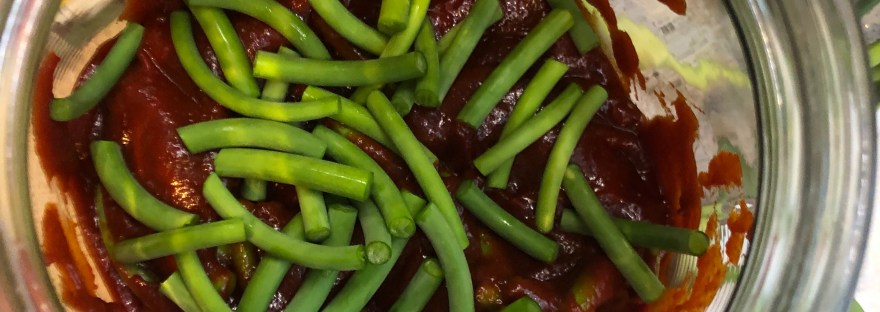
One of the joys (and sometimes frustrations) of joining a CSA (Community Supported Agriculture) is that you get whatever is in season. Around late spring of 2020, I joined the Savoie Organic Farm CSA. When I used to shop regularly at the Headhouse Farmers Market, I shopped with them mostly to get pepper seedlings (I still have fond memories of purchasing Trinidad Scorpion seedlings from them several years ago). Late May, I started getting boatloads of garlic scapes. Garlic scapes are the stalks that grow from the bulbs of garlic plants. I love them but I could not use them quickly enough in stir fries and they started to accumulate in the fridge.
Then I remembered that one of my favorite 반찬 (banchan or side dishes) was 마늘장아찌 (pickled garlic scapes) but not the kind that is served in most restaurants that are cooked in soy sauce but ones that were peppery and chewy and crunchy at the same time. I did a few google searches and none of them were what I remembered.
So I called Mom.
She, too, started with the soy sauce version:
- Sterilize jars and fill with scapes.
- Combine 2 cups sugar, 2 cups vinegar, 2 cups soy sauce, and 1 cup water and bring to a boil.
- Pour hot liquid over the scapes.
- Let cool completely and store it in the fridge for 3-5 days.
- Once ripened, fish out the scapes, add 1 Tbsp gochujang, 1 tsp sesame seeds, 1 tsp simple syrup, 1 tsp sesame oil, and mix.
I said that was not what I remembered. She paused for a second, then asked, “How much gochujang do you have?” I happened to have a lot. Then came the simplest instructions ever: “Cut the scapes to about 3cm and bury it in the gochujang and let it sit for a few weeks. You can fish out what you want to eat, add sesame oil, sesame seed, and rice wine vinegar, and that’s it. You can use the garlicky gochujang for making banchan or soup.” (Turns out that the pickle I was looking for is 마늘쫑 and not 마늘장아찌).
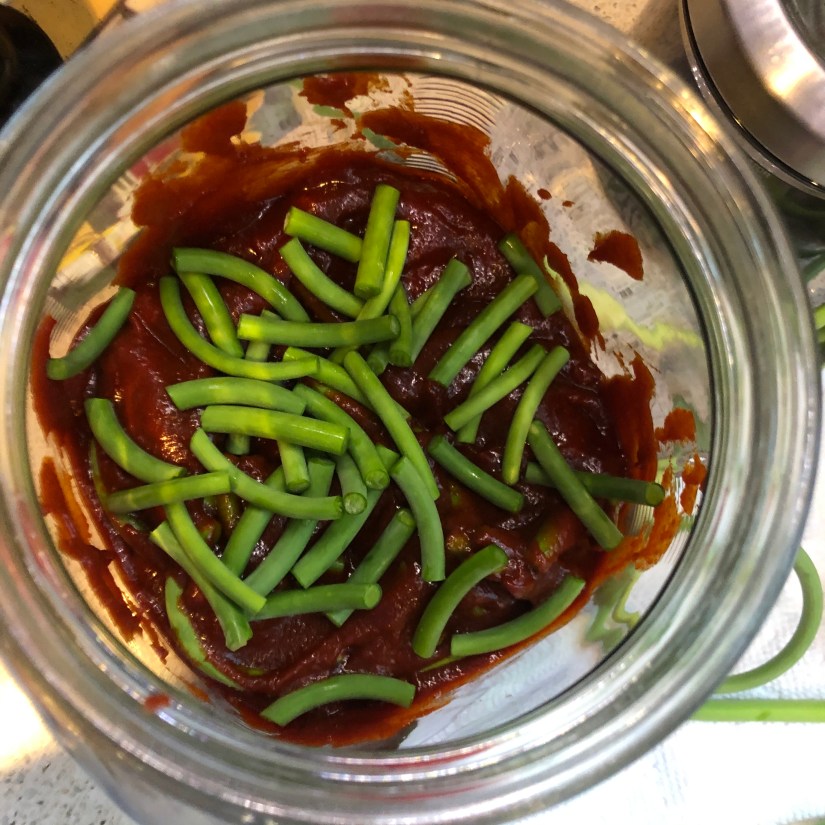
“This is your 외할머니’s (maternal grandmother, so my mom’s mom) method. She knew I liked this so every spring she would bury the garlic scapes in the gochujang 장독 (jang dok, earthenware pot that is specially made for fermenting sauces) so that they would be ready when we came to visit in the summer.”
Her voice broke a little.
Out of her four sons and four daughters, my mom was closest to my grandmother. She also lived furthest away, in Ghana. Back in the 80’s the journey from Ghana to Korea was Accra-Lagos-Amsterdam-Anchorage-Tokyo-Seoul and the reverse to get back so it took several days to travel back and forth. We tried to go to Korea every summer if possible. In the time of snail mail and $2 per minute phone calls, keeping in touch with family half way around the globe was not easy. This was my grandmother’s way of thinking of her daughter and waiting for her to come home.
My grandmother passed away very suddenly while my mother was in Ghana and it devastated her. She still tears up when she speaks of her. This is the first recipe that has been handed down from my grandmother to my mother to me.
 What will Dr. Gwak say?