Cooking

빈대떡엔 막걸리 (Mung bean pancake and Makgeolli)

When I was sixteen, I swore never to go back to Korea. Until then, Korea was where my brother and I spent most of our summer holidays, sometimes with both our parents, sometimes with just one parent, sometimes by ourselves. It was expected that we took the almost three day trek across the globe to see extended family. Back in the 80’s, in the height of the Cold War, the multileg journey went something like this: Accra-Lagos-Amsterdam-Anchorage-Tokyo-Seoul and then the reverse on the way back. As an angry and sensitive teenager, I hated my cousins who made me speak English even when I spoke Korean perfectly well, like I was a circus monkey. I hated that their friends would treat me like any other Korean kid until they found out I lived in Ghana and then spent the rest of the time making racist and ignorant jokes about Africans. I hated the rules and expectations that I had to follow as a girl that my younger brother could ignore. So at sixteen, I stopped spending my summers in Korea and stayed home in Ghana, mostly reading.

For this reason, I never truly learned to eat and drink in Korea. One thing I knew was that drinking with food was socializing and drinking without food was just one step away from alcoholism. As an adult, I learned a little from my brother who went to university in Seoul and then stayed to work. He knew where all the 맛집 (matjib: literally translates as “tasty house” or places known to have the best food, usually in one category) was and with him as a guide, I ate and drank well.

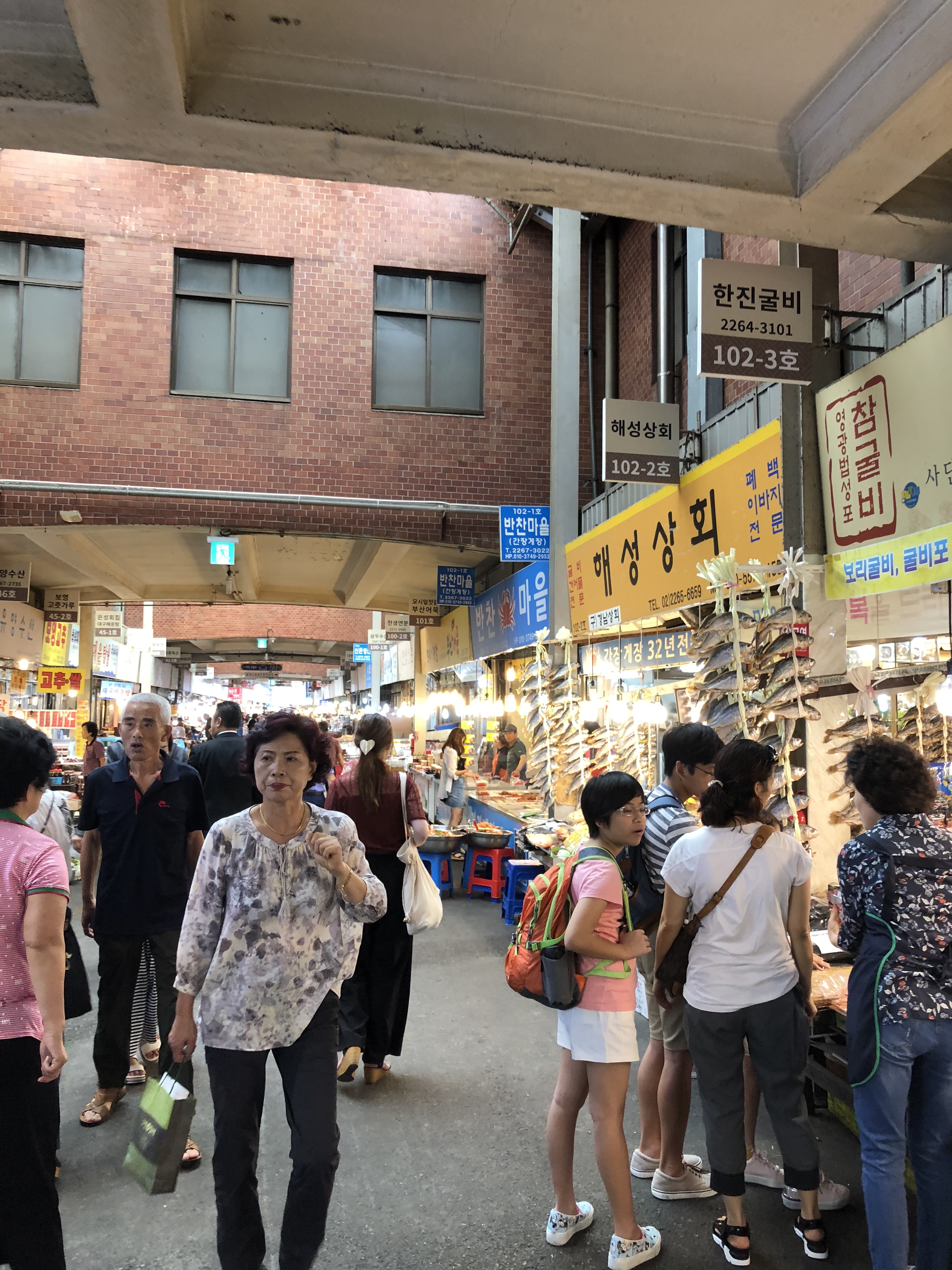
Many years later, I started traveling to Seoul for work about once a year and began to explore places on my own. One stop in the summer of 2018 was Gwangjang Sijang.
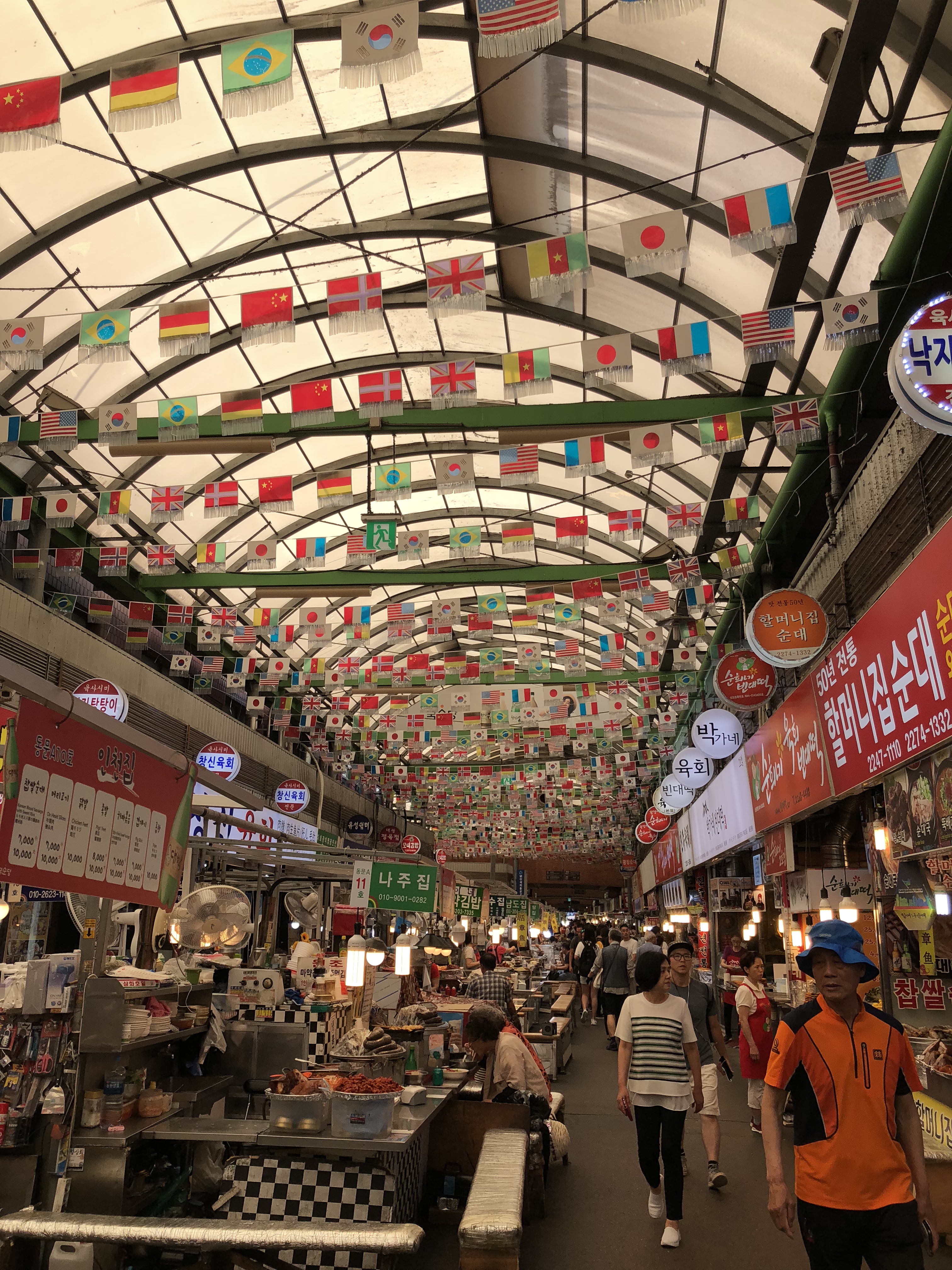
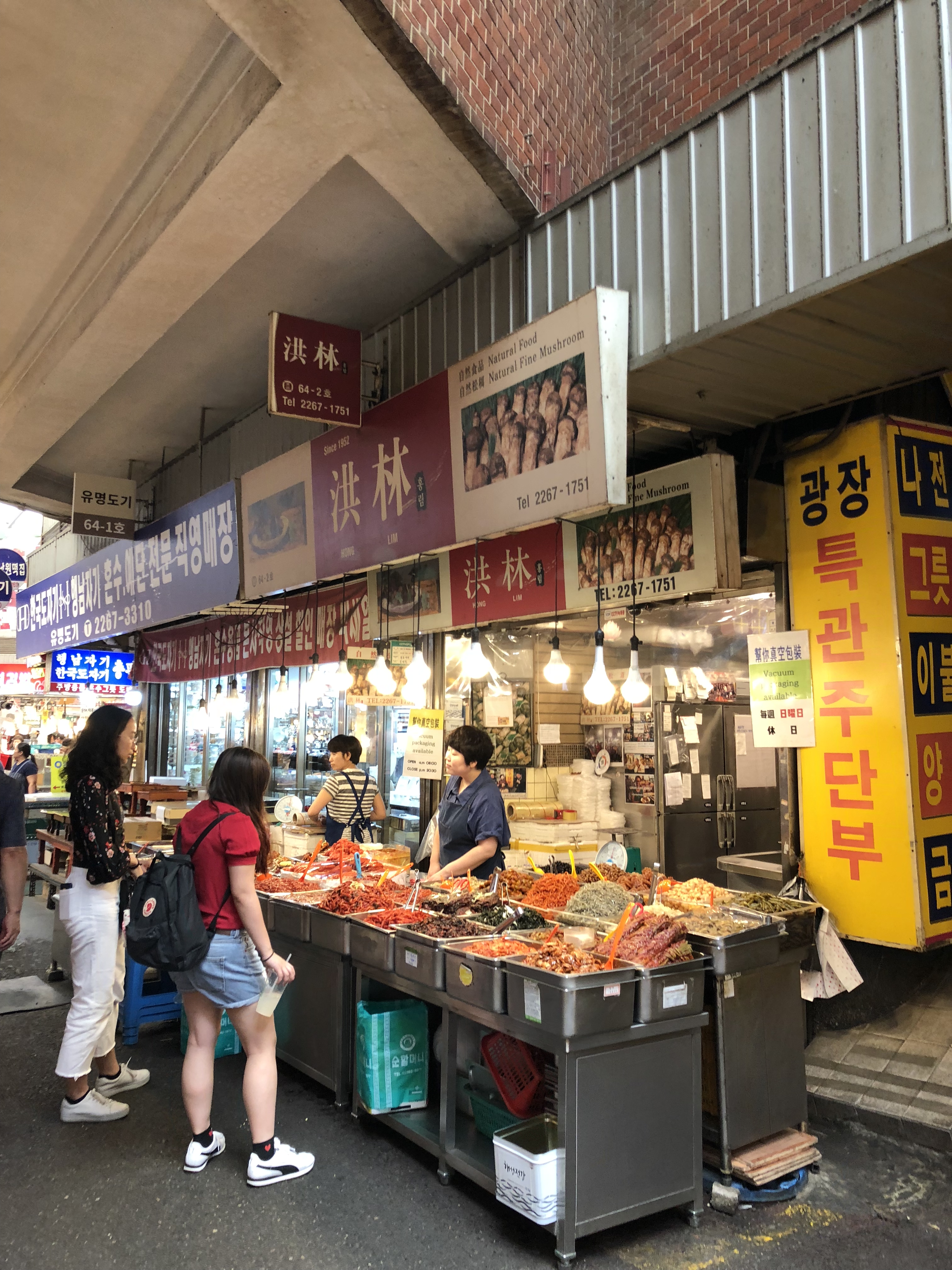
On our first trip to Korea, the Dude and I stayed in a place close to Gwangjang Sijang but we were too overwhelmed and full from a recent meal to enjoy the abundant street food. I could not forget the aromas literally steaming up from the hot griddles and cauldrons so the first chance I got, I sought out a 빈대떡 (bindaedduk: mung bean pancakes) stand. Bindaedduk is one of my favorite foods, only made occasionally due to the lack of ingredients in Ghana but a common street food in Korea.

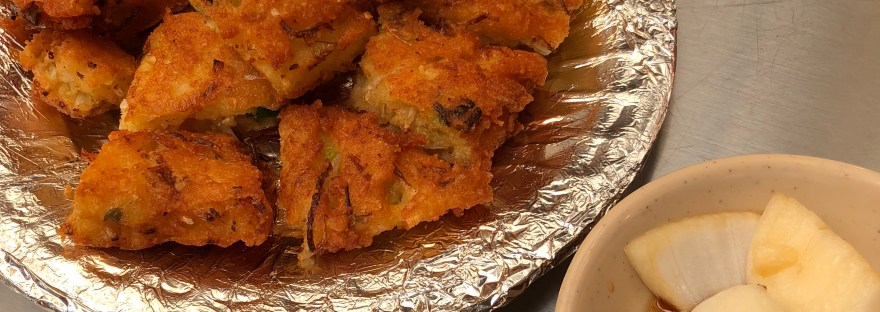
Located in A-60, it is an outpost of 순희네 (Soonhee-nae: Soonhee’s House), the most well known bindaedduk eatery in the Market. There was a bench that seated about three people next to a griddle and a mechanized 맷돌 (metdol: millstone) grinding soaked mung beans into a large vat. It was lunchtime but I lucked out and snagged a seat next to a young woman who was eating by herself. I asked for bindaedduk and said how excited I was to have it since I have been dreaming about it for years (the truth!). I started chatting with the lady in front of the sizzling griddle with the pancakes spitting and crisping up to a golden brown. As she put a styrofoam plate covered in foil in front of me with the bindaedduk cut into small pieces and a side of sauce, she said “빈대떡엔 막걸리가 딱인데 (For eating bindaedduk, makgeolli is the best accompaniment).” So I ordered a bottle. Mass market makgeolli does not come in bottles smaller than 750ml and even if it’s about 6% ABV or less, it’s a lot of day drinking, but what the hell!
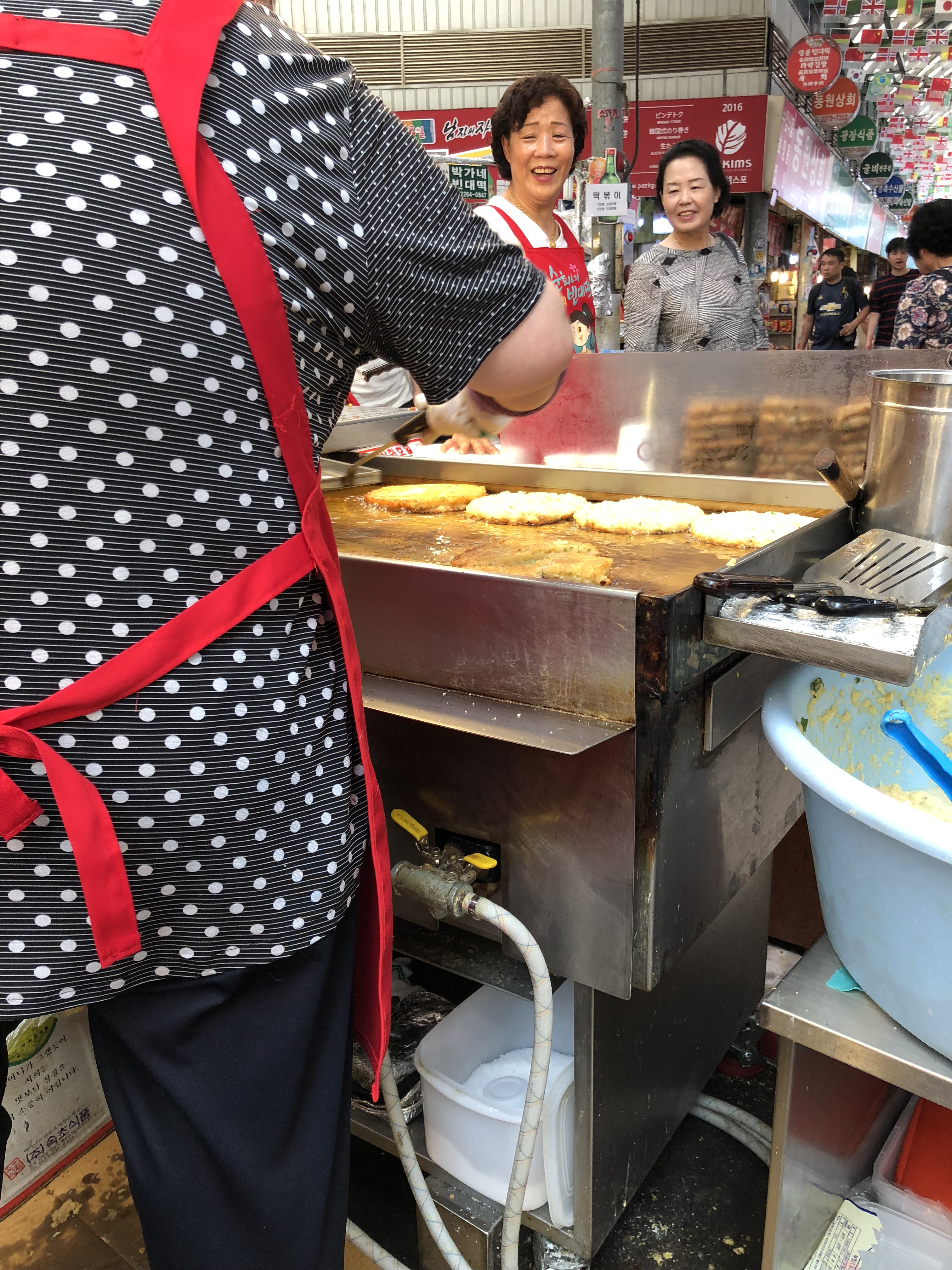
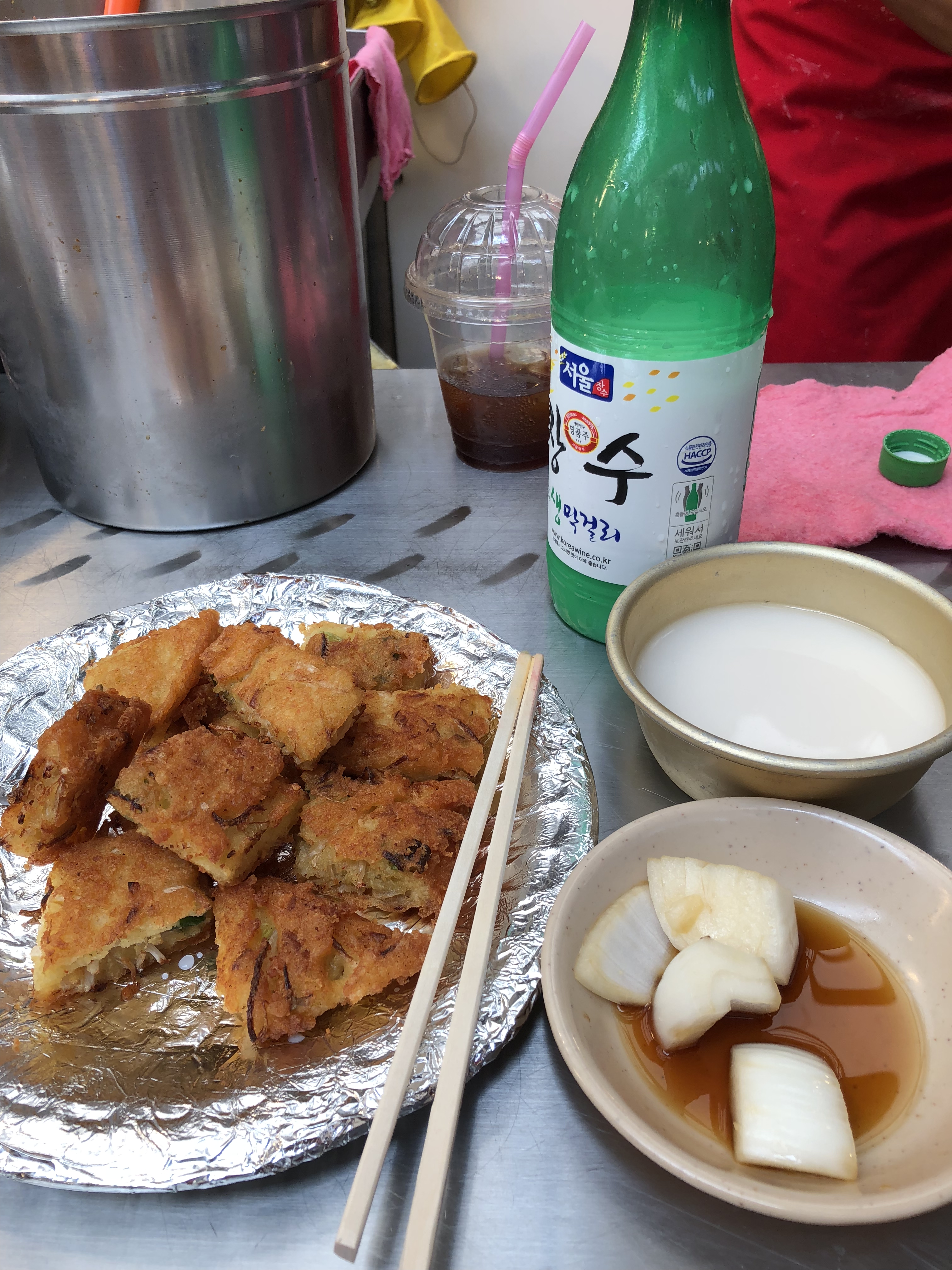
She also gave me some 완자전 (wanjajeon: meat pancakes) to try. A perfect bindaedduk is crispy on the outside and creamy on the inside, salty, savory, and filled with stuff. I turned to the young woman and asked in Korean if she would like some makgeolli. She replied in English that she was Japanese, and upon a repeat offer in English, she accepted. After she was done, she smiled and thanked me and left. My next neighbor was a pilot who was trying to purchase a bag of batter to take with him back home to Canada. I translated his request to the 이모 (eemo: auntie, strictly speaking, mother’s sister) and translated her instructions on how to fry it up to him. It was a glorious lunch, chattering with strangers and filling my belly. The bindaedduk-makgeolli combo, while classic, was one that I had never had before and I had a strange coming-of-age feeling. I promised to return. At the time, I didn’t realize how soon that would be.

About fifteen minutes later, as I neared Kyungbokgoong, it suddenly dawned on me that I had not paid for my meal! I hurried back, red from walking fast in the heat, completely embarrassed. I sheepishly apologized and asked how much I owed her. She looked at me with a wry smile and said, “그냥 가지 (you should have just gone).” Her assistant chuckled and said she was trying to treat me to lunch. She accepted the money but then gave me a large bag filled with bindaedduk and wanjajeon. I teared up a little.

During the pandemic, I made bindaedduk a few times but it was never like the one in Gwangjang Sijang. For one thing, it takes griddle mastery to get the oil temperature correct. Plus, Soonhee-nae probably has a secret recipe to have just the right consistency. Nevertheless, here is my recipe.

빈대떡 (Bindaedduk)

  • 1 cups split mung beans (The yellow beans look like tiny yellow split peas. You can also use whole mung beans and gently rub of the skin after soaking.)
  • 1 cup water
  • 4 Tbsp glutinous rice flour (Alternatively, you can soak 1/4 cup glutinous rice with the mung beans.)
  • 1/2 cup napa kimchi, chopped
  • 1 scallion, chopped
  • 1/2-1 cup various other stuff like bean sprouts, ground meat, leftover banchan, etc.
  • 1 Tbsp sesame oil
  • Salt, pepper, sesame seeds to taste
  1. Soak the mung beans for about 6 hours and drain well.
  2. In a food processor, grind the soaked mung beans and water but not too finely.
  3. Add glutinous rice flour and mix.
  4. Add the rest of the ingredients and mix into a thick batter.
  5. Let it rest for about 20 minutes.
  6. Heat oil gently in low heat in the griddle or cast iron pan or frying pan.
  7. Add the batter in small scoops, about 1/3-1/2 cup (do not crowd the pan).
  8. Flip over when golden brown and fry until cooked through and golden brown on both sides.

You can keep the batter in the fridge for a day or two.

I have not been able to replicate this experience for years because finding makgeolli in Philadelphia is almost impossible unless you go to an HMart with a liquor license (too far for me without a car) or special order it through the PLCB. Recently, I discovered Hana Makgeolli, an artisanal makgeolli brewery in Brooklyn that would ship!
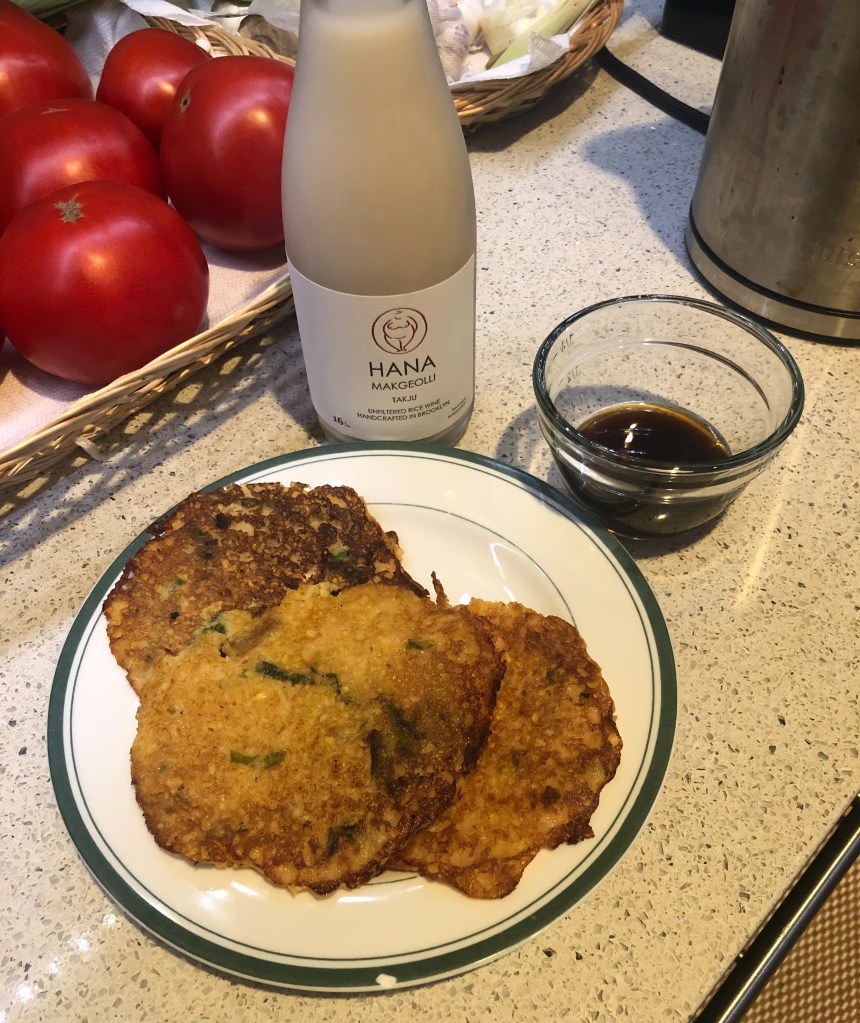
I burnt this batch a bit, and it is tasty but not even close to stand A-60 in Gwangjang Sijang. As I wait for the day I can travel back to Korea for the full experience, this will have to do.
canning

Longing for Kimchi

I don’t eat kimchi regularly. When I was going off to college in the US, my mom was relieved that at least I won’t starve since I did not need kimchi with every meal like most Koreans. For the better part of my adult life, I went weeks, and even years, without eating kimchi. Kimchi is now widely available in grocery stores, even ones that are not Korean. Even back then, if I wanted to purchase it, I could. However, there was something that didn’t quite sit right with me about buying mass market kimchi, like there was no soul and therefore no taste.

About ten years ago, I found out that the convenience store around the corner from our new home had homemade kimchi. I could tell that it wasn’t repackaged large grocery store kimchi because each time it tasted slightly different. I was probably one of their best customers and got to know the cashier very well, well enough to make food for each other (she would make me Thai food and I made her cookies and dduk). Then one day, with two weeks notice, the landlord terminated the lease and I had lost my kimchi hook up. The store front remained vacant for almost a year, then the pandemic hit. And suddenly, I was desperate for kimchi.

I found a convenience store owned by Koreans and tried their kimchi. It was pretty good. I ordered a quart from a restaurant. It was pretty good, too. However, fear of leaving the house and the early days of disinfecting everything that crossed the threshold of the front door meant that neither was going to be my go-to source for kimchi. This craving was an alien feeling and the need for kimchi grew each day. So finally, I decided that I will try my hands on making it myself.

The recipes seemed simple enough but I had never made it before. One of my earliest childhood memories was 김장 (gimjang: kimchi making) at my maternal grandmother’s house, involving huge red oblong tubs filled with 배추 (baechoo: napa cabbage) and 무우 (mu: Korean radish pronounced moo) and vats of red pepper powder. My mother’s family owned a farm so I assume now that most of the ingredients were planted and harvested on the farm. It was an all day event that involved a dozen people and took up most of the courtyard in the house. In Ghana, my mom and the staff made kimchi regularly for home and for the restaurant we owned. My job was always eating and never making so the recipe sounded simple but incomprehensible. I called Mom.

She was surprised and delighted at the same time. She said the easiest one to make would be 깍두기 (kkaktoogi: Korean radish kimchi) because all I needed to do was cut the mu into cubes and mix everything. The second easiest one would be 오이 깍두기 (oh-ee kkaktoogi: cucumber kimchi) because all I needed to do was cut the seedless cucumbers into cubes and mix everything. One thing I needed, though, was 젖 (jeot: fermented fish sauce) because that was what was needed to ferment the kimchi and give it its signature funk. I ordered what I could from HMart and gave it a whirl.

깍두기 is basically a two-step process.

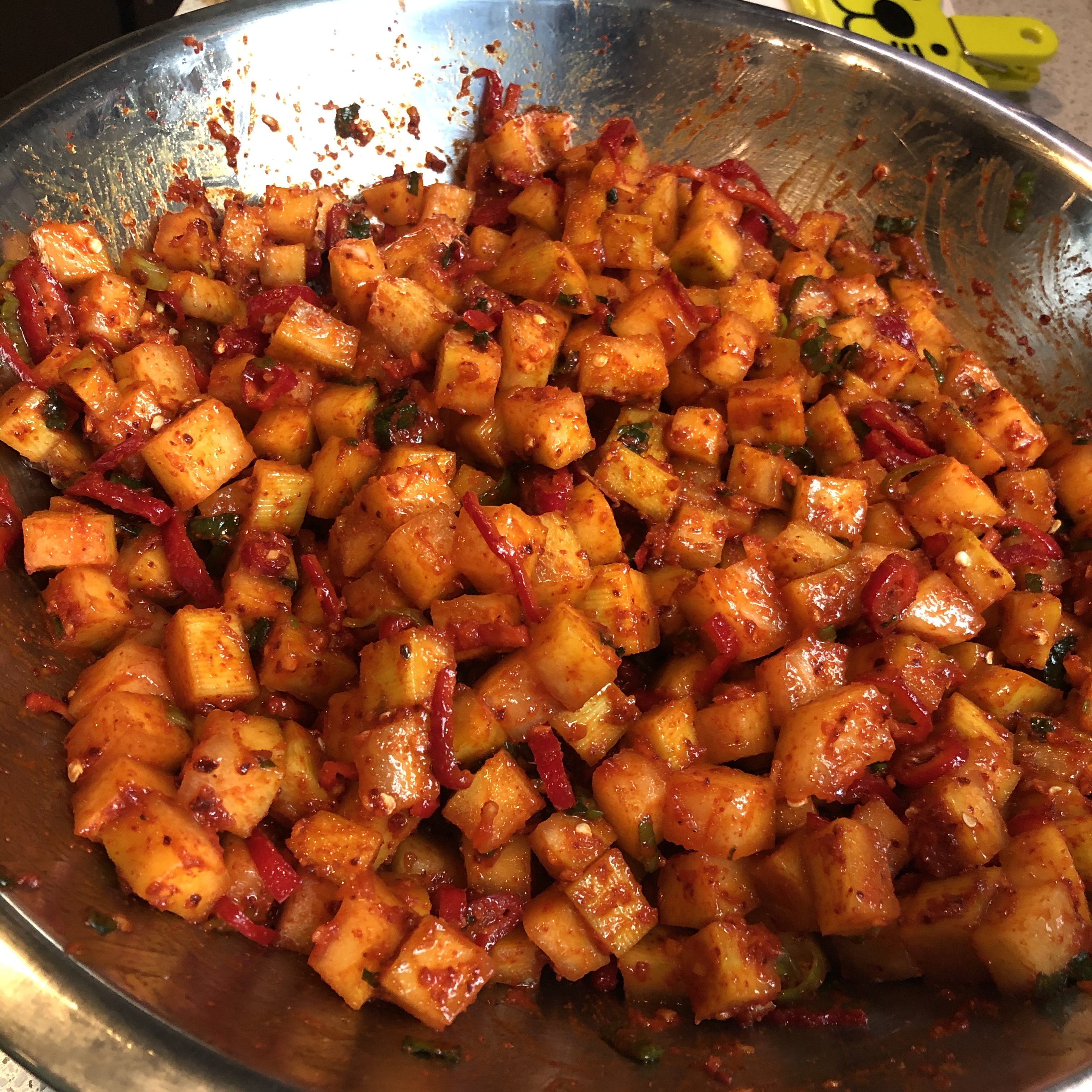
깍두기 (Korean Radish Kimchi)

  • 3-4 lb mu (it’s a large white radish, slightly green at the end, and really fat)
  • 2 Tbsp sugar
  • 2 1/2 Tbsp of coarse salt
  • 8 Tbsp gochugaru (Korean pepper powder. There is no substitute for gochugaru because Korean pepper powder tastes different. This is the main flavor of kimchi and you cannot replicate with other pepper powders. I use a mix of fine and coarse grinds because I like it extra spicy about 2/3 fine and 1/3 coarse.)
  • 4 Tbsp crushed garlic (must be crushed in a mortar, not chopped)
  • 3-4 Tbsp Korean anchovy sauce (if substituting Thai fish sauce, add about 50% to twice as much. Fermented shrimp sauce can also work but it has to be ground into a paste or chopped superfine.)
  1. Peel and cut the radish into 3/4 inch cubes.
  2. Mix the rest of the ingredients well into a paste. Add the radish and mix until it is evenly coated.
  3. Put everything in a jar, close the lid, and let it sit at room temperature for about a day. Make sure there is at least an inch of space on top. It’s fermenting so it will need the space for the gas to go somewhere.
  4. Store in the fridge so that it ferments slowly. It will stay crisp for about a month but I have eaten it after 6 months and it’s still good!

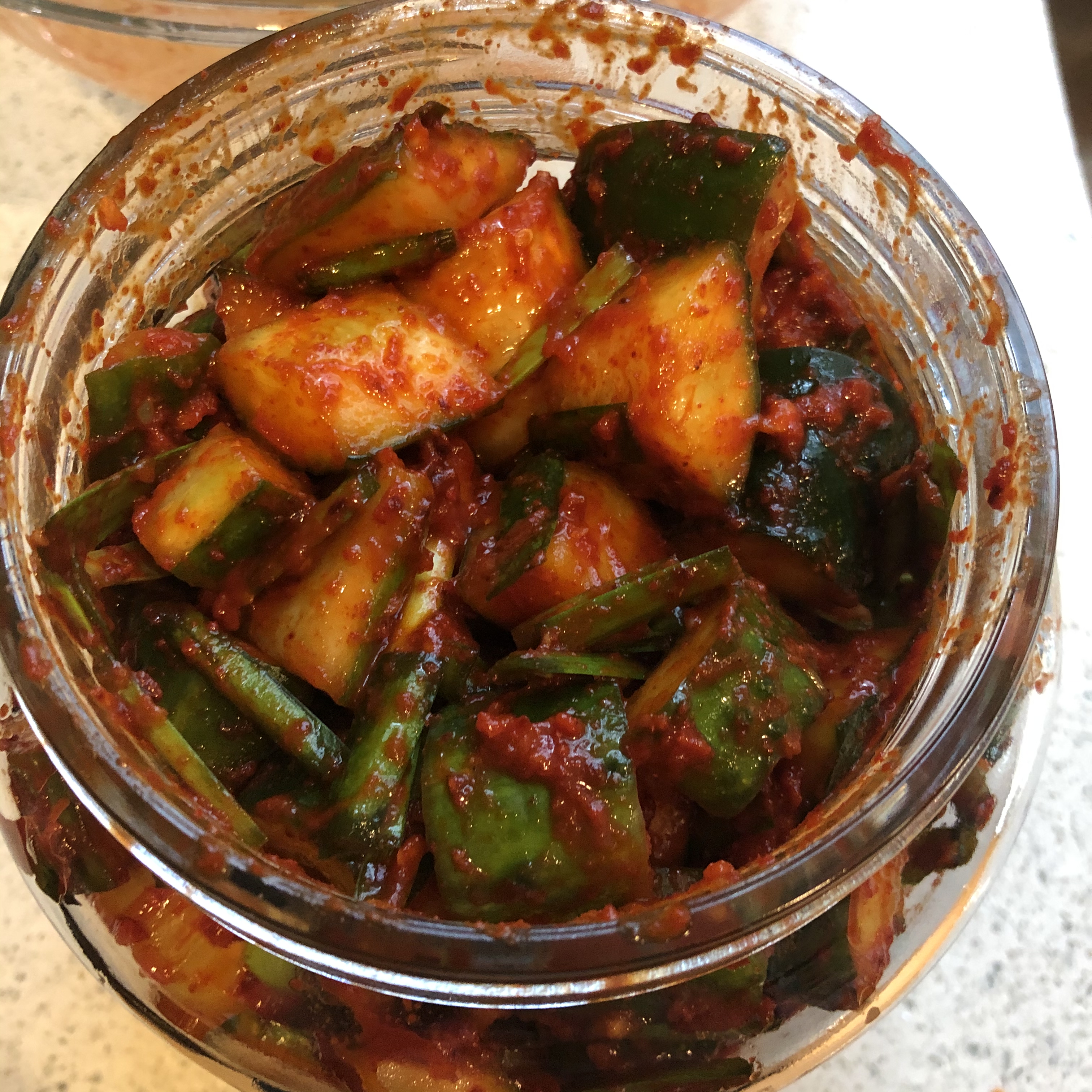
You can add scallions or julienned carrots if you like. The cucumber 깍두기 is about the same but with 부추 (boochoo: Korean chives. These are flat chives and they have a very distinctive taste.) instead of scallions. I even made it with watermelon rinds when I read an article in Food 52 but without the fancy optional ingredients. All good!

The traditional napa cabbage kimchi is another story because it requires several steps.

  • Brine the cabbage
  • Make the rice paste
  • Make the filling
  • Put it all together
  • Store it in clay jars to slow ferment over many weeks

Visions of large red rubber tubs and armies of people laboring all day came into mind and I couldn’t get started. Moreover, I didn’t have any container that could hold a whole cabbage even when cut in half. Mom laughed and she said the simplest way to make cabbage kimchi in small quantities is to start by chopping the cabbage before brining. In terms of making the filling, rather than julienning the radish, she said to cut it to about the same shape and size of the cabbage (2 inch by 2 inch squares). That way, I would not have to make the filling separately since I had nothing to “fill” which also meant that the sauce could be made in a blender and the whole thing could be mixed like 깍두기. In any case, the kimchi would have to be cut up into pieces to eat if it was made the traditional way, an unnecessary inconvenience later on. Suddenly, it wasn’t as daunting and I have since made it a few times.

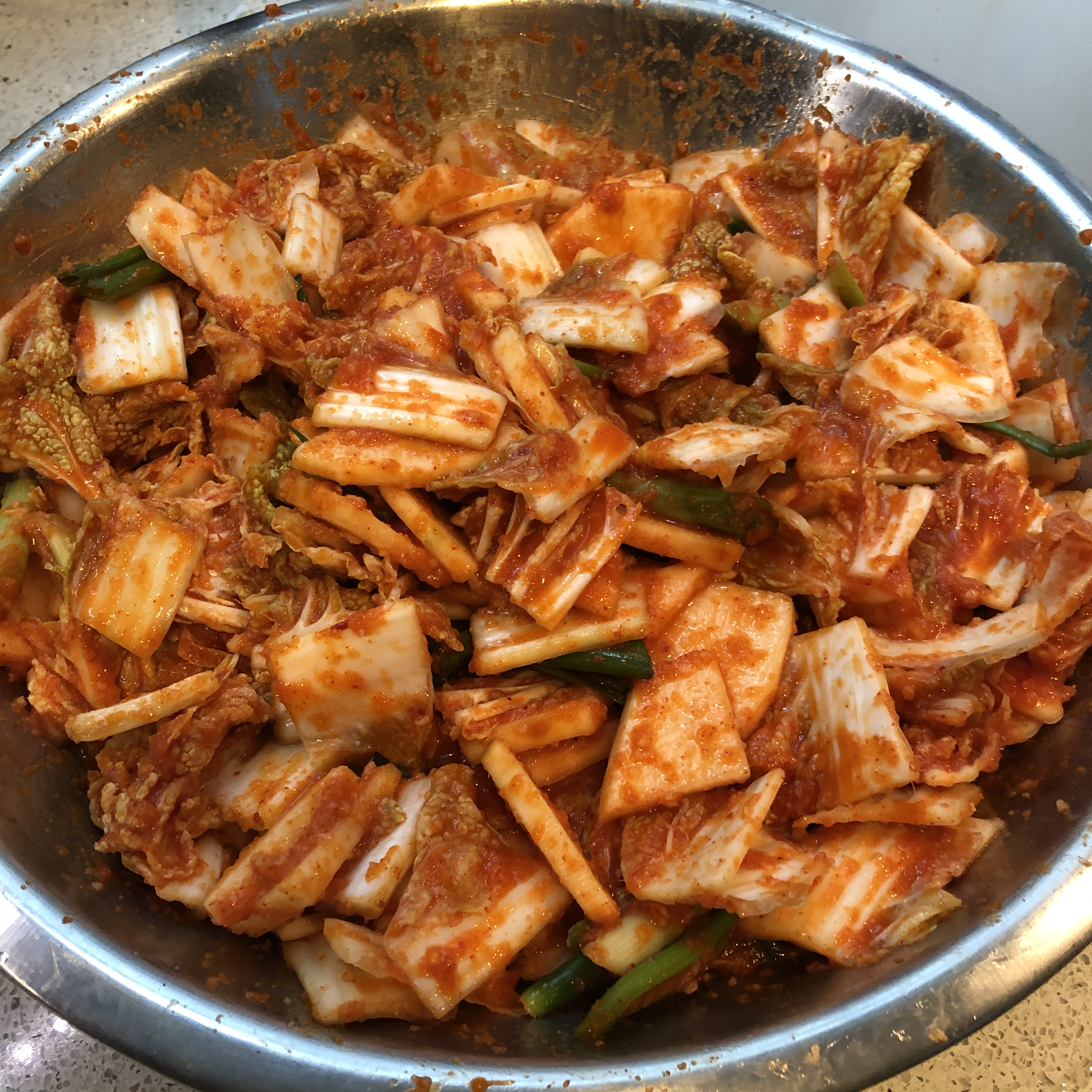
Mom’s Napa Cabbage Kimchi

  • 2 napa cabbages (about 10 lbs)
  • 1 cup kosher salt
  • 15 cups lukewarm water

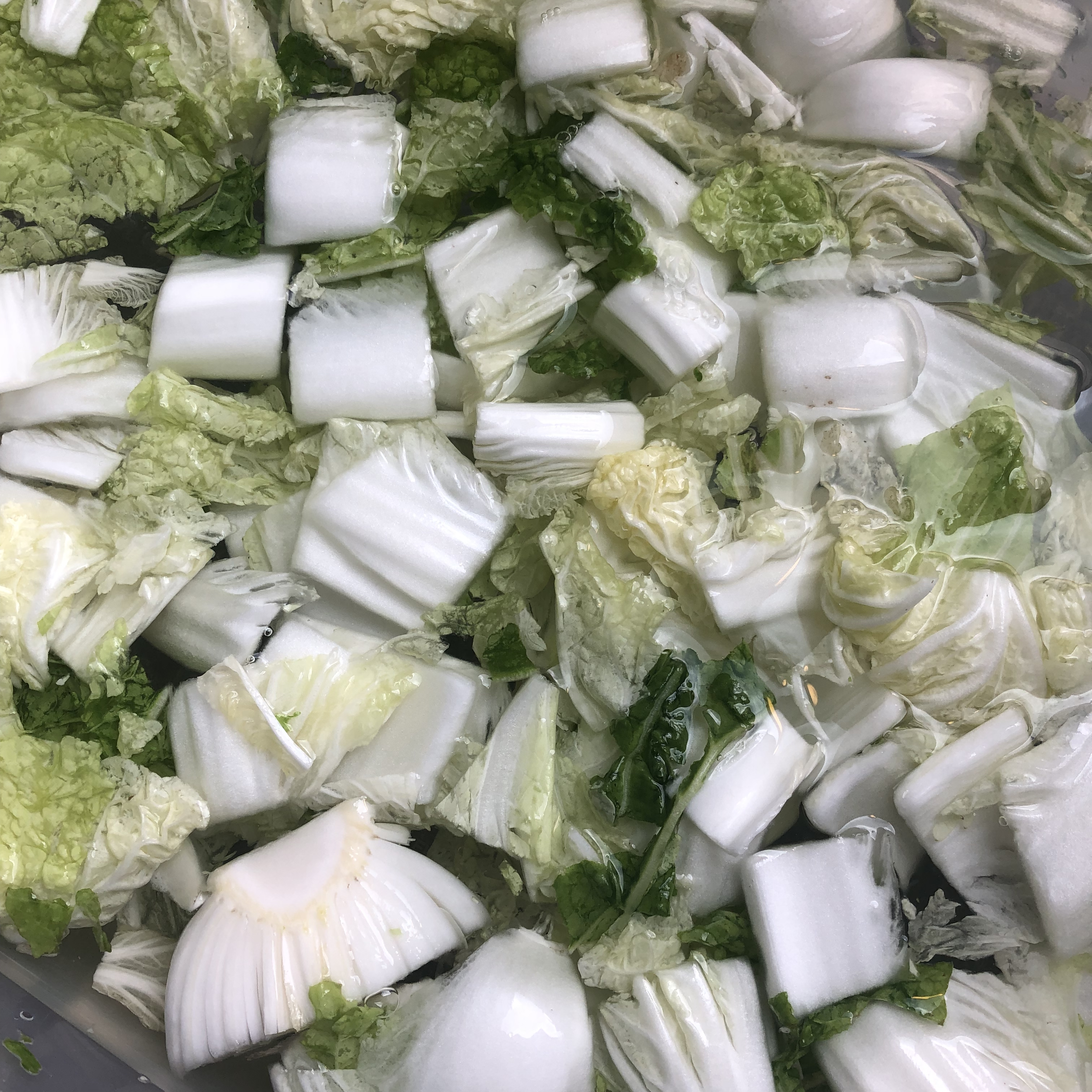
Cut the cabbage into 2 inch by 2 inch squares (rough chop okay but not small). Mix salt and water and brine the cabbage for about an hour.

  • 1 lb Korean radish
  • 10 scallions
  • 1 cup gochugaru
  • 5-6 Tbsp salt

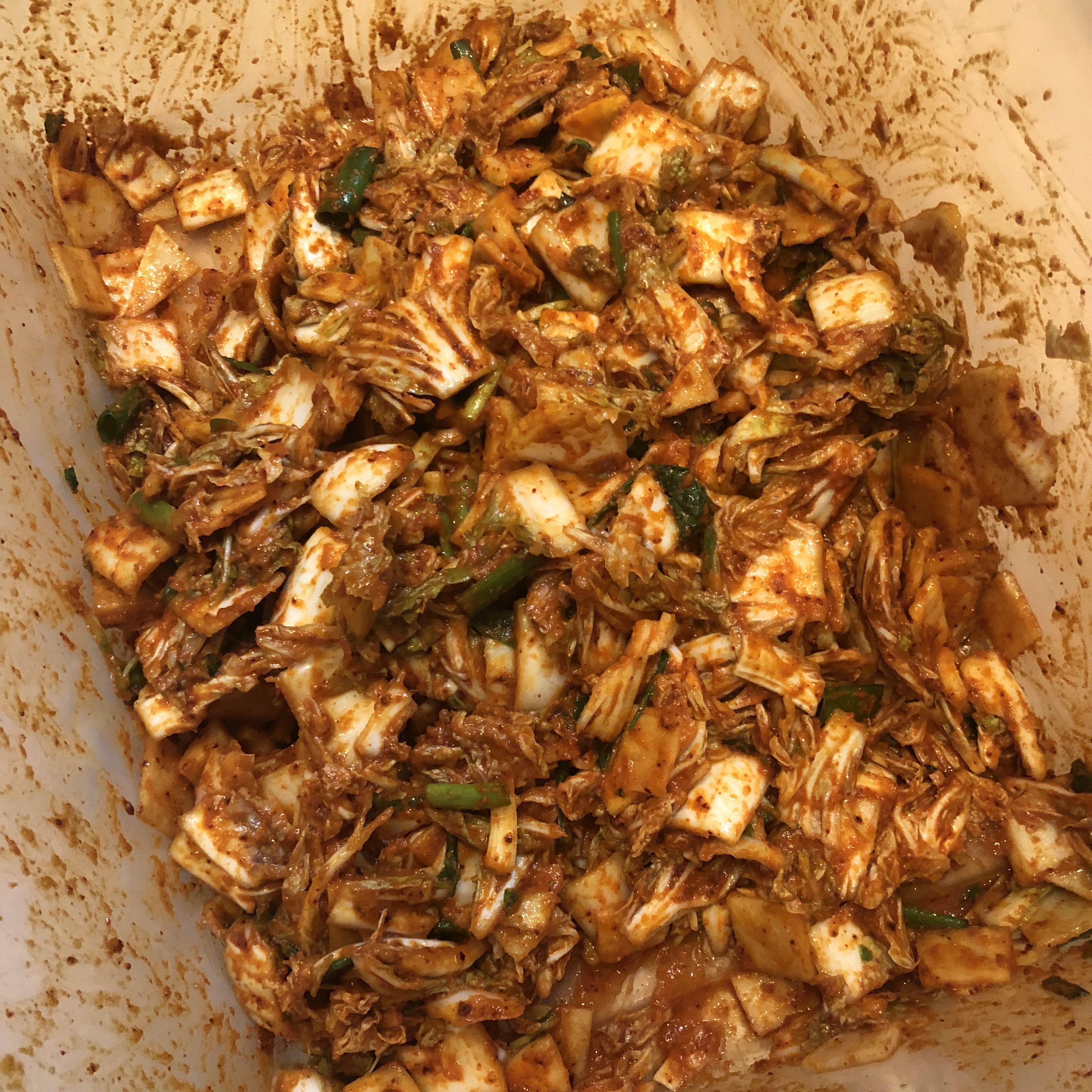
Drain the brined cabbage well (for about 30 minutes in a colander). Slice the radish into about the same thickness and shape of the cabbage. Cut the green part of the scallions to about 1 inch length. Split the white parts and also cut into about 1 inch length. Put everything in a large mixing bowl and mix in gochugaru and salt.

  • 1/4 cup anchovy sauce
  • 1/2 lb Korean radish
  • 1/4 large onion
  • 1 Korean pear, peeled and cored (this makes it extra special but you can substitute with about 1/4 cup of sugar)
  • 10-12 cloves of garlic
  • 1 thumb ginger
  • 1/2 cup cooked white rice
  • 8 Tbsp Korean pepper powder
  • 5 Tbsp shrimp sauce (3 Tbsp shrimp and 2 Tbsp juice)
  • 3/4 cup water

Put all ingredients in a blender and blend until smooth. Pour over the cabbage/radish mixture and mix well. Add 1 cup of water in the blender to wash out any remaining sauce and add to the mix. Put in large containers and let it sit out for a day or so at room temperature. Store in fridge. Eat until whenever.

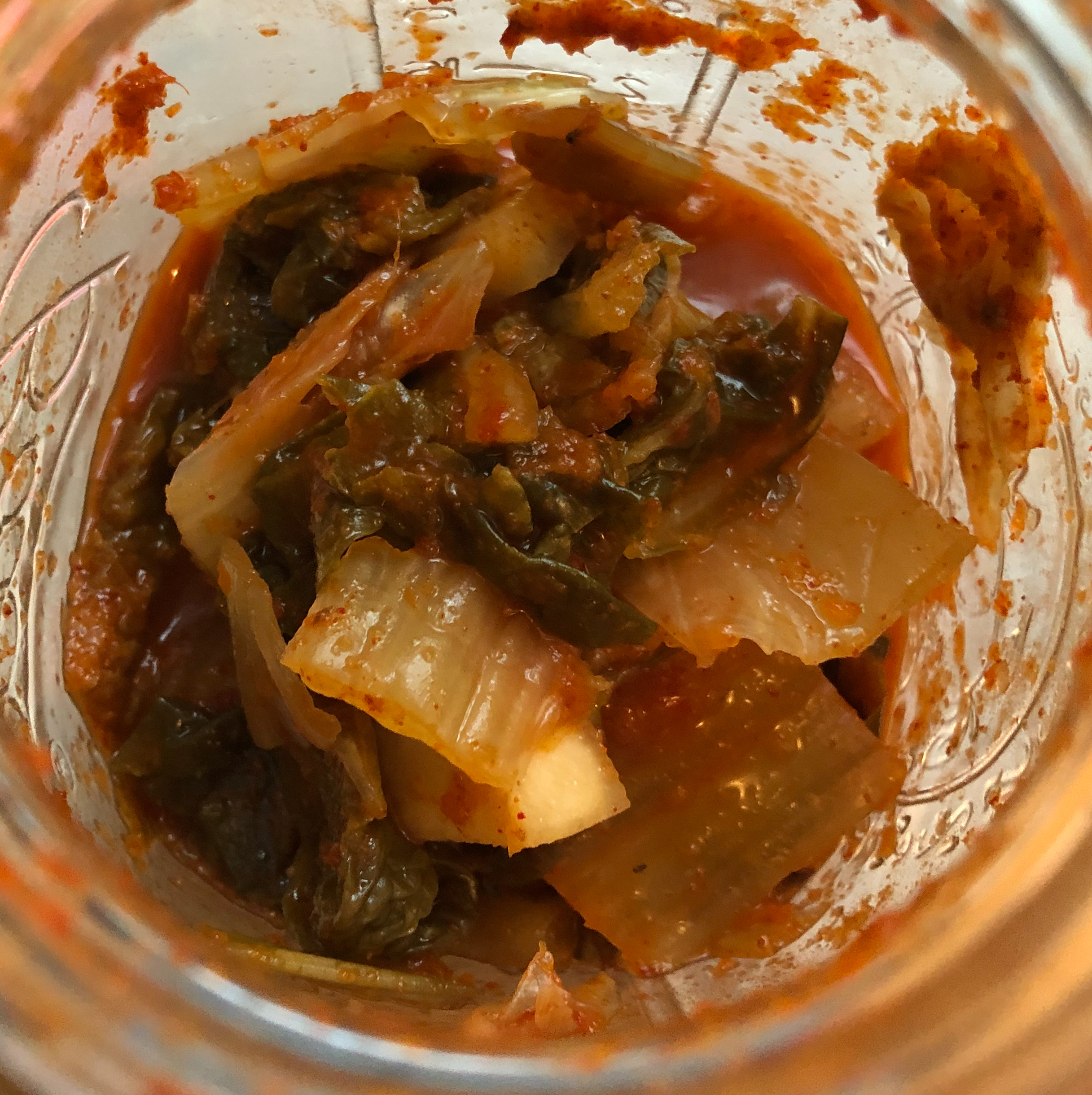
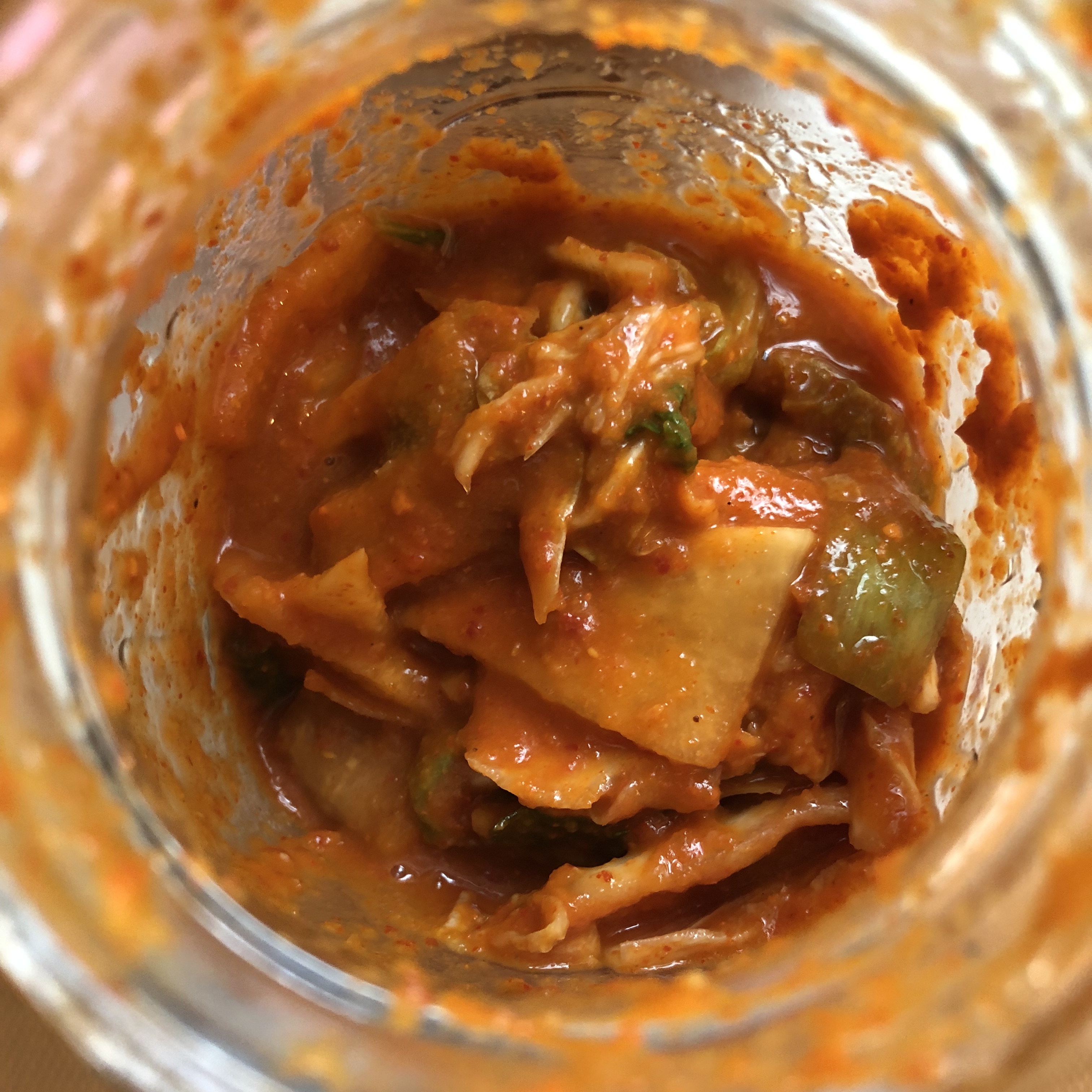
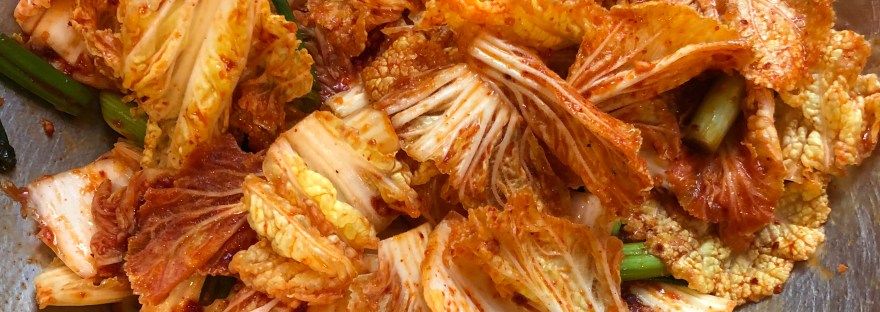
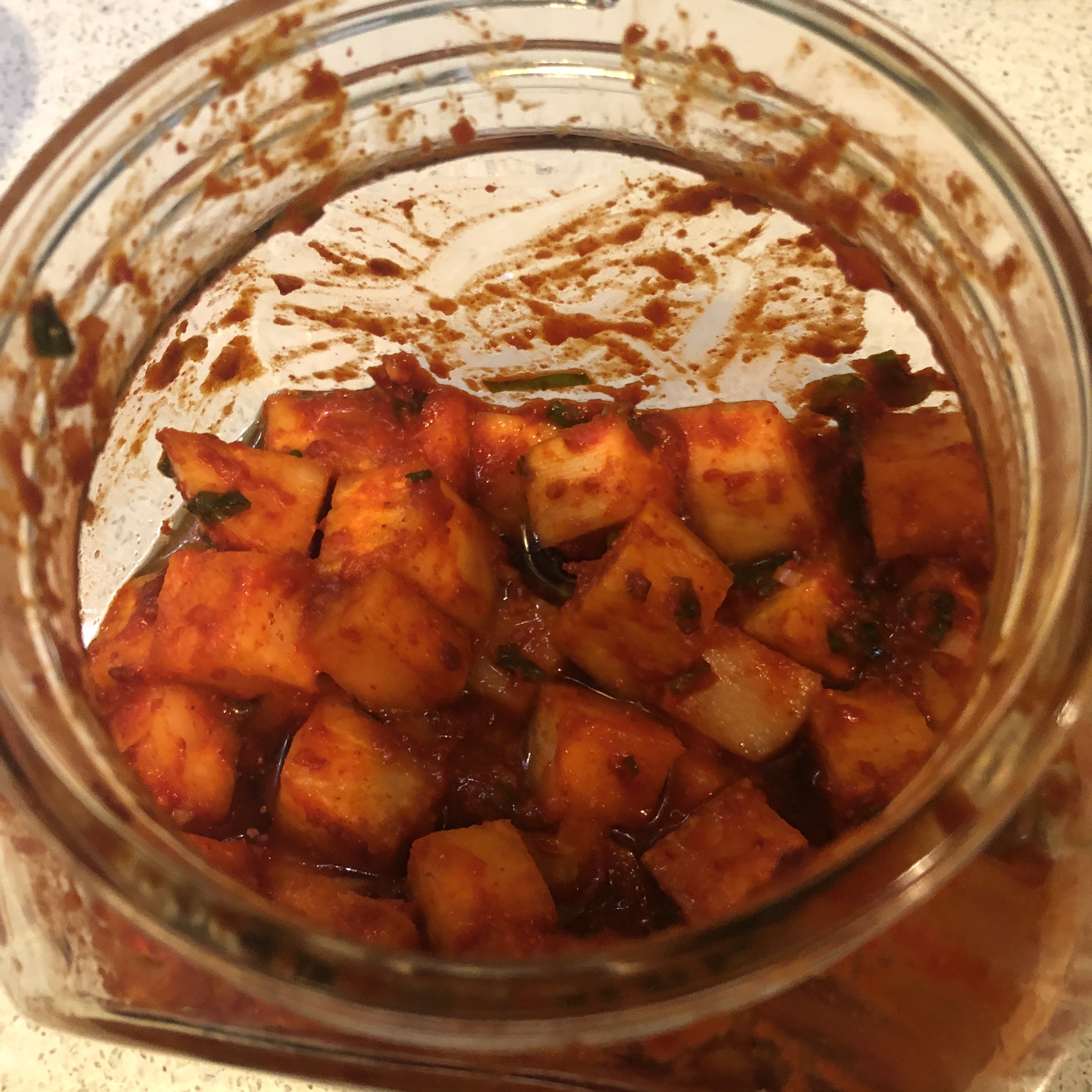
The image on the left is one that has been fermenting for about a year. The image on the right is one that has been fermenting for 3 days. They are both good although different. I prefer the really aged stuff myself because the ingredients have been marinating in its own juices and has become extra pungent and sour. The cabbage is still crunchy even after a year.

I don’t think I will ever buy kimchi in the store again, especially since I found out that my CSA, Root Mass Farm, grows napa cabbage, scallions, and garlic. In the care package my Mom sends me a few times a year, she usually includes a pound or two of the good gochugaru, grown by one of her brothers who still farms, dried and milled, and shared with immediate family only.

Making kimchi used to be a community affair when people still lived close to home and Korea had more farmland than cities. The kimchi would be shared with family and friends and lasted throughout the year. Around June of 2020 would have been the time I would have seen my parents, albeit briefly, as I returned from my annual work trip to Asia. My mom would spend days planning out home cooked meals for me: 반찬 (banchan: side dishes) made with plants foraged in season during hikes with my dad, blanched and frozen; fried mackerel and stir fried dried anchovies; whatever my parents wanted to eat that week (spicy salmon head stew was on the menu June 2019); and, of course, kimchi. Nothing reminds me of home like kimchi, a staple of my childhood, the very “Korean” thing we did in eating it with every meal. I believe my craving of kimchi was my own way of reclaiming the loss of community, forced upon us by the pandemic as we distanced ourselves from each other physically. I read somewhere that in times of uncertainty you seek food from your childhood. I made a lot of kimchi during the pandemic.

Cooking

Soybean Sprout Soup/콩나물국

The last time I spent any amount of time with my grandmother was almost thirty years ago, the summer I turned sixteen and also vowed never to go back to Korea. The last time I saw her was in about ten years later, a few weeks before she passed away. My mom called to say that I should plan on coming to Korea for spring break because 할머니 (halmoni/grandmother) was not doing well.

I remember she was tall (I never got to be as tall as her) and a woman of few words. Widowed early, she raised her children on her own and then many of her grandchildren. I was her first grandchild and because my parents both worked in a different city, my grandmother raised me from the moment I was weaned until my brother was born. According to my mom, when she was pregnant with me, 할머니 ordered him to do all the household chores (cleaning, laundry, dishes, whatever required physical labor). This was unheard of in the seventies in Korea, especially coming from the 시어머니 (mother in law), since the stereotype is one who treats the daughter in law like an indentured servant as the elder of the household. I guess 할머니 was the first person I met who gave the middle finger to gender norms. My dad still does those chores, by the way.

I only have snippets of memories about 할머니, because we really didn’t do much together. After the entire family moved to Ghana when I was five, summer vacations in Korea were always filled with either being shuttled from activity to activity or playing in her house with the cousins. I remember things like her taking me to the Buddhist temple and having lunch when I was very littel, and complaining while scrubbing my back raw and washing my hair, and sitting on the stoop with her skirt hiked up over her knees on a hot July day while the neighborhood grandmothers watched over the kids, and calling for us to wash our hands and eat.

콩나물국 is the food that I associate most closely with 할머니. It’s a ubiquitous soup on a Korean table that is quick and requires only a few ingredients to make: soybean sprouts, dashima, dried anchovies, salt, scallions, garlic, and water. Also, it is difficult to find in restaurants probably for its sheer simplicity and cheapness. It’s the only thing I ever remember asking 할머니 to make for me. I remember her chuckling that of all the things I asked for, it was 콩나물국. In markets in Korea, it is common to see buckets or basins piled high with soybean sprouts. It is also one of the cheapest things you can buy in bulk for multiple dishes. In Ghana, the second bathroom was off limits while the shower head was left dripping water onto a sieve for several days until the beans sprouted. Usually, whatever we harvested will be gone in a meal or two. For me, it was a real treat.

Simple as it is, until recently, I never attempted making 콩나물국. There are two reasons.

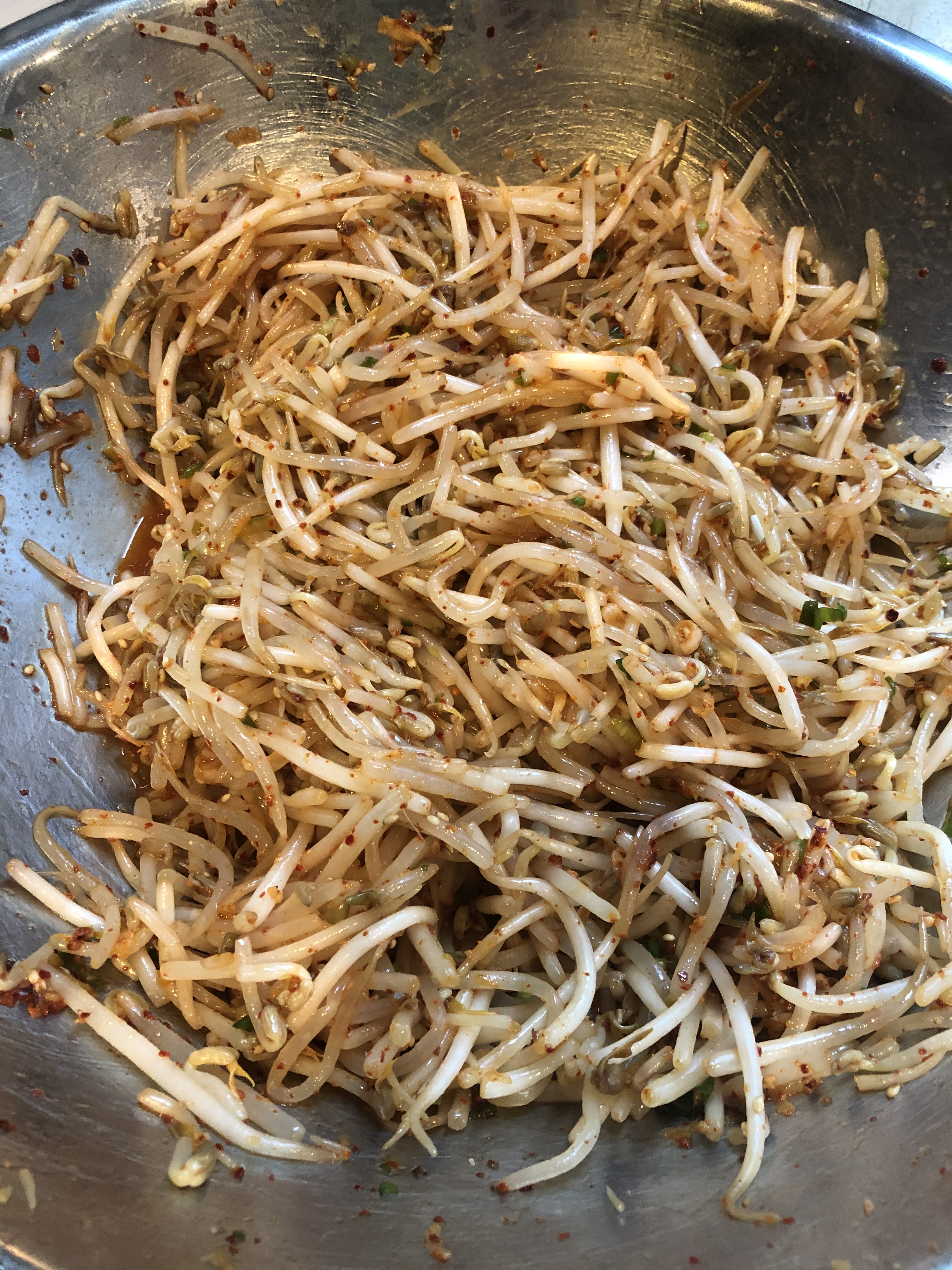
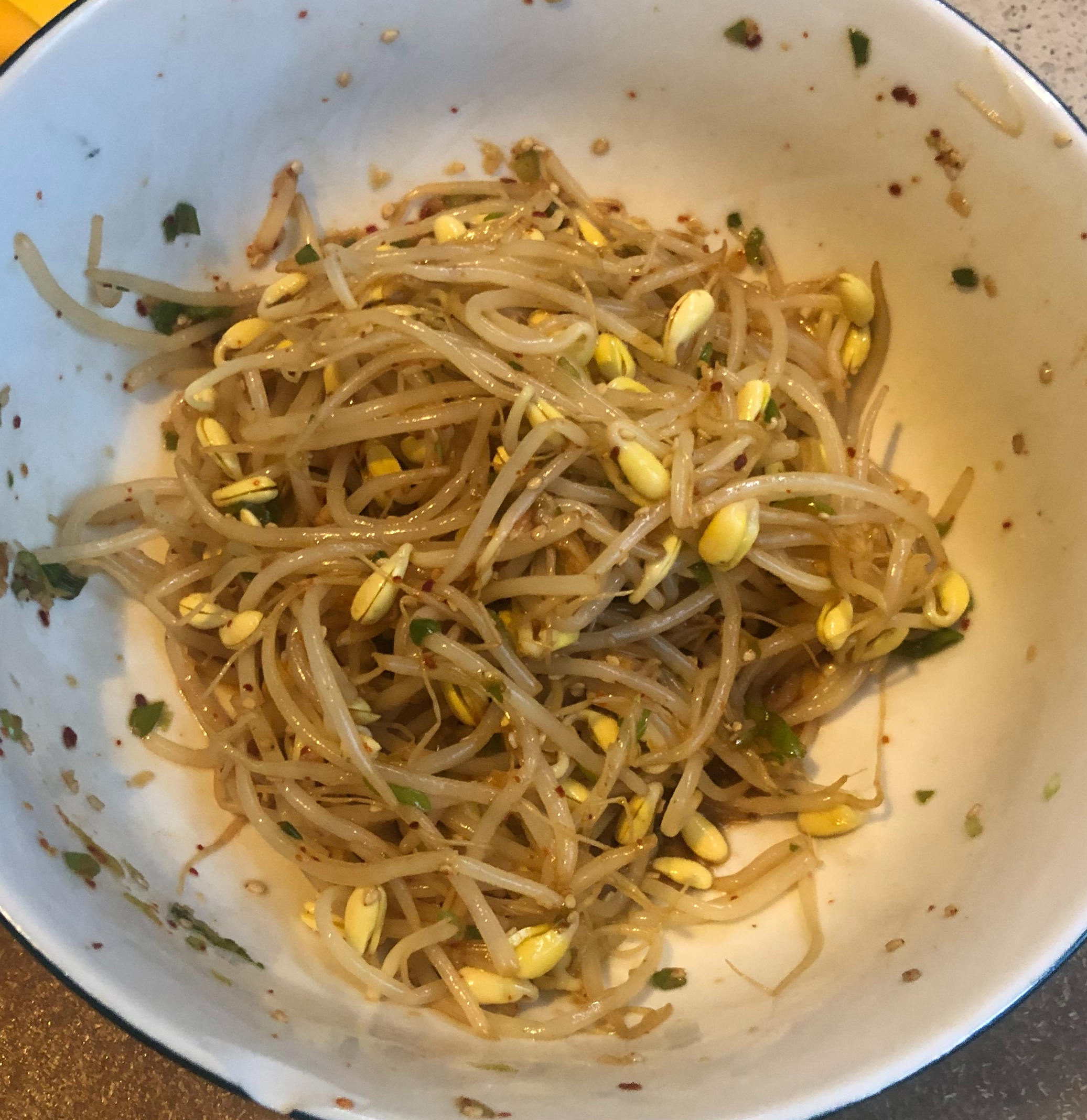
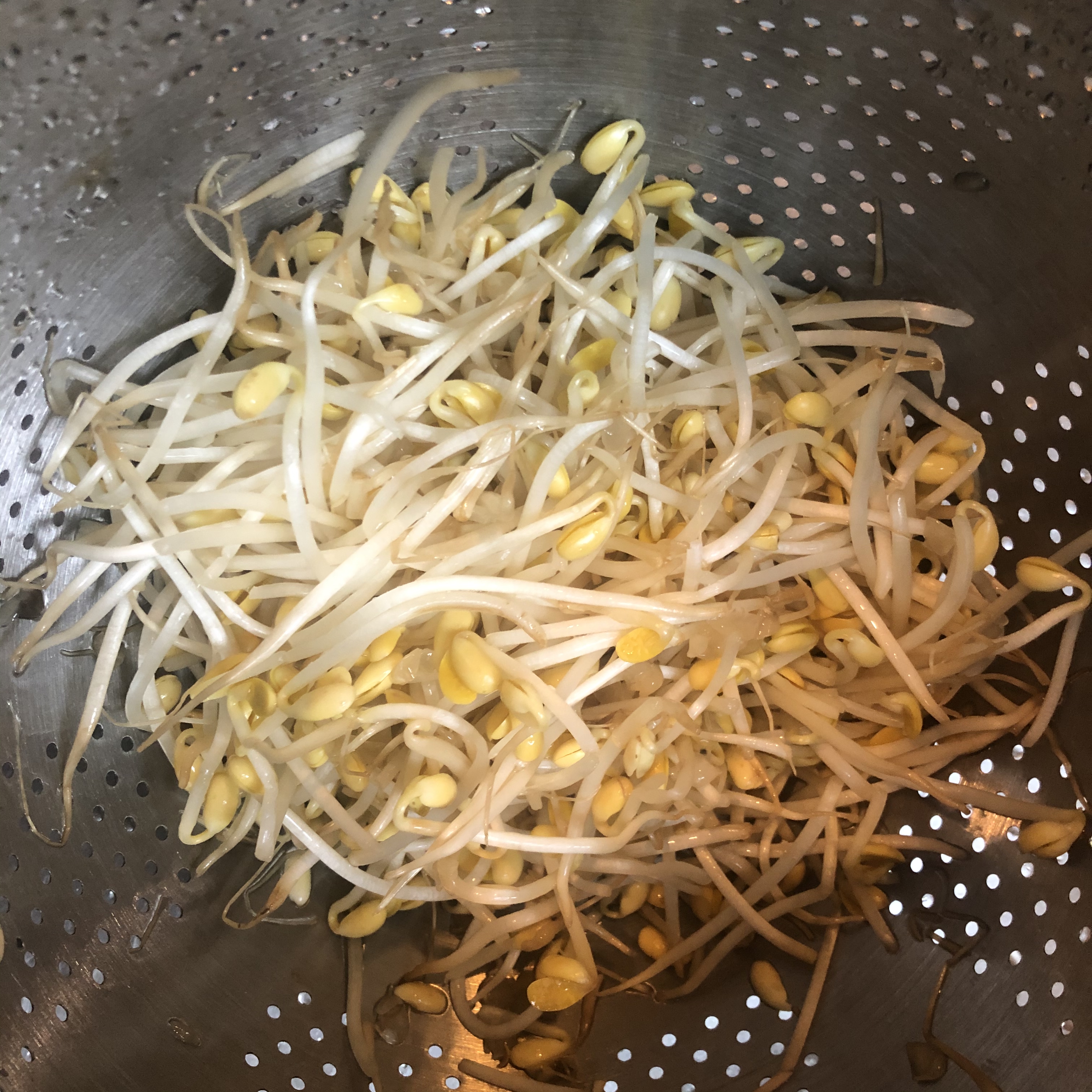
First of all, it’s surprisingly difficult to find soybean sprouts unless you have access to a Korean market. Even then, you can often end up with mung bean sprouts instead. The way you can tell that it is soybean sprout is the bright, hard, yellow split bean attached to the end. If it looks peaked and leafy, it’s probably mung bean sprouts. (See below: Mung bean sprouts on the left, soybean sprouts on the right. Both blanched and mixed in sauce.)

Mung bean sprouts in Korean is 숙주나물 (sookjoo namul), named after Shin Sook Joo, a traitor, because it turns so easily. Seriously. It turns slimy if left unused for a few days so make sure to eat it quickly. I once bought 5 pounds of mung bean sprouts by mistake, gave half of it away, and still ate sprouts for every meal for three days. Soybean sprouts are much sturdier and it kept well in the fridge for almost a week after purchase.

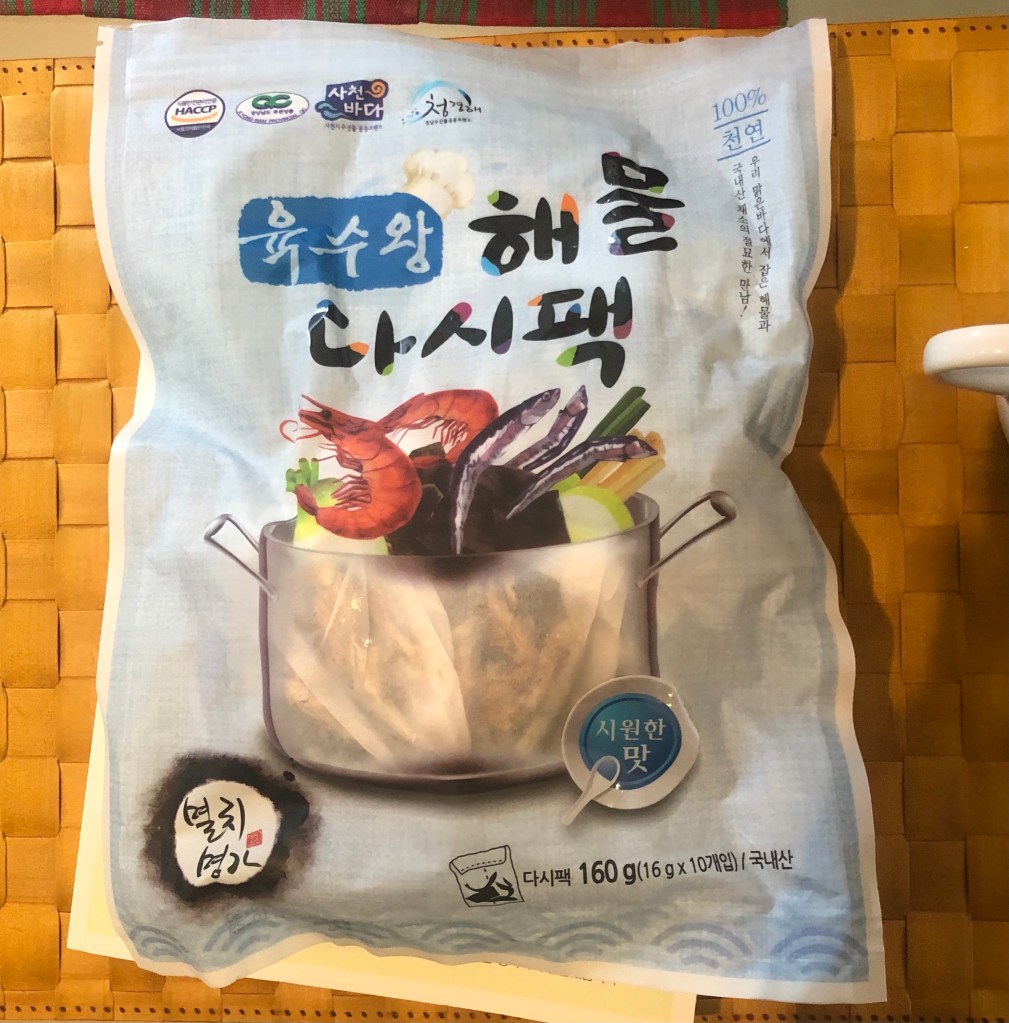
Individually wrapped soup base

Secondly, I never have dashima (dried kelp) or dried soup anchovies in the house. My mom used to send me both but that was when I wasn’t cooking Korean food much at home. Also, I only ever need a bit of each at a time so much goest to waste. Then I discovered pre-packaged dashi soup base, individually packed in large tea bags! It’s about $12 for a pack of 10, so a lot more expensive that buying the dashima and anchovies separately. (It comes in a spicy version, too). However, it’s perfect for me since I don’t cook Korean soup every day and I hate to waste good ingredients. While dried goods have long shelf lives in general, they don’t last forever.

With both problems solved, I made 콩나물국 for the first time ever.

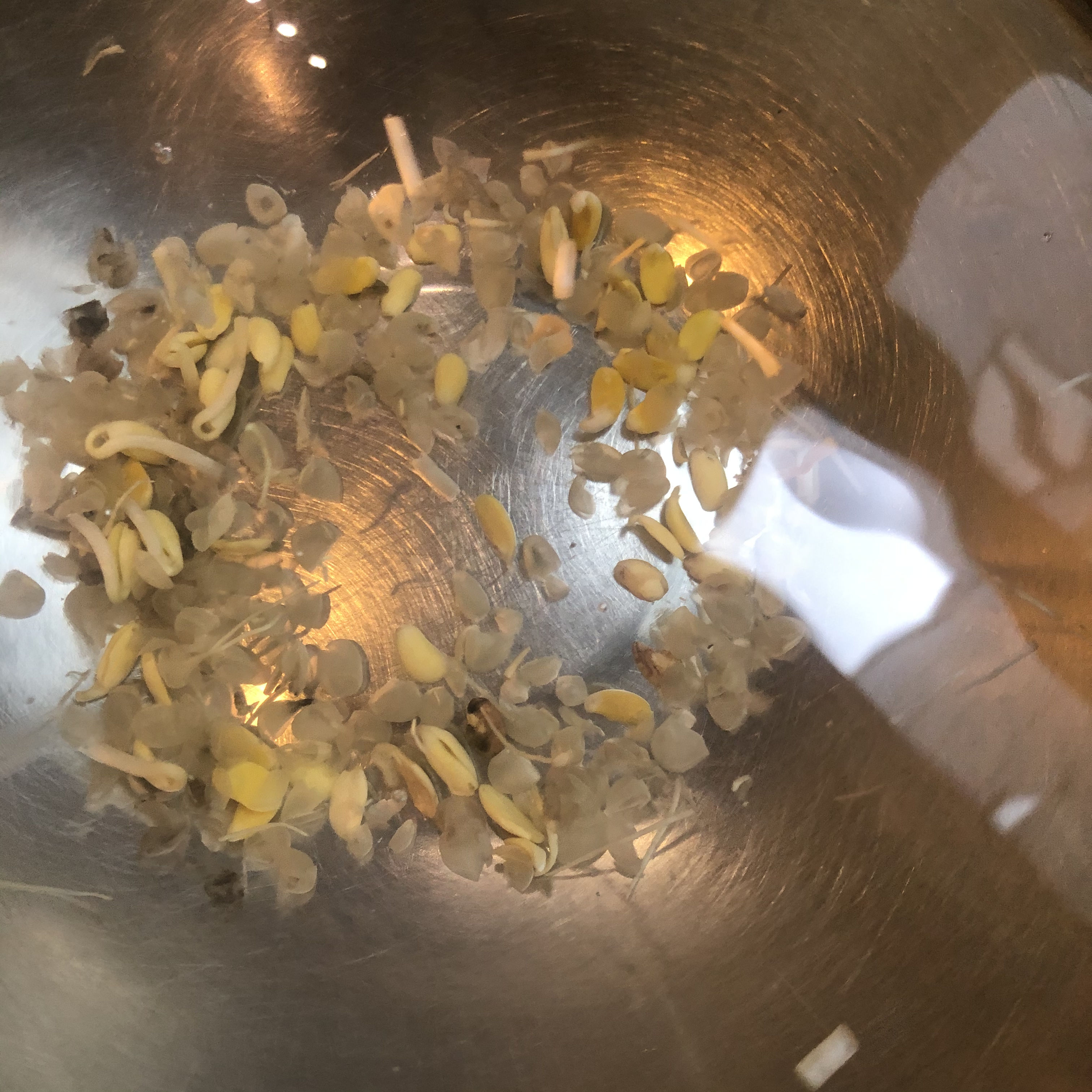
First, you have to rinse the bean sprouts in cold water and drain it. Even though the sprouts themselves are pretty clean, it may have some peels floating around (you want to get rid of the peels).

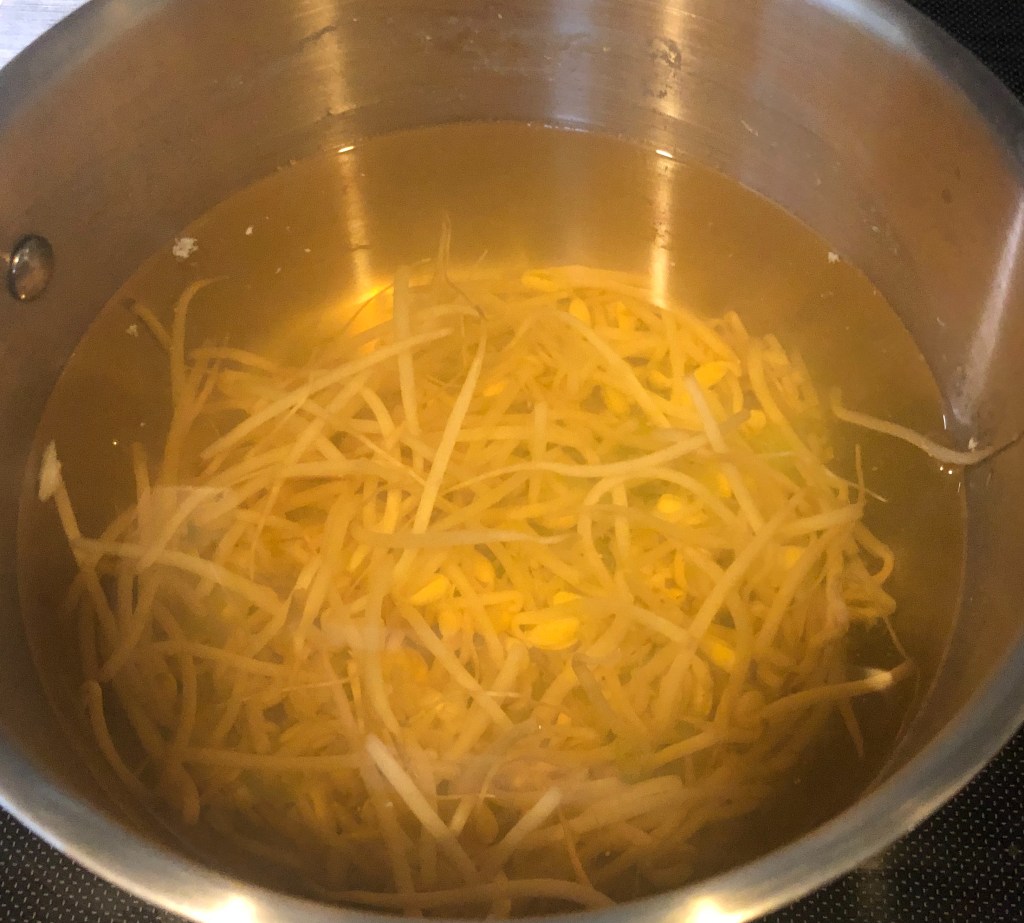
Then, it is basically putting stuff in a pot and boiling.

  • Boil 1 dashi soup base in 3 1/2 cup water for about 10 minutes.
  • Add 1 cup washed soybean sprouts and boil for another 4-5 minutes uncovered.
  • Add 1 tsp salt (or shrimp sauce) to taste, 1 tsp crushed garlic, and 1 Tbsp chopped scallions and boil for another minute or so.

You got soup. From beginning to end it takes about 20 minutes, much less if you already have the broth in hand since all you have to do at that point is throw in the ingredients and boil. You can add some Korean pepper flakes, the course one, not the ground powder, and more scallion for garnish.

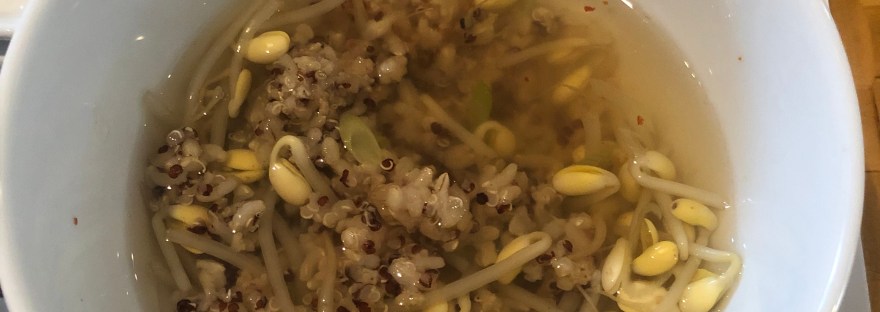
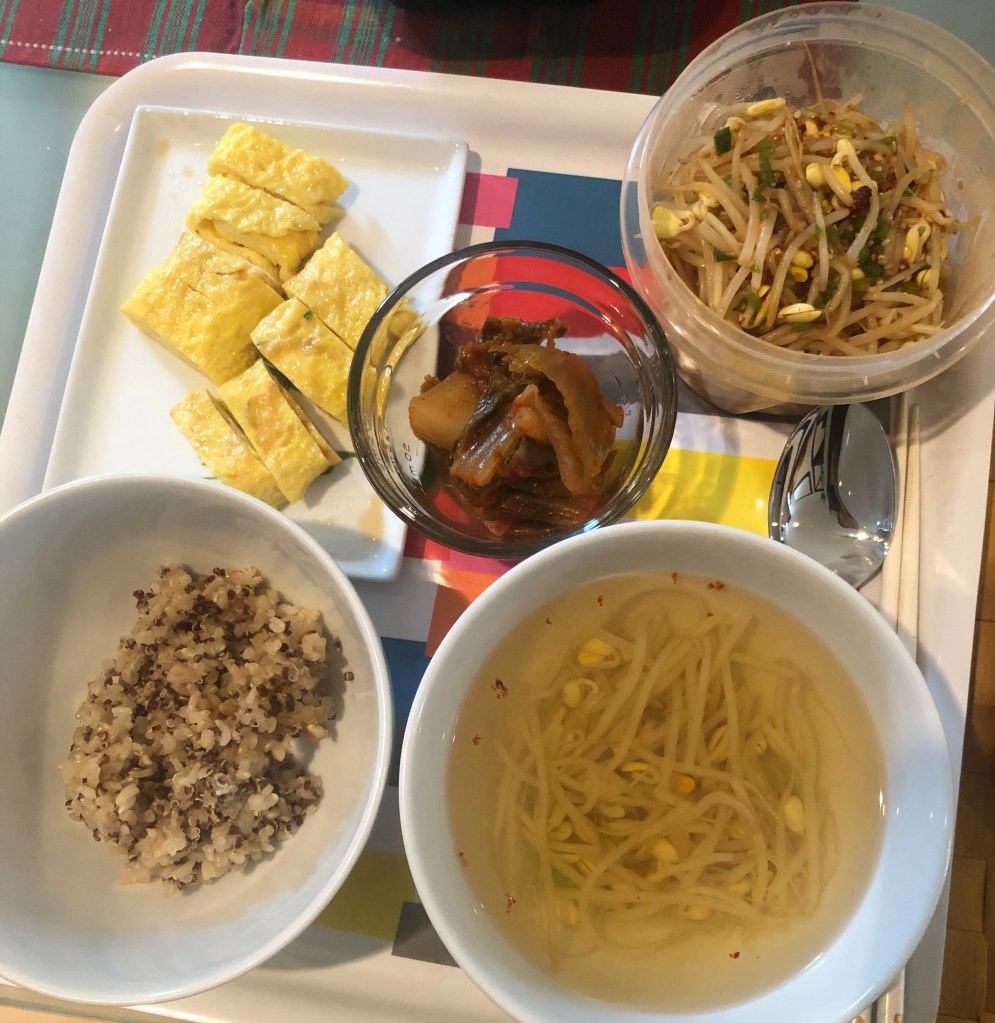
콩나물국 is a common hangover food and has been proven to help due to its arginine content. Hair of the dog aside, it’s probably a healthier choice over a greasy breakfast. I had it for lunch with some rice/quinoa, kimchi, rolled egg omelet, and 콩나물무침 (soybean sprouts in sauce), minus the hangover.

It’s been years since I had it. I don’t know how to describe the taste of it; it’s simple and complex all at once and the only unsatisfactory word that fits is umami. I am not sure if it tastes the way 할머니 made it. But I did choke up a bit because of its familiarity and its association to her. I can’t rightfully say memories, because there are no specific words or incidents or experiences that I can point to as the reasons why her loss is still so heartfelt after twenty years. Perhaps, it’s just the absolute simplicity of it all that makes it so profound. Just like the soup.