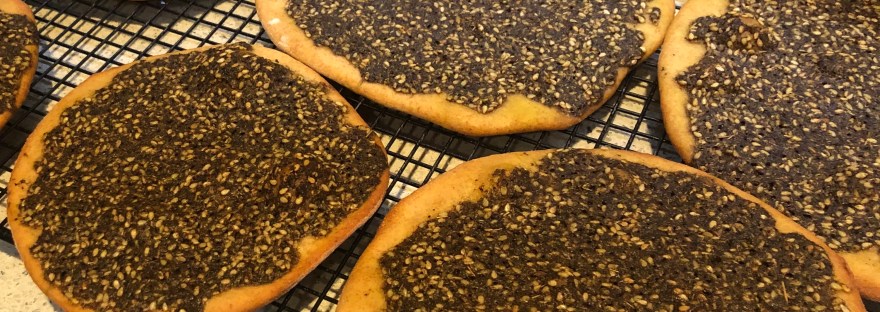
The first bread that I learned how to make with fairly reliable consistency is mana’eesh. Mana’eesh is a Lebanese flatbread with za’atar. Mana’eesh (or sometimes manakish) is the plural term. Mana’oushe is the singular term.
Each time the dude’s parents visit the United States, they bring a kilo or two of freshly made za’atar from the best vendor in Beirut. She would make sure that the za’atar is fresh, as in it was made within the week or their travel date. Once in the US, she would bake mana’eesh and wrap them individually in foil so that it could be frozen then thawed/rebaked in the oven. The entire house will be filled with the aroma of warm bread and herby goodness and linger afterward for several hours. It is the smell of warmth.
The dude doesn’t speak much about his early childhood in Lebanon. Like so many families, they left suddenly during the war in the 1970s. From what I remember about my Lebanese friends in Ghana whose family escaped their homeland (if not at the time, in the proceeding few years), while they themselves remembered little and some were born in Ghana and held Ghanaian citizenship, the feeling of displacement was indelibly linked with their identities. When the war was over, they went to visit family each summer and speak hopefully about the time they would go home. Some did; many did not. The dude never returned.
For that reason, I was surprised that he voluntarily mentioned the happiness of smelling fresh mana’eesh in a nearby bakery, one of the few memories he had of his childhood in Beirut. It explained his excitement every time his mom made it for him and it made me sad that the leftover za’atar sat in the pantry, unused for months. Also, since his mom always made mana’eesh in their apartment and never on site, I had no idea what that smell was, whether it was same or different from the reheated version.
So, I decided to give it a go at making mana’eesh myself.
Mind you, at the time, I had just gotten over my fear of baking with yeast (focaccia turning into a frisbee will get you off breadmaking for a while), and the only other dough I had made successfully was pizza. Since I am gluten free, I had no idea of gauging success by eating and tasting. With pizza, at least I know what it’s supposed to look, smell, and taste like and I remember the mouthfeel of the dough. Luckily, the dude enthusiastically agreed to eat through all the experiments.
First stop in learning how to make something was his mom. But like most moms who have been making something for a long time, it was difficult for her to actually explain what to do and nothing came with measurements. And, like me, she doesn’t like company in the kitchen so I didn’t press the issue. I tried several recipes with varying success. Finally, I found the one that I use consistently, which is Yotam Ottolenghi’s recipe I stumbled upon. This is one that I also received a thumbs up from his dad.
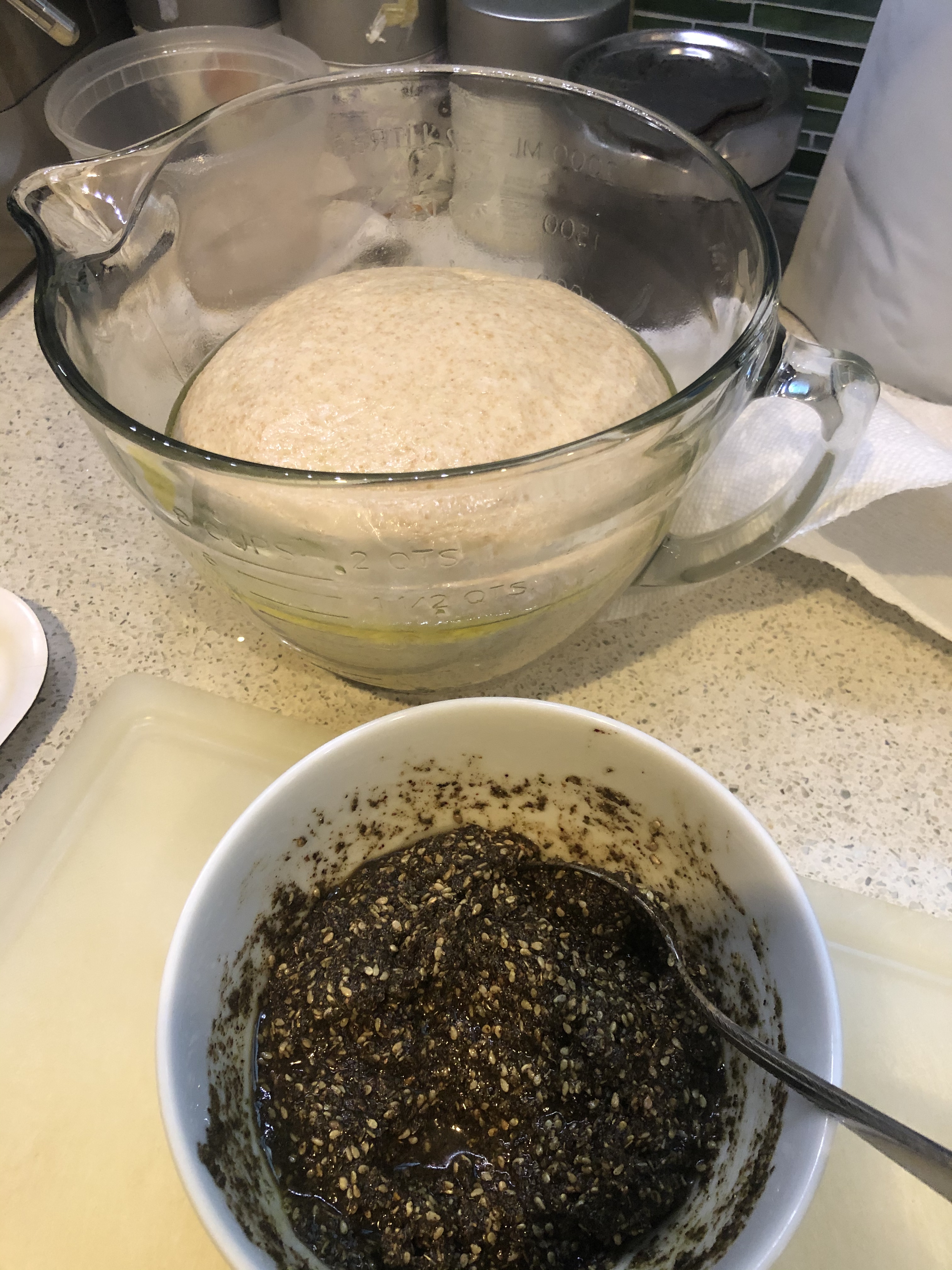
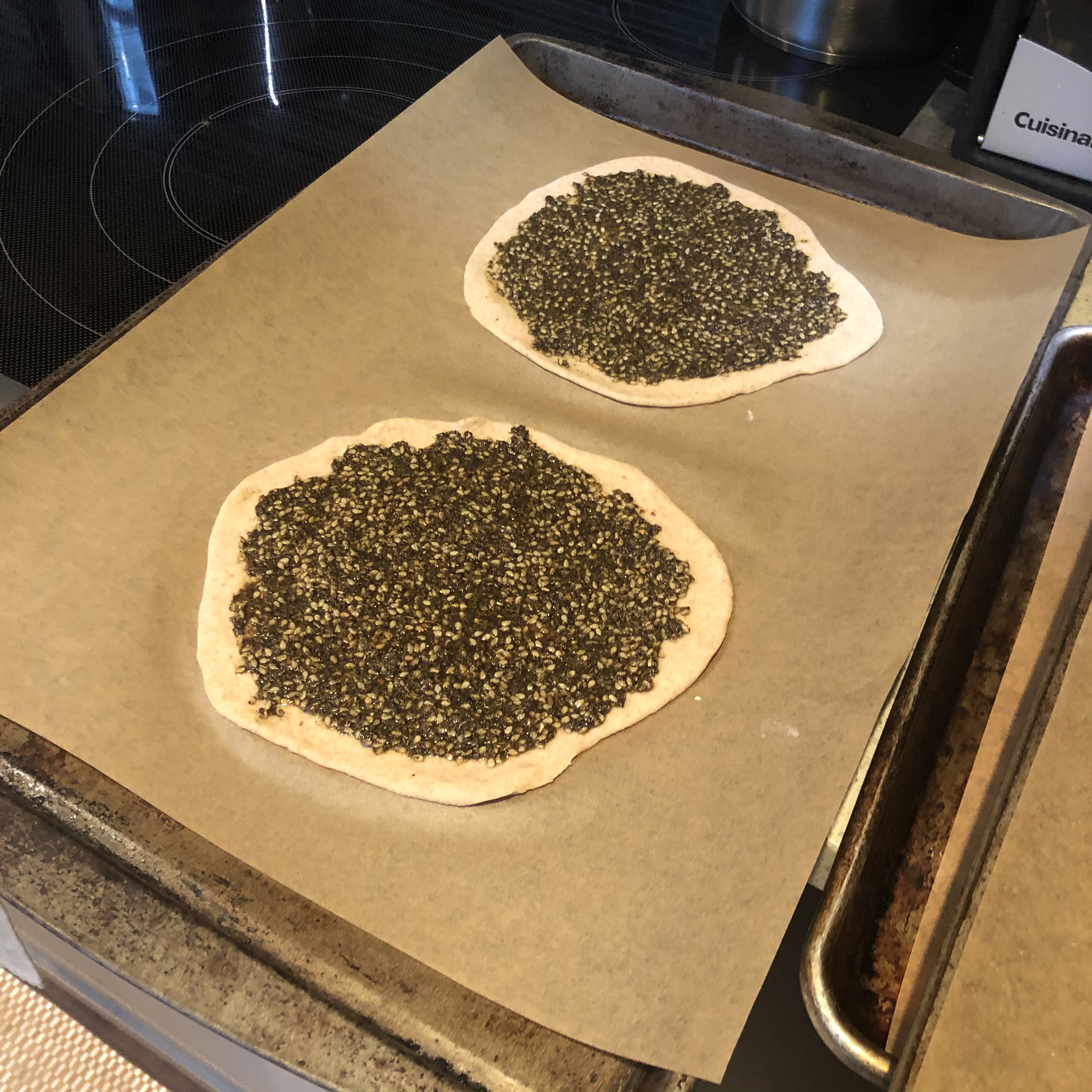
There are a few notes to this recipe, based on my experience:
- No yogurt. It’s not how the dude remembers and it’s not how his mom makes it. Just the za’atar/olive oil paste.
- Instead of caster sugar, I used 1 Tbsp of honey. So the yeast mixture is 300ml filtered water, 1 Tbsp honey, 2 tsp dry yeast.
- The olive oil in the recipe is not divided up (pet peeve in recipes). Most of the oil in the recipe is for the za’atar paste save for 2 Tbsp. The dough is as follows: 4 cups bread flour, 2 tsp sea salt, 2 Tbsp olive oil, and yeast water mixture. I measure everything by volume and not weight. The breadmaking purists would say that volume is too much of an approximation; I am just too lazy to bring out the kitchen scale.
- I often replace up to half the bread flour with whole wheat flour. The dough will not be not as stretchy and chewy and bubbly but it does have more nutrients.
- The promised land for the right dough is when it bubbles up with air pockets, sometimes as big as a ping pong ball. To get this consistency, I found that there are 3 things that should be done: 1. Knead it for 10-15 minutes until smooth; 2. The dough should feel slightly moist and sticky on the hands without actually sticking; and 3. After the initial rise and after dividing the dough, let it sit for a bit for until it’s pliable before rolling it out. I don’t have a commercial oven and baking pans large enough to bake all 12 breads at once. Also, I don’t like to bake more than one pan at a time. What ends up happening is that the there will be some inconsistencies in the final result based on how long the dough has rested after the initial rise and the middle half will be more bubby than the first and last pans.
- Roll out the dough pretty thin, more than 1/8 but thinner than 1/4 inch. I found that stretching the dough first and rolling out the dough quickly helps with the bubble formation.
- Most recipes have a shmear of the za’atar/olive oil paste. I often use close to half a pound with each batch. This is an individual preference because the za’atar has a very strong smell and taste. The dude is of the opinion that za’atar on dog turd would taste good so I coat the dough with the mixture like I would coat pizza dough with tomato sauce.
- I have the oven temperature to 400F from beginning to end. Because I bake two at a time, I can’t really heat up the pan each time and reduce the temperature. It works just fine.
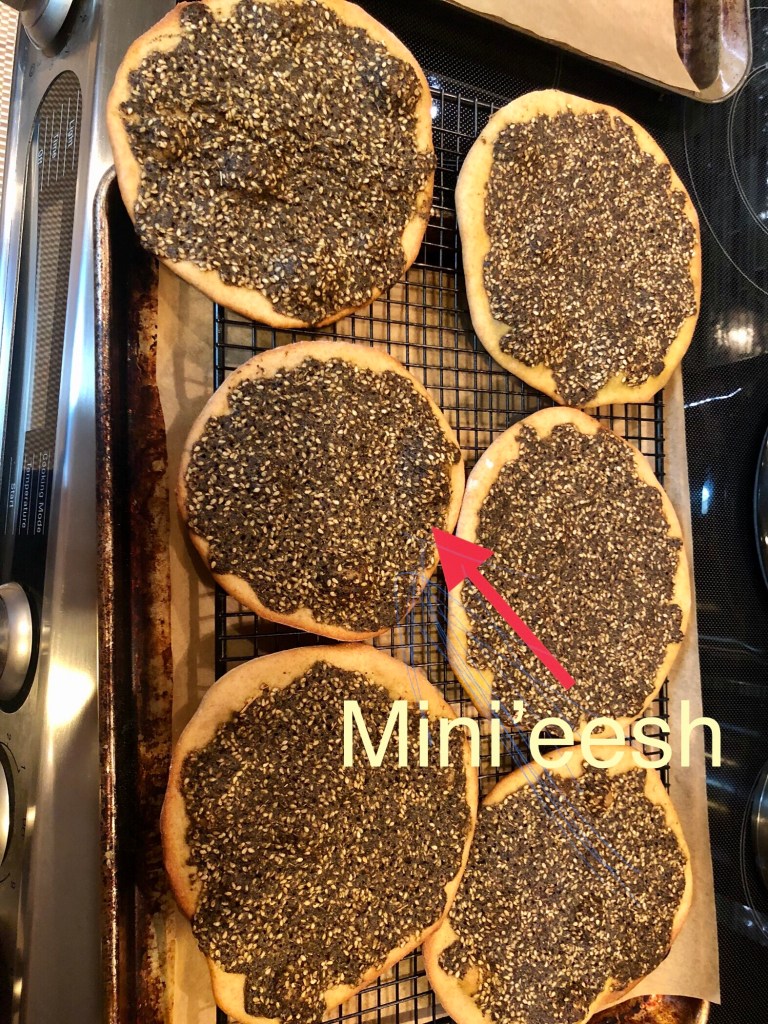
Even now, some days produce better bread than other days. I make it roughly once every 7-10 days because this is the dude’s favorite bread so I get a lot of practice. The process, from beginning to end, takes about 3 hours.
Finally, just in case you are wandering, “Mini’eesh” is not a typo. This recipe is supposed to make mana’eesh that are about 7-8 inches and some bakeries have them as big as 12 inches wide. I have yet to learn how to cut the dough properly so that they are roughly the same size. One time, about half of them came out to be less than 5 inches in diameter so I labeled them “Mini’eesh” in the freezer bag. We all had a good laugh and the name stuck.
 What will Dr. Gwak say?